 Safekipedia
Lighthouse of Alexandria
Adapted from Wikipedia · Discoverer experience
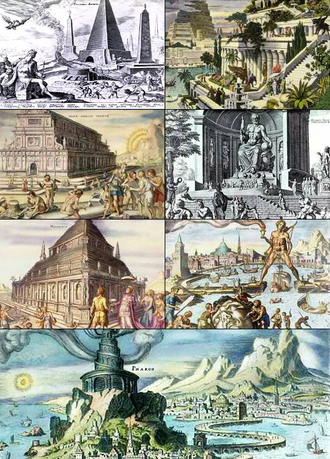
The Lighthouse of Alexandria, also known as the Pharos of Alexandria, was a very tall lighthouse built by the Ptolemaic Kingdom in Ancient Egypt. It was constructed during the time of Ptolemy II Philadelphus between 280 and 247 BC. This amazing structure was one of the Seven Wonders of the Ancient World and was one of the world's tallest man-made structures for many years, standing at least 100 metres (330 feet) tall.
Over time, the lighthouse suffered damage from three strong earthquakes between the years AD 956 and 1303. After this, it was left in ruins. It survived longer than most ancient wonders, only finally disappearing around 1480 when its stones were used to build the Citadel of Qaitbay nearby.
In 1994, French archaeologists found some parts of the lighthouse lying on the sea floor in Alexandria's Eastern Harbour. In 2016, Egypt planned to create an underwater museum to show these ancient remains. In 2025, workers brought up parts of the lighthouse's entrance and foundation to help experts create digital models of how it may have looked.
Origin
Pharos was a small island near the western edge of the Nile Delta. In 332 BC, Alexander the Great created the city of Alexandria on land across from Pharos. Later, Alexandria and Pharos were linked by a long structure called the Heptastadion, which stretched over 1,200 metres (0.75 miles).
One side of this structure became a big harbour, and the other side had a smaller port. Over time, sand and silt covered most of the structure. Today, only a small part of the island of Pharos remains, called Ras el-Tin, where a palace was built in the 1800s.
Construction
Maritime navigation to Alexandria was dangerous because of the flat shores, shallow waters, and hidden reefs along the northern coast of Africa. The lighthouse was built in the third century BC. After Alexander the Great died, Ptolemy I Soter became king in 305 BC and started building it. His son, Ptolemy II Philadelphus, saw the tower finished after twelve years. The light came from a furnace at the top, and the tower was made mostly from strong blocks of limestone and granite.
Scientists studied the sandstone and limestone blocks used for the lighthouse. They found that the stones came from quarries in the Wadi Hammamat, a desert area east of Alexandria.
Height and description
Arab writers described the Lighthouse of Alexandria as having a height between 103 and 118 metres (338 to 387 feet), standing on a base that was 30 by 30 metres (98 by 98 feet). The tower was built from large, light-colored stone and had three parts that got smaller as they went up: a square bottom, an octagonal middle, and a circular top.
On top of the lighthouse was a mirror that shone in the sun during the day, and a fire that glowed at night. Coins from ancient times show that statues of sea gods like Triton and Poseidon or Zeus were placed around the building. One visitor in the 12th century described the inside, noting a wide, roofed path that could fit two horses side by side. After a big earthquake in 1303 damaged the lighthouse, later visitors only saw parts of its remains.
Destruction
The lighthouse was damaged by earthquakes in the years 796, 951, and 956, and then again in 1303. These earthquakes came from tectonic areas far away, including near Africa and the Red Sea. The earthquake in 956 was the first to cause the top part of the lighthouse to fall down.
After the 956 earthquake, people added a dome to the top of the lighthouse. The worst earthquake happened in 1303, coming from Crete. The last bit of the lighthouse disappeared in 1480 when a leader in Egypt named Qaitbay built a fort using the fallen stones.
Archaeological research and rediscovery
In 1916, Gaston Jondet first described the underwater ruins of the old port of Alexandria. Later, other experts continued this work.
In 1968, the lighthouse was found again. A group of sea experts confirmed its ruins. Work stopped because they needed more experts and the area became a military zone.
In 1994, French experts led by Jean-Yves Empereur found the lighthouse's remains on the sea floor. They took the first underwater pictures of broken columns and statues. They found huge stone blocks, sphinxes, obelisks, and columns with carvings from ancient times.
By 1995, they had recorded over 3,300 pieces. Some of these discoveries are now shown in museums in Alexandria. Satellite images have shown more ruins under the water. Today, people can dive and see these ancient remains.
Significance
The Lighthouse of Alexandria was built to help ships find their way safely into the port at night. The island where it stood was known for people who would try to steal ships that ran aground.
The word "Pharos" later came to mean "lighthouse" in many languages, including French, Italian, Spanish, and others. It even influenced words for car headlights in some languages.
Proposed reconstruction
Since 1978, people have suggested building something new to replace the old lighthouse. In 2015, leaders in Egypt and the city of Alexandria talked about building a very tall building, called a skyscraper, where the lighthouse once stood. This idea was part of plans to make the eastern harbour of Alexandria Port better and more modern.
Pharos in culture
The lighthouse of Alexandria remains an important symbol for the city of Alexandria and the Alexandria Governorate. You can see its shape on the flag and seal of the Governorate and on many city services, like the seal of Alexandria University.
The lighthouse has inspired many buildings and stories. An ancient tomb near Abusir, called the Pharos of Abusir or Burg al-Arab, looks like a smaller version of the lighthouse. Many early Egyptian Islamic mosques have tall towers that resemble the lighthouse, too. In the United States, the George Washington Masonic National Memorial in Alexandria, Virginia copies the lighthouse's design. The theme park Universal Islands of Adventure at Universal Orlando Resort also uses a model of the lighthouse as its main symbol.
Famous people wrote about the lighthouse. Julius Caesar described it in his book Civil Wars because it was important for ships. The Jewish historian Josephus wrote about it, as did a Chinese writer named Zhao Rugua and the traveler Ibn Battuta.
Images
Related articles



This article is a child-friendly adaptation of the Wikipedia article on Lighthouse of Alexandria, available under CC BY-SA 4.0.
Images from Wikimedia Commons. Tap any image to view credits and license.