 Safekipedia
Microfossil
Adapted from Wikipedia · Discoverer experience
A microfossil is a tiny fossil, usually between one micrometre and one millimetre in size. To study these small fossils, scientists use special tools called light or electron microscopy. Fossils that can be seen without such tools, or with just a hand lens, are called macrofossils.
Microfossils appear often in the geological record from very old times, like the Precambrian, up to the present day, known as the Holocene. They are most often found in places that were once oceans, but they can also be in areas that had salty, fresh, or even land water sedimentary deposits.
Almost every kind of life has left behind microfossils, but the most common ones come from tiny water creatures and their remains, such as protist skeletons or microbial cysts. These include groups like the Chrysophyta, Pyrrhophyta, Sarcodina, acritarchs, and chitinozoans. We also find pollen and spores from vascular plants in microfossil records.
Overview
A microfossil is a tiny fossil that can be studied only with a microscope. These fossils are usually smaller than 1 mm and can come from tiny sea creatures, plants, or even parts of bigger plants and animals like small teeth or seeds.
Microfossils are found in rocks and sediments all over the world. They help scientists learn about past climates and environments, and they can even help find oil and gas. Some of the oldest known microfossils were found in Canada and may be as old as 4.28 billion years, showing that life on Earth began very early after the planet formed.
Index fossils
Index fossils, also known as guide fossils, indicator fossils or dating fossils, are the remains or traces of certain plants or animals that lived during a specific time in Earth's history. They help scientists figure out how old rocks are. To be useful, these fossils need to come from a short time period, be found in many places, and change quickly over time. When rocks far apart have the same index fossil, scientists know they are about the same age.
Scientists often use tiny fossils, called microfossils, to help date rocks. These include acritarchs, chitinozoans, conodonts, dinoflagellate cysts, ostracods, pollen, spores, and foraminiferans. Different fossils work best for different ages of rocks. The best fossils are found everywhere and lived only for a short time. This makes it easier to pinpoint when the rocks were formed. Sometimes, scientists look at a group of fossils together instead of just one. This group can give an even more exact time frame for the rocks.
Composition
Microfossils can be grouped by what they are made of. Some are made of siliceous material, like diatoms and radiolaria. Others are made of calcareous material, such as coccoliths and foraminifera. Some are phosphatic, like parts of certain vertebrates, and others are organic, such as pollen and spores studied in palynology. These groups are based on the different materials that make up microfossils, not on what living things they came from.
Organic-walled
Further information: Palynomorphs and Kerogen
Pollen has a special outer layer that helps it stay intact over time. It is made in very large amounts, and we can find many pollen grains that are separated from the plants they came from. Scientists study pollen to learn about past plants and climates. Pollen first appears in the fossil record during the late Devonian period.
A spore is a tiny part of a plant, algae, fungus, or other tiny organism that helps it reproduce. Spores can survive in tough conditions and move to new places.
Chitinozoa are tiny, flask-shaped fossils from the ocean. They were made by organisms we still don’t fully understand. They are common from the Ordovician to Devonian periods and are found all over the world in ocean sediments. Because they changed quickly, they help scientists date rocks.
Acritarchs are tiny fossils with uncertain origins, found from about 2,000 million years ago to today. They are made of carbon and come in many shapes and sizes. Their changes over time show important events in Earth’s history, like changes in plant life and climate.
Cells from very early life can be preserved in rocks. Their walls turn into a special material called kerogen, which helps them stay intact. These tiny cells come in different shapes and sizes.
See also: Pollen zone
See also: Cryptospore
See also: Archean life in the Barberton Greenstone Belt
Mineralised
Further information: Shelled protists
Siliceous
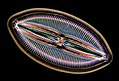
Siliceous ooze is a special kind of material on the deep ocean floor made from the tiny skeletons of small sea creatures. It is made mostly from silica, a kind of material that comes from tiny sea plants and animals like diatoms and radiolarians. Silica is a very important part of the ocean and moves around through a process called the silica cycle. How far you are from land, how deep the water is, and how rich the ocean is with food all affect how much silica is in the water.
[Diatomaceous earth](/wiki/Diatomaceous_earth) is a soft, rocky material made from the tiny shells of [diatoms](/wiki/Diatom)
-
.jpg)
-
.jpg)
.jpg)
Phytoliths are tiny, hard parts made of silica that are found in some plants. They stay even after the plant breaks down.
Calcareous
The word calcareous means something made from or containing a lot of calcium carbonate, a kind of mineral. This kind of material is usually found in shallow water near land because the tiny sea creatures that make it need nutrients from the land. Calcareous ooze is made from the tiny remains of sea creatures and builds up on the sea floor. This only happens in water that is not too deep, because in very deep water the calcium carbonate dissolves.
Illustration of a _[Globigerina](/wiki/Globigerina)_ ooze
Shells ([tests](/wiki/Test_\(biology\))), usually made of calcium carbonate, from a [foraminiferal](/wiki/Foraminifera) ooze on the deep ocean floor

Calcareous ooze | |||||||
|---|---|---|---|---|---|---|---|
| mineral forms | protist involved | name of skeleton | typical size | ||||
| CaCO3 calcite aragonite limestone marble chalk | foraminiferan | 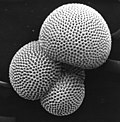 | test or shell | many under 1 mm | Calcified test of a planktic foraminiferan. There are about 10,000 living species of foraminiferans | ||
| coccolithophore | 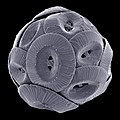 | coccoliths | under 0.1 mm | Coccolithophores are the largest global source of biogenic calcium carbonate, and significantly contribute to the global carbon cycle. They are the main constituent of chalk deposits such as the white cliffs of Dover. | |||
Ostracods
Ostracods are small creatures found everywhere, often called seed shrimps. They have flat bodies and are protected by a shell made of calcium or a material called chitin. There are about 70,000 types of ostracods, and 13,000 of them are still alive today. Most ostracods are about the size of a small seed, but some can be much larger.
Conodonts
See also: Conodont biostratigraphy
Conodonts were tiny, ancient fish without jaws that looked like eels. For a long time, scientists only knew about them from small tooth-like pieces found in rocks, now called conodont elements. These elements were made of a special mineral called hydroxylapatite.
Conodonts had a unique way of eating that was very different from animals today. Their teeth came in three shapes and likely helped them catch food in different ways. These tiny fossils are found all over the world and are very useful for dating layers of rocks. They are some of the earliest known teeth from animals with backbones, and some of them were extremely sharp.
Scolecodonts
Scolecodonts are tiny jaws from a type of worm called polychaete annelids. These worms have lived in many ocean homes for over 500 million years. Their jaws are made of strong material and are often found as fossils in very old rocks from the Cambrian time. Because the worms themselves are soft and rarely become fossils, their jaws are the main clue we have about these worms from long ago. Scolecodonts are very small, usually less than 1 mm, which makes them a type of microfossil. They are often found together with other tiny fossils, but sometimes they are the only fossils in certain sediments.
Cloudinids
The cloudinids were an early group of animals that lived in the late Ediacaran period about 550 million years ago. They went extinct at the start of the Cambrian period. Cloudinids created small, cone-shaped fossils made of a substance called calcite. These cones were nested inside each other like funnels within funnels. Though we know what they looked like as fossils, the actual appearance of the living creature remains a mystery.
Cloudinids were found in many places around the world. Scientists have wondered how they lived. Some think they may have grown in layers of tiny water organisms called microbial mats, building new cones to stay on top of the silt. However, no cloudinids have been found actually living in these mats, so their way of life is still not fully understood. Scientists have debated whether cloudinids were a type of worm or another kind of simple animal. Recent studies suggest they might have had a simple body plan similar to other early animals.
Cloudinids are important because they are among the first small fossils with hard parts, which helps scientists understand how animals first began to develop hard shells or skeletons. Some fossils show marks that look like they were made by predators trying to eat them, suggesting that the need to protect themselves from being eaten may have driven animals to develop hard shells. This competition between predators and their prey is thought to have played a role in the sudden burst of animal life known as the Cambrian explosion.
Dinoflagellate cysts
Some dinoflagellates, which are tiny living things, create special resting stages called dinoflagellate cysts or dinocysts as part of their life cycles. These cysts are usually between 15 to 100 micrometres in size and are found in sediments as microfossils. They have strong walls made of a material called dinosporin, and there are also types made from calcium or silica.
Dinocysts are made by some dinoflagellates when they are in a resting, zygotic stage of their life cycle. These cysts are found in many species of dinoflagellates, both in freshwater and in the ocean. Scientists have found evidence that dinocysts have been around since the Early Cambrian period.
See also: Microbial cyst and Dinoflagellate § Dinoflagellate cysts
Sponge spicules
Main article: Sponge spicule
Spicules are tiny parts that help most sponges stay standing and protect them from being eaten. When many of these spicules fit together, they make the sponge's skeleton.
Very small spicules, so tiny you need special tools to see them, can become microfossils. These are called microscleres. Bigger spicules that you can see without help are called megascleres. Spicules can be made from different materials, like calcareous or siliceous substances, or from a special material called spongin. They come in many different shapes and patterns.
Freshwater sediments
See also: Paleolimnology
Freshwater sediments are layers of material found in lakes, rivers, and other water bodies. These sediments can contain tiny fossils called microfossils. Studying these microfossils helps scientists learn about past environments and life in freshwater systems.
Marine sediments
Main article: Marine sediments
Further information: Paleoceanography, Paleoclimatology, and Marine isotope stage
Sediments at the bottom of the ocean come from two main places: land and tiny sea creatures. Land sediments, called terrigenous sediments, make up about 45% of ocean sediment. They come from rocks on land that are worn away by rivers, wind, volcanoes, or glaciers.
The other 55% of ocean sediment comes from the remains of tiny sea creatures, called biogenous sediments. These tiny creatures, known as marine protists, leave behind skeletons when they die. Some of these sediments are called "ooze" because they come from these tiny sea creatures, not because they are slimy.
Micropaleontology
Main article: Micropaleontology
The study of tiny fossils is called micropaleontology. These small fossils include both tiny living things and small parts of bigger creatures. Because they are found in many places and are tough to break down, microfossils help scientists understand how old layers of rock were formed. They are also useful for learning about past environments since they change in predictable ways when conditions around them shift.
Images
Related articles


This article is a child-friendly adaptation of the Wikipedia article on Microfossil, available under CC BY-SA 4.0.
Images from Wikimedia Commons. Tap any image to view credits and license.