 Safekipedia
Mission San Gabriel Arcángel
Adapted from Wikipedia · Discoverer experience
Mission San Gabriel Arcángel is a historic landmark in San Gabriel, California. It was founded by the Spanish Empire on September 8, 1771, as the fourth of twenty-one Spanish missions in California. The mission was named after the Archangel Gabriel and is often called the "Godmother of the Pueblo of Los Angeles."
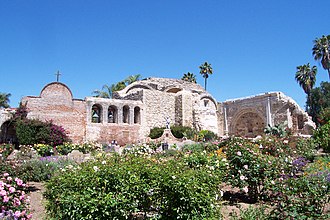
The mission was designed by Antonio Cruzado and completed in 1805. It has special capped buttresses and tall narrow windows that make it unique. A large stone cross stands in the center of the Campo Santo, the cemetery, which was first consecrated in 1778 and again in 1939. This cemetery is the resting place for about 6,000 neophytes.
According to a Spanish legend, when the founding expedition arrived, they were met by many native Tongva people who wanted to send them away. A priest laid a painting of Our Lady of Sorrows on the ground, and the Tongva people, known as the Gabrieleños, were moved by its beauty and made peace with the missionaries. Today, the 300-year-old painting still hangs in the Mission's sanctuary near the old high altar and reredos.
History
In August 1771, a group of Spanish soldiers and priests met with Tongva people near the Santa Ana River. One month later, on September 8, 1771, Mission San Gabriel Arcángel was founded by two priests. They chose a fertile plain by the Río Hondo River for the mission.
The mission was built with help from nearby Tongva villages. Over time, many changes happened to the mission. Floods and earthquakes damaged parts of it, and it was moved closer to the mountains. By 1834, most of the mission had fallen into ruins. In the 1850s, some people even turned part of it into a saloon. Later, efforts were made to restore the mission, and it was repaired and reopened in 2023 after a fire in 2020.
Mission industries
The missions aimed to become self-sufficient quickly, with farming being the most important activity. The mission priests taught local people their methods of farming, crafts, and caring for animals. The missions used the work of local community members to produce all they needed.
Ranchos were set up in many areas to raise cattle, sheep, and other animals. These included places like San Pasqual and San Gorgonio Pass. Many local communities, known as rancherías, were connected to the mission. To manage their large lands, Mission San Gabriel created several smaller outposts called asistencias. Some of these later became land grants.
The mission also built a grist mill in 1816, and El Molino Viejo still stands today as a museum. Other activities included making cowhide, soap, lime, tiles, cloth, and adobe bricks.
Mission bells
Bells were very important at missions. They helped everyone know when to eat, work, or go to services. They also marked special events like births and funerals, and even told time.
A TV show called Death Valley Days told a story about a bell at Mission San Gabriel Arcángel. In the story, a young monk was helped by the sound of the bell when he was lost in the desert.
Burials
The Mission San Gabriel Arcángel Cemetery is the oldest and first Catholic cemetery in the state of California. A large stone cross stands in the center of the Campo Santo (cemetery), first consecrated in 1778 and then again on January 29, 1939, by the Los Angeles Archbishop John Cantwell. It serves as the final resting place for some 6,000 people; a small stone marker denotes the gravesite of José de los Santos, the last American Indian to be buried on the grounds, at the age of 101 in February 1921.
Also interred at the Mission are the bodies of numerous Franciscan priests who died during their time of service, as well as the remains of Reverend Raymond Catalan, C.M.F., who undertook the restoration of the Mission's gardens. Entombed at the foot of the altar are the remains of eight Franciscan priests (listed in order of interment): Miguel Sánchez, Antonio Cruzado, Francisco Dumetz, Ramón Ulibarri, Joaquín P. Núñez, Gerónimo Boscana, José Bernardo Sánchez, and Blas Ordaz. Buried among the priests is Eulalia Pérez de Guillén Mariné, the "keeper of the keys" under Spanish rule; her grave is marked by a bench dedicated in her memory, and Victoria Reid, a woman from Comicranga, who was taken to the mission at a young age and became a respected figure in Mexican California.
Exhibits
Visitors can explore the church, museum, and grounds of Mission San Gabriel Arcángel. The museum building, made of adobe and built in 1812, was once used for storing books and as sleeping quarters. Inside, you will find old mission items, books, and religious objects. The grounds show parts of the original mission, such as indoor and outdoor kitchens, a winery, water storage areas, places for making soap and candles, vats for treating animal hides, and a cemetery. There is also a gift shop for visitors.
Matrimonial Investigation Records
The San Gabriel Mission holds important records that help us learn about life before California became a state. These records are part of a collection donated by William McPherson, a rancher and scholar from Orange County, California. He gave his mission documents to the Special Collections at the Claremont Colleges in 1964.
The records include interviews from couples who wanted to get married in the Roman Catholic Church between 1788 and 1861. These interviews checked if the couples were allowed to marry. There are 165 of these records, with information about 173 men and 170 women. Because the original papers are delicate, they cannot be copied anymore. But you can search the collection online using a guide from the California Digital Library.
Images
Related articles



This article is a child-friendly adaptation of the Wikipedia article on Mission San Gabriel Arcángel, available under CC BY-SA 4.0.
Images from Wikimedia Commons. Tap any image to view credits and license.