 Safekipedia
Montenegro
Adapted from Wikipedia · Discoverer experience
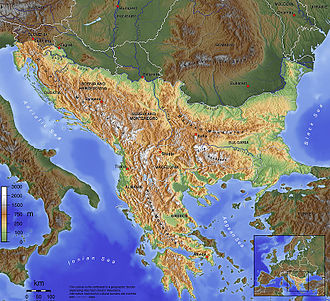
Montenegro is a small country in Southeast Europe, located on the Balkan Peninsula. It has a population of about 633,158 people and covers an area of 13,883 km2. The country is bordered by Serbia to the northeast, Bosnia and Herzegovina to the northwest, Kosovo to the east, Albania to the southeast, and Croatia to the west. It also has a beautiful coastline along the Adriatic Sea.
The capital and largest city is Podgorica, while Cetinje serves as the Old Royal Capital and a cultural center. The area now known as Montenegro has a long history, originally inhabited by people called Illyrians. Over the centuries, it has been ruled by various empires and kingdoms, including the Venetian Republic and the Ottoman Empire.
Montenegro gained its independence in 2006 after a referendum. Today, it is an upper-middle-income economy focused mainly on services and is working toward joining the European Union. The country is also a member of several international organizations, including the United Nations and NATO.
Etymology
The name "Montenegro" comes from the phrase "Crna Gora", which means "Black Mountain." This name describes how Mount Lovćen looks when covered in dark green forests. The name was first used a long time ago and became more common after the fall of a nearby kingdom in 1459. Over time, the name grew to cover a larger area.
Today, Montenegro is known by this name, and it has been the country's official name since 2007. In different languages, the country has different names, like "Mali i Zi" in Albanian.
History
Main article: History of Montenegro
Antiquity
Modern-day Montenegro was part of Illyria and populated by the Indo-European-speaking Illyrians. The Illyrian kingdom was conquered by the Roman Republic and the region was incorporated into the province of Illyricum.
Arrival of the Slavs
Three principalities were located on the territory: Duklja, Travunia, and Raška. Duklja gained its independence from the Byzantine Empire in 1042. Over the next few decades, it expanded its territory and became recognised as a kingdom. Its power started declining in the 12th century.
Early modern period
From 1392, parts of the territory were controlled by the Republic of Venice, including the city of Budva. Large portions fell under the control of the Ottoman Empire from 1496 to 1878. In the 16th century, Montenegro developed a unique form of autonomy within the Ottoman Empire.
Principality and Kingdom of Montenegro
In 1858, a major victory over the Ottomans occurred at the Battle of Grahovac. In the Battle of Vučji Do, Montenegrins defeated the Ottoman Army. The Ottoman Empire recognised the independence of Montenegro in the Treaty of Berlin in 1878.
Kingdom of Yugoslavia
In 1922, Montenegro formally became the Oblast of Cetinje in the Kingdom of Serbs, Croats and Slovenes. In 1929, it became a part of a larger Zeta Banate of the Kingdom of Yugoslavia.
World War II and Socialist Yugoslavia
In April 1941, Nazi Germany, the Kingdom of Italy, and other Axis allies attacked and occupied the Kingdom of Yugoslavia. Italian forces occupied Montenegro. In May, the Montenegrin branch of the Communist Party started preparations for an uprising. The uprising took hold, and by July, many had joined the fight. The uprising lasted until mid-August.
Montenegro became one of the six constituent republics of the communist Socialist Federal Republic of Yugoslavia. Its capital became Podgorica, renamed Titograd in honour of President Josip Broz Tito.
Montenegro within FR Yugoslavia
After the formal dissolution of the SFRY in 1992, Montenegro remained part of a smaller Federal Republic of Yugoslavia along with Serbia.
Independence
The status of the union between Montenegro and Serbia was decided by a referendum on Montenegrin independence on 21 May 2006. On 3 June 2006, the Montenegrin Parliament declared the independence of Montenegro. On 28 June 2006, Montenegro joined the United Nations as its 192nd member state.
Recent history
Montenegro formally became a member of NATO in June 2017. Montenegro has been in negotiations with the EU since 2012. In March 2023, Jakov Milatovic won the presidential election. The Europe Now movement won the highest number of seats in the 2023 Montenegrin parliamentary election. On 31 October 2023, Milojko Spajic became Montenegro's new prime minister.
Geography
Main article: Geography of Montenegro
Montenegro has tall mountains along its borders with Albania, Bosnia and Herzegovina, Kosovo, and Serbia. It also has a small coastal area along the Adriatic Sea, which is only 1.5 to 6 kilometres (1 to 4 miles) wide. The land rises sharply in the north, where Mount Lovćen and Mount Orjen stand near the beautiful Bay of Kotor.
The country has many rugged mountains, with some reaching over 2,000 metres (6,600 feet). One famous peak is Bobotov Kuk in the Durmitor mountains, and another is Zla Kolata in the Prokletije mountains. Montenegro is also home to several national parks, which help protect its many plants and animals. These parks include Durmitor National Park, Biogradska Gora National Park, Lovćen National Park, Lake Skadar National Park, and Prokletije National Park.
Montenegro has a great variety of plants and animals because of its different landscapes and climates. It has many types of birds, fish, and insects, as well as forests and mountains. The country has many protected areas, including five national parks, which help keep its nature safe.
Politics
Main article: Politics of Montenegro
Montenegro is a country with a system where leaders are chosen by voting. It has a president and a prime minister. The president is chosen every five years and helps make important decisions. The prime minister leads the government, which works together with different groups of leaders.
Montenegro has a group of leaders called a parliament. They make laws and help run the country. The people of Montenegro vote for these leaders, and they work in the city of Podgorica.
Administrative divisions
Main articles: Municipalities of Montenegro and List of regions of Montenegro
Montenegro is divided into twenty-five areas called municipalities. These areas include many towns and cities.
Regions of Montenegro—designed for statistical purposes by the Statistical Office—have no administrative function. Note that other organizations (i.e. Football Association of Montenegro) use different municipalities as a part of similar regions.
-
Central Region
Foreign relations
See also: Foreign relations of Montenegro
Montenegro works with other countries to make friends and help each other. It joined a group of friendly countries called NATO in 2017. Montenegro wants to join a bigger group of countries called the European Union in the future.
Law
Main article: Constitution of Montenegro
Montenegro has rules and laws to keep everyone safe and fair. The highest court makes sure these laws are followed. Leaders are chosen to make sure people’s rights are protected.
Law enforcement, security and emergency services
Main article: Police Directorate of Montenegro
Montenegro has police to keep people safe and solve problems. There are special teams for very important jobs, like keeping borders safe. Doctors and firefighters help when people need urgent care.
Military
Main article: Armed Forces of Montenegro
Montenegro has an army, navy, and air force. They work to protect the country and help keep peace in the world. Montenegro is part of NATO and works with other countries to help keep everyone safe.
| Municipality | Area | Population | ||
|---|---|---|---|---|
| Km2 | Rank | Total | Rank | |
| Cetinje | 899 | 3 | 16,757 | 4 |
| Danilovgrad | 501 | 4 | 17,678 | 3 |
| Nikšić | 2,065 | 1 | 72,824 | 2 |
| Podgorica | 1,399 | 2 | 187,085 | 1 |
| Tuzi | 236 | 5 | 12,096 | 5 |
Economy
Main article: Economy of Montenegro
Montenegro's economy is mostly based on services and is changing to work more like a market economy. In 2019, the total value of goods and services produced in Montenegro was about $5.4 billion. This amount is smaller than in many other European countries, but it supports the country's population well.
Infrastructure
Main article: Transport in Montenegro
Montenegro's roads are not as modern as those in Western Europe, and there are no full motorways. Building new motorways is very important for the country's growth and for attracting tourists.
Montenegro has railways that connect it to Serbia and some smaller lines for local travel. The country also has two airports and a main port in Bar, which handles lots of cargo but has not been doing well recently. Plans are in place to improve these facilities.
Tourism
Main article: Tourism in Montenegro
In 2022, Montenegro welcomed about 2.1 million visitors who stayed for over 12 million nights. Many of these visitors came from nearby countries like Serbia, Bosnia and Herzegovina, and Kosovo, as well as from Russia.
Montenegro's coast along the Adriatic Sea is very beautiful, with long beaches and old towns. Popular spots include Jaz Beach, Mogren Beach, Bečići Beach, Sveti Stefan Beach, and Velika Plaža. The old towns of Herceg Novi, Perast, Kotor, Budva, and Ulcinj are also very popular with tourists. Travel magazines have praised Montenegro as a wonderful place to visit.
Demographics
Main articles: Demographics of Montenegro and Demographic history of Montenegro
Montenegro is a country where many different ethnic groups live together. According to the latest count, there are over 600,000 people living there. The largest groups are Montenegrins and Serbs, but there are also Bosniaks, Albanians, Russians, and others such as Romani people, Croats, Ukrainians, Belarusians, and Turks.
The official language of Montenegro is Montenegrin, but Serbian, Bosnian, Albanian, and Croatian are also used in official places. Many people speak Serbian as their first language, followed by Montenegrin. Other languages spoken include Bosnian, Albanian, and Russian.
Most people in Montenegro follow Christianity, mainly Eastern Orthodox Christianity. A smaller group practices Islam, and there are also Catholics, Protestants, and people with no religious affiliation. Even though there have been difficult times in the past, Montenegro is known for its respect for different religions and beliefs. Religious groups have their own rights and are separate from the government.
Culture
Main article: Culture of Montenegro
Montenegrin culture has been shaped by many different influences, including Orthodox, Ottoman, Slavic, Central European, and seafaring Adriatic cultures. The country has many important historical sites, including churches and monasteries with beautiful paintings. One famous tradition is the folk dance called the Oro, where people dance in circles and end by standing on each other's shoulders to form a pyramid.
Media
Main article: Media of Montenegro
Montenegro has many television, magazine, and newspaper outlets run by both the government and private companies. The Constitution guarantees freedom of speech. One popular private news channel is Vijesti, while the government runs Radio and Television of Montenegro, which also broadcasts news in Albanian.
Sport
Main article: Sport in Montenegro
Sport in Montenegro is mostly about team games like water polo, football, basketball, handball, and volleyball. Other sports include boxing, tennis, swimming, judo, karate, athletics, table tennis, and chess. Water polo is the most popular sport and is considered the national sport. The Montenegro men's water polo team has won important competitions, such as gold medals at the 2008 Men's European Water Polo Championship in Málaga, Spain, and the 2009 FINA Men's Water Polo World League in Podgorica. Montenegro came fourth in the men's water polo at the 2016 Olympics.
Football is the second most popular sport. The Montenegro national football team, started in 2006, played in the playoffs for UEFA Euro 2012. The Montenegro national basketball team has performed well and won many medals as part of the Yugoslavia national basketball team. Montenegro joined the International Basketball Federation in 2006 and has taken part in two EuroBaskets.
Among women's sports, the national handball team is the most successful, winning the country's first Olympic medal—silver at the 2012 Summer Olympics. They also won the 2012 European Championship. The team ŽRK Budućnost Podgorica has won the EHF Champions League twice. Montenegro was one of the host countries for the 2022 European Women's Handball Championship and came third.
Cuisine
Main article: Montenegrin cuisine
Montenegrin food has been influenced by many cultures, including from the Levant and Turkey, which brought dishes like sarma, musaka, pilav, pita, gibanica, burek, ćevapi, kebab, đuveč, and sweets such as baklava and tulumba. Hungarian influences include stews and sataraš. Central European foods like crêpes, doughnuts, jams, biscuits, and cakes are also common. The coastal area has a Mediterranean style of cooking, with lots of seafood, and has been influenced by Italian cuisine.
Images
Related articles



This article is a child-friendly adaptation of the Wikipedia article on Montenegro, available under CC BY-SA 4.0.
Images from Wikimedia Commons. Tap any image to view credits and license.