 Safekipedia
Muhammad in Islam
Adapted from Wikipedia · Discoverer experience
In Islam, Muhammad is honored as the Seal of the Prophets. Muslims believe he received the Quran, Islam's holy book, from the angel Gabriel. They think Muhammad was sent to share God's message with people and jinn, continuing the original faith of mankind taught by earlier prophets like Abraham, Moses, and Jesus.
Muhammad began sharing his messages when he was 40 years old in a cave named Hira near Mecca. He taught the oneness of God and opposed idolatry practiced in pre-Islamic Arabia. This caused conflict, and he and his followers moved to Medina in an event called the Hijrah. Later, Muhammad returned to Mecca and fought in battles like the Battle of Badr, which Muslims see as a sign of God's support.
Muhammad is seen as a perfect example of how to live a good and moral life. His actions and teachings, called the Sunnah, guide Muslims today. He is known by many respectful titles, and Muslims often say sallallahu 'alayhi wa sallam meaning "Peace be upon him" after using his name. He is called "The Prophet" and is regarded as the greatest prophet in Islam.
In the Quran
Further information: Muhammad in the Quran
The Quran mentions Muhammad by name four times. It speaks about his role as a prophet and his good character, but does not share many details about his early life. The Quran teaches that Muhammad was the last prophet sent by God. He is called many things in the Quran, such as "Messenger", "Messenger of God", and "Prophet". The Quran says that Muhammad was a wonderful example for people to follow.
The Quran also explains that God sent Muhammad with important messages for everyone. It describes Muhammad as a blessing to the whole world. Some parts of the Quran are thought to relate to special moments in Muhammad’s life, like receiving the first message or meeting angels and other prophets.
Names and titles of praise
See also: Names and Titles of Muhammad, Islamic honorifics, Durood, Mawlid, Naat, Madih nabawi, Haḍra, and Dala'il al-Khayrat
Muhammad is known by many special names and titles that show how people respect him. Some of these names include "the Prophet," "the Messenger," "the beloved," and "the chosen one." He is also called "the trustworthy," "the honest," and "the truthful." Other titles describe him as kind, a good example, and a mercy to the world.
He has other names too, like "Abu'l-Qasim," which means "father of Qasim," and "Ahmad," meaning "the Praised one." These names show the high respect and love that followers of Islam have for him.
Overview
In Muslim tradition, Muhammad is seen as a special person who shone with light. Stories tell us that when he walked into a dark place, light would shine around him like moonlight. Muslims believe that Muhammad showed God's kindness and guidance, unlike others who might show anger or pride.
Although Muhammad said he was just an ordinary person, many stories tell of amazing things he did. The Quran, the important book for Muslims, reminds us that Muhammad was human by saying, "I am only a human being like you." But Muslims still respect him deeply, comparing him to a precious gem among ordinary stones. Some believe that the Quran itself is the greatest miracle given to Muhammad.
Final prophet
Main article: Khatam an-Nabiyyin
Muslims believe that Muhammad was the last prophet sent by God to guide people to the right path. The Quran calls him the Seal of the Prophets, meaning he was the final messenger in a long line of prophets that began with Adam. Both Sunni and Shi'i Muslims agree that Muhammad is the last prophet.
There are also stories about when Muhammad’s role as a prophet began. Some say it started when Adam, the first human, was just being formed. Other traditions, especially among Shi'i Muslims, share unique views about Muhammad and his family that go back to the time before Adam was created.
Morality and Sunnah
Muslims believe that Muhammad showed the best moral qualities and was a model of excellence. They think he was the finest person ever created by God. His virtues included modesty, humility, forgiveness, generosity, honesty, justice, patience, and self-denial. For over a thousand years, many Muslims have tried to live like Muhammad in every part of their daily lives.
In Muslim legal and religious thought, Muhammad’s actions and teachings, called the Sunnah, guide how Muslims should behave. The Sunnah is recorded in the Hadith literature and covers many areas of life, from simple daily habits to important religious practices. While the Quran tells Muslims to pray, fast, and give to others, it was Muhammad who showed them how to do these things in practice.
Biography
Muhammad's biography is recorded in historical texts called Al-Sīra al-Nabawiyya (prophetic biography). Early biographies were written by ibn ʾIsḥāq, though only a later version by ibn Hishām survives. These works describe Muhammad in both human and miraculous ways. He is seen as a loving and devoted leader whose actions, known as the sunnah, guide his followers.
Muhammad was born around 570 CE in Mecca, in the Arabian Peninsula, to the family of Banu Hashim. He was orphaned as a child and raised by his grandfather and later his uncle Abu Talib. As a young boy, he was sent to live with a Bedouin tribe to learn their pure speech and manners. At age 25, he began working for a woman named Khadijah, and they later married.
At age 40, in 610 CE, Muhammad began receiving messages from the angel Gabriel. These messages became the Quran, Islam's holy book. He shared these teachings with his family and close friends. As his message spread, he faced opposition from some leaders in Mecca who did not want to change their ways. Some of his followers were treated unfairly, and Muhammad eventually led many of them to settle in a place called Medina.
In Medina, Muhammad built a mosque and created a community where different groups could live together peacefully. He worked to resolve conflicts and establish fair rules for everyone. Over time, more people accepted his teachings, and Muhammad's influence grew. He traveled to Mecca to spread his message and eventually entered the city peacefully, where many people accepted Islam.
Muhammad continued to guide his community until his death in 632 CE in Medina. He is remembered as a kind and wise leader who brought a new way of living to many people.
Veneration
Muhammad is greatly respected by Muslims, who consider him the most important prophet. When talking about him, Muslims add the title "Prophet" and use a special greeting meaning "Peace be upon him."
Muslims do not worship Muhammad—they believe only God should be worshipped.
Throughout the Islamic calendar year, Muslims celebrate five special days connected to Muhammad’s life. These days include his birthday and events like his journey to heaven. During these celebrations, people gather to read from the Quran, share stories about Muhammad, and offer free food to others.
Some Muslims also keep small pieces of hair said to belong to Muhammad, believing they bring special blessings. Many visit Muhammad’s tomb in Medina, thinking it brings good fortune and that he will help them on a very important day in the future.
Night Journey and Ascension
Main article: Isra and Mi'raj
The ’Isrā’ wal-Miʿrāj tells the story of Muhammad's special night journey and ascension. Many believe these events happened on the same night, though there is some debate about whether they were physical or spiritual experiences. The Quran mentions this event briefly in Surah 17, but later writings add more details.
Traditionally, many Muslims believe Muhammad's journey was a real, physical trip. Over time, different stories about this journey were shared and written down. One early story comes from a writer named ibn ʾIsḥāq. In his version, Muhammad was woken up by the angel Gabriel, who took him on a ride to Jerusalem on a special animal called the Buraq. There, he met many important prophets and led them in prayer. Later, Muhammad climbed a ladder through the heavens, meeting more prophets and finally receiving instructions from God about daily prayers for believers.
Other writers tell the story a bit differently, sometimes separating the journey to Jerusalem from the climb through the heavens. These stories show how people have thought about and remembered Muhammad's special night over many years.
Today, many Muslims celebrate this journey as Miʿrāj Qindīl.
Splitting of the Moon
Main article: Splitting of the Moon
Surah 54:1-2 talks about Muhammad splitting the Moon when he was in Mecca. Some believe this event was actually a lunar eclipse that happened between 610 and 622. At that time, people thought such events were signs from God.
Some stories say Muhammad’s friends asked him to show a miracle to prove he was a prophet. In these stories, Muhammad split the Moon into two parts, and then it came back together. Others thought it was just magic. This story is told in old Islamic writings.
Animals
See also: Animals in Islam
In Islam, there is a well-known story about Muhammad and his close friend, Abu Bakr. They were being chased and had to hide in a cave on Mount Thawr. A spider spun a web across the entrance of the cave, and a bird built a nest there. This made the people chasing them think no one was inside, so they were safe. Because of this story, many Muslims believe it is okay to let spiders live.
Many Muslims also believe that Muhammad had a special cat named Muezza. He cared for this cat and warned people to treat cats kindly. Cats are often seen as clean and special in Muslim communities.
Visual representation
Main article: Depictions of Muhammad
See also: Depictions of Muhammad in film and List of films about Muhammad
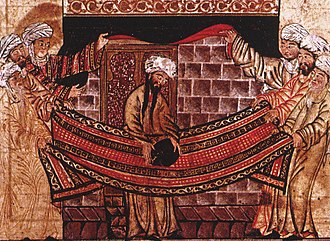
In Islam, showing pictures of important religious figures like Muhammad is handled carefully. Some traditions suggest that showing any living being, including prophets, in art is not allowed. This idea grew stronger around the eighth century.
When Muhammad is shown in old artworks from places like the Ilkhanate, Timurid, and Safavid times, his face is often covered or shown as a bright light. Some believe these artworks were made during times when rulers were not strictly following religious rules, while others think they were made by very devoted followers of Islam.
Artworks showing Muhammad became more common among Turkish and Mongol people after they converted to Islam. These pictures helped teach people about the religion and support certain Islamic beliefs. Even in these images, Muhammad’s face is usually hidden or shown as glowing light, because of how bright his face was described to be.
Images
Related articles




This article is a child-friendly adaptation of the Wikipedia article on Muhammad in Islam, available under CC BY-SA 4.0.
Images from Wikimedia Commons. Tap any image to view credits and license.