 Safekipedia
Nisenan
Adapted from Wikipedia · Discoverer experience
The Nisenan are a group of Native Americans and an Indigenous people of California from the Yuba River and American River watersheds in Northern California and the California Central Valley. They have lived in these areas for a very long time, even before Europeans arrived.
According to a 1929 report from the University of California, Berkeley, the Nisenan are sometimes grouped with a larger group called the Maidu. However, many Nisenan people disagree with this. They believe they are their own distinct group with their own culture, leaders, and language.
The Nisenan are often divided into three groups based on where they lived: Valley Nisenan, Hill Nisenan, and Mountain Nisenan. Each group has its own special customs and traditions because of where they lived. Even though they lived in these areas for many years, they are not recognized as a tribe by the US government. Some Nisenan people today are part of the Shingle Springs Band of Miwok Indians, which is a group that is officially recognized by the government.
Name
The name Nisenan comes from a special word, nisena·n, which is a pronoun in their language.
The Nisenan are sometimes called the Southern Maidu or Valley Maidu. Even though many people use the term Maidu, it is really a simple way to talk about many smaller groups of Native Americans.
Territory
The Nisenan lived in Northern California, between the Sacramento River to the west and the Sierra Mountains to the east. Their area reached south to near the Cosumnes River, but was north of Elk Grove and parts of Sacramento. To the north, their land went between the northern fork of the Yuba River and the southern fork of the Feather River.
They had neighbors including the Valley and North Sierra Miwok to the south, the Washoe to the east, the Konkow and Maidu to the north, and the Patwin to the west.
History
Gold Rush
The Nisenan people were not affected by European influence at first. In the early 1800s, their first meetings with Spanish and U.S. groups were peaceful. But in 1833, a serious sickness called malaria spread, causing many Nisenan and nearby tribes to become very ill.
When the Gold Rush happened in 1849, many Europeans came to the area looking for gold. This led to problems for the Nisenan, including loss of land, fewer resources, more sickness, and violence. The many new people also used too much land and took away food and water, making life very hard. When a dry period came, crops did not grow and some people did not have enough food. Because of these hard times, the number of Nisenan people went down from about 9,000 to just 2,500 by the year 1895. Some of the remaining Nisenan lived in the foothills of the Sierra Nevada and found jobs that paid very little.
Customs
Different Nisenan families had various traditions, and some of these customs were not always easy to understand because early researchers often studied many tribes together.
For births, some old stories say that twins and their mother might have been treated badly, but modern leaders say twins were seen as lucky if they survived. After a baby was born, the mother and child would stay in a special hut for sixteen days. The mother would sit up and keep warm with a heated stone. After the sixteen days, a celebration would happen where the baby would get a name, often from an elder or ancestor.
In the past, marriages were arranged by families, but today couples choose each other. Families would exchange gifts and hold a celebration. The couple would start by sleeping far apart and slowly move closer until they were finally together. If a spouse passed away, the other could remarry after a respectful waiting time, and permission from the family of the deceased was needed.
When someone passed away, the Nisenan people would hold a burning ceremony where the body and belongings were cremated. They believed the spirit would join others in another place and could appear as animals or weather. The living did not welcome these spirits back, and speaking the name of someone who had passed was avoided.
Language
The Nisenan language had 13 different dialects, spread across the Sierra Nevada and the Sacramento Valley. These dialects were spoken between the Cosumnes River, Yuba River, American River, and Feather River.
In the past, people thought there were only four main dialects: Valley Nisenan, Northern Hill Nisenan, Central Hill Nisenan, and Southern Hill Nisenan. But we now know there were actually 13.
Spanish influence
When the Spanish came to California in the late 1700s, they built missions to control the land and change the culture of local tribes. The Nisenan people did not have as much contact with these Spanish settlers as some other tribes did. Sometimes Spanish or Mexican soldiers would come through Nisenan land, but the Nisenan were mostly left alone compared to their neighbors.
Social organization
The Nisenan people lived in small, independent groups that shared a common language but spoke slightly different versions of it. Each group was self-sufficient and made its own decisions.
Early studies of the Nisenan focused mostly on men and did not include the full story from women. These studies said that leadership and property were passed down through men. However, women also played leadership roles through family ties, and Nisenan families remember that their society had strong roles for women as well.
Daily life
Housing
The Nisenan people built two special kinds of homes. One type, called Hu, was where families lived. These dome-shaped homes were made from tule, earth, and wooden poles. Inside, the floor was covered with leaves, and a fire burned in the middle, with smoke rising through a hole in the roof. Earth was piled around the outside to keep the home warm.
The other type of home, called K’um, was partly underground and used for special ceremonies and dances. It was usually found in bigger villages and could also provide a place to stay for visitors. The floor of the K’um was dug a little below ground, and the door faced east. It had strong posts to hold up the roof.
Food
The Nisenan had plenty of food from nature. A main food source was acorns. In the fall, people gathered acorns using long poles. They stored the acorns and then ground them into mush, gruels, or cakes. They also collected pine nuts, berries, and other plants. The root of tule was boiled or roasted over a fire.
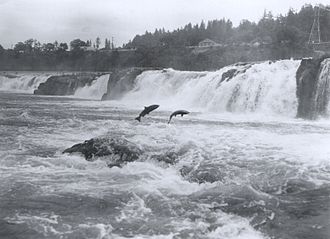
Men often hunted animals such as deer, elk, and rabbits. Bears were hunted in winter while they slept. Fishing was common near rivers, with popular catches including salmon, sturgeon, and trout. They also ate insects like grubs, earthworms, and yellow jackets, which were smoked over a fire.
Currency and trade
The Nisenan used shell beads as a sign of wealth and for trading. These beads came from coastal communities and were not altered by the Nisenan. When the beads got worn, they were punctured to be strung on strings. The Valley Nisenan and Hill Nisenan often traded with each other. Valley Nisenan would trade fish, roots, shells, beads, salt, and feathers. In return, they received black acorns, pine nuts, berries, animal skins, and wood for making bows.
Current events
As of 2020, around 147 Nisenan people lived in Nevada City, California. The tribe is not recognized by the government, so they do not receive federal help or money. In 2015, they were the first tribe denied the chance to restore their Rancheria, which means they miss out on important services like healthcare, housing help, education, and job support. Because of this, many in the tribe live in poverty, and challenges like poor health and lack of education are common.
The Nisenan work hard to keep their traditions alive. They hold Nisenan Heritage Day each year, where people can see ceremonial dances and take part in activities like basket weaving. They also focus on teaching their language, which they see as a vital link to their homeland. In 2024, the Nevada City Rancheria Nisenan Tribe started a campaign called "Homeland Return" to raise money to buy back the old John Woolman School.
Rancheria Act of 1958 Nevada City Rancheria Nisenan Tribe John Woolman School
Images
Related articles



This article is a child-friendly adaptation of the Wikipedia article on Nisenan, available under CC BY-SA 4.0.
Images from Wikimedia Commons. Tap any image to view credits and license.