 Safekipedia
Olive
Adapted from Wikipedia · Discoverer experience
The olive (botanical name Olea europaea, "European olive") is a species of subtropical evergreen tree in the family Oleaceae. It originated in Asia Minor and is now found all around the Mediterranean Basin. Wild versions grow in Africa and western Asia, while modern types mainly come from the Near East, the Aegean Sea, and near the Strait of Gibraltar.
Olives have been very important for a long time in history, money, and culture around the Mediterranean Sea. People first started growing them between 6,000 and 4,000 BC in the Eastern Mediterranean, likely in the Levant. From there, olives spread through trade and moving people, reaching places like Crete around 3500 BC and Iberia by about 1050 BC. Olives helped many old cultures grow, like the Minoans, Myceneans, Greeks, and Romans.
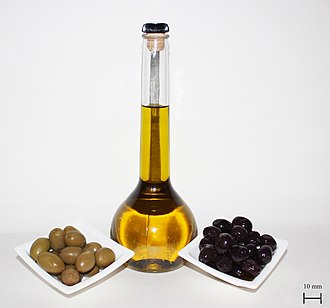
People have always liked olives for many uses. We can eat the fruit, and we can make oil from it to use in cooking, lighting lamps, cleaning, making soap, and even for medicine. Olive wood was sometimes used to build things. Because olive trees live a very long time and are useful, they also had special meaning in many cultures. Their leaves and branches were used in ceremonies, like in the ancient Olympic games and when Israelite kings were crowned. The Greeks thought olive trees were sacred and stood for peace, wealth, and wisdom.
Today, olives are grown all around the Mediterranean, and also in places like Australia, New Zealand, the Americas, and South Africa. Spain, Italy, and Greece make the most olive oil. There are thousands of kinds of olive trees, and some olives are used for making oil, some we can eat, and some are just grown for decoration. About 80% of all olives are made into oil, and the other 20% are eaten as food, called "table olives".
Etymology
The word olive comes from the Latin word ŏlīva, which means "olive fruit; olive tree". It may have passed through the Etruscan language as eleiva from an old form of Greek called *ἐλαίϝα (elaíwa). In Classic Greek, this became ἐλαία (elaía), still meaning "olive fruit; olive tree". The word oil originally meant "olive oil", coming from Latin ŏlĕum and Greek ἔλαιον (élaion). Many languages use a word for "oil" that comes from the name of the olive tree and its fruit. The oldest known forms of these Greek words are found in Mycenaean writing, using the Linear B script.
Description
The olive tree, Olea europaea, is an evergreen tree or shrub that grows in places like Europe, Asia, and Africa near the Mediterranean Sea. It usually stands between 8 to 15 meters (25 to 50 feet) tall, but one special kind found near Pisciotta in Campania, Italy, can grow even taller. Its leaves are silvery green and shaped like ovals, measuring about 4 to 10 centimeters (1.5 to 4 inches) long.
The tree produces tiny white flowers on branches from the year before. These flowers have four light yellow petals and four green parts at the base. They bloom quickly in warm weather but take longer when it’s colder. The olive tree’s fruit is a small, round shape, turning from green to purple when ready to pick. Inside each olive is a hard part called a “stone” or “pit".
Taxonomy
The olive tree, known scientifically as Olea europaea, has six natural subspecies found across many regions. One subspecies, O. e. subsp. europaea, lives in the Mediterranean Basin and has two varieties: O. e. var. europaea and O. e. var. silvestris. Another subspecies, O. e. subsp. cuspidata, grows from South Africa through East Africa, Arabia, Northwest India, to Southwest China. Other subspecies include O. e. subsp. cerasiformis in Madeira, O. e. subsp. guanchica in the Canary Islands, O. e. subsp. laperrinei in Algeria, Sudan, and Niger, and O. e. subsp. maroccana in Morocco.
Cultivars
Main article: List of olive cultivars
There are hundreds of types, or cultivars, of olive trees. These cultivars affect the color, size, shape, and growth of the olives, as well as the quality of the olive oil. Some olives are grown for making oil, while others are for eating, often called "table olives". Because many olive cultivars cannot produce fruit on their own, they are usually planted together with another cultivar that can help them grow. Recently, farmers have been working on creating new hybrid cultivars that can resist diseases better.
History
The olive tree is one of the oldest trees humans have grown. It has a special place in history because people have used it for thousands of years. The olive tree likely started growing in what is now Italy and the eastern Mediterranean about 20 to 40 million years ago. Humans began using olives around 100,000 years ago in Africa and the Mediterranean for fuel and food.
People first began to grow olives in the Mediterranean between 8,000 and 6,000 years ago, probably starting in a place called the Levant. Olives were first used for making oil for lamps, not for eating, because the fruit is very bitter. The earliest ways to make olive oil date back about 6,500 years ago. By around 3000 BC, olives were being grown in Crete and were important to the Minoan civilisation.
Olives spread around the Mediterranean with help from traders like the Phoenicians. The Greeks grew many olives, and important leaders like Solon made rules to encourage growing them. The Romans helped spread olives even more, growing them across their empire from Italy to Spain and North Africa. After the Roman Empire fell, olives continued to grow, especially when Muslim rulers brought new kinds to Spain.
Olives were also taken to new parts of the world by explorers. Spanish colonists brought olives to South America in the 1500s, and missionaries brought them to California in the late 1700s. Today, olives are grown in many places, including Japan, Pakistan, and even in deserts like in India, though some places face challenges making olives grow well.
Cultivation
The earliest evidence for the growing of olives comes from ancient archaeological sites in what is now Jordan. In old times, farmers thought olive trees would not grow well far from the sea. Modern farming shows this is not always true, and olives are now grown far inland in some places with the right climate, especially in parts of southwestern Europe where winters are mild. An old book about farming from Spain, written in the 1100s, describes how olives were grown there.
Olives are grown in many parts of the world that have climates like the Mediterranean, such as South Africa, Chile, Peru, Pakistan, Australia, and parts of the western United States, especially California. They are also grown in places with cooler climates, like New Zealand, Uruguay, and Córdoba Province, Argentina.
Growth and propagation
Olive trees grow best in certain types of soil, especially those that are chalky or made of limestone, and they like coastal areas. They can grow in many types of soil, even clay, if it drains well, but rich soil can make them sick and produce bad oil. Olives need hot, sunny weather and can hurt if the temperature drops below −10 °C (14 °F). They can survive long droughts because of their strong root systems. Olive trees can live for many years if they are pruned properly.
Only a few kinds of olive trees can help each other make fruit. Some trees, like the 'Pendolino' variety, can make fruit on their own but need help from other trees to make a lot of fruit. Other trees that help include 'Leccino' and 'Maurino'. Olives can be grown from cuttings or layers, which means taking parts of the tree and planting them in the ground. They can also be grown from seeds, but this often gives poor results. In some places, small branches are cut and placed in the ground to grow new trees. In Greece, people often attach small olive trees to wild olive trees to help them grow.
Olives grow very slowly, and over many years, the trunk can become very thick. These trees are strong and can survive fires and diseases. Even if the parts above the ground are destroyed, the roots can grow new trees. Olives do not always make fruit every year, and big harvests can happen every few years. In some places, like Liguria, Languedoc, and Provence, farmers carefully cut the trees to help them make fruit and to keep the trees small so the olives are easy to pick.
Pests, diseases, and weather
Different problems can affect olive trees. One big problem is a small bug called the olive fruit fly, which lays eggs in the olives. This can make the olives taste bad and spoil. Farmers use different ways to control this bug, including natural methods like trapping and using special bacteria.
A type of mold can infect olive trees for many years and hurt them a lot. Some bacteria can make growths on the tree, and some insects eat the leaves and flowers. In southern Italy, a disease called olive quick decline syndrome has hurt olive trees, spread by a small bug called the meadow spittlebug.
Rabbits can eat the bark of olive trees and hurt them, especially young trees. In places where it is cold, olive trees can sometimes get hurt by frost. Strong winds and long rains during the olive-picking time can also cause damage. In colder parts of the Mediterranean, people grow other fruits instead of olives, like sweet chestnuts.
As an invasive species
Olives have spread from places where they were planted back into the wild. In some places where they were brought from other parts of the world, like South Australia, olives have become a problem. They grow too well and push out plants that belong there. In South Australia, animals like red foxes and birds spread olive seeds, and the olives grow dense and block sunlight from other plants. Because the climate is dry, these olives can also make wildfires more likely.
Harvesting
Olives are picked in the autumn and winter. In the Northern Hemisphere, green olives are picked from late September to mid-November. In the Southern Hemisphere, green olives are picked from mid-October to late November, and black olives are picked from mid-November to early February. In southern Europe, people pick olives for several weeks in winter, but the exact time depends on the country, the season, and the type of olive. One olive tree can make about 400 pounds of olives each year.
Most olives today are picked by shaking the branches or the whole tree. Picking olives from the ground can give bad oil because the olives get hurt. Another way is for a person to stand on a ladder and gently take the olives into a bag tied around their waist. This gives very good oil. Another method uses a special net around the tree to catch the olives. Some tools spin around to take olives off the tree.
Some kinds of olives, called table olives, are harder to pick without hurting them. Workers use baskets around their necks to carry the olives. In some mountainous places in Italy, Croatia, and Greece, people pick olives by hand because machines cannot reach. This care means the olives are not hurt and make a better product. Sometimes branches are cut off, which helps the tree make more olives in the future.
The amount of oil in olives depends on the type, but it is usually about 60–70% oil. Farmers usually get about 1.5–2.2 kg (about 3–5 pounds) of oil from each tree each year.
Fermentation and curing
Olives right off the tree are very bitter and unpleasant to eat. To make them tasty, olives must be treated and fermented, which removes a bitter substance called oleuropein. This process can take from a few days to a few months, depending on the method.
There are many ways to prepare olives for eating, depending on local tastes and traditions. One common way is the Spanish method, where olives are soaked in a special liquid to remove the bitter part, then washed and put in salt water to ferment. This method is used for about 60% of all olives eaten worldwide.
Other methods include the Sicilian method, where olives are put directly into salt water without the first soaking, and the Picholine method, where olives are soaked longer and then put in salt water. Some olives are cured in water, which removes the bitter part over time. In some places, ripe olives are packed in salt to dry them out, and in California, olives are treated to turn them black without fermentation.
All these methods help make olives taste good and safe to eat.
Longevity
See also: List of oldest trees
Olive trees are known for living a very long time. People have respected these trees for thousands of years because they can survive for so long. But it is hard to know exactly how old olive trees are. Unlike some other trees, olive trees do not grow in a regular way, making it difficult to count their rings to find their age.
Scientists think olive trees can live between 300 and 500 years, but some might even live up to 700 years. There are a few olive trees that people believe are thousands of years old. For example, an olive tree in Portugal is thought to be about 3,350 years old. Another in Montenegro is estimated to be between 2,014 and 2,480 years old. Some trees in Greece and Spain are also believed to be over 2,000 years old.
These ancient olive trees continue to grow and produce olives, showing their amazing strength and ability to live through many years of change.
Global production
Olives are one of the most commonly grown fruits in the world. As of 2024, 58 countries across five continents grow olives on about 11.6 million hectares (28.6 million acres) of land. This is a quarter of all the world's permanent crops. In 2011, there were about 9.6 million hectares (24 million acres) of olive trees, which was more than twice the land used for apples, bananas, or mangoes. Only coconut trees and oil palms used more space.
Spain is the biggest producer of olives, with over 180 million trees on more than 2.5 million hectares. Tunisia and Italy follow. In Italy, most olives are grown in the south, but there is also growth in cooler areas like Liguria and near Lake Garda. About 170 million olive plants are spread across one million farms.
Spain also makes the most olive oil, providing 25% of the world's supply. Italy, Morocco, and Tunisia are next. The European Union produces nearly 60% of the world's olive oil.
| Country/Region | Production (tonnes) | Cultivated area (hectares) | Yield (tonnes/ha) |
|---|---|---|---|
| World | 19,267,000 | 10,650,000 | 1.8091 |
 European Union European Union | 11,686,528 | 5,028,637 | 2.3240 |
 Spain Spain | 6,560,000 | 2,573,000 | 2.5490 |
 Greece Greece | 2,343,000 | 887,000 | 2.6414 |
 Italy Italy | 2,092,000 | 1,165,000 | 1.7950 |
 Turkey Turkey | 1,730,000 | 846,000 | 2.0460 |
 Morocco Morocco | 1,416,000 | 1,008,000 | 1.4044 |
 Syria Syria | 899,000 | 765,000 | 1.1748 |
 Tunisia Tunisia | 700,000 | 1,646,000 | 0.4253 |
 Algeria Algeria | 697,000 | 424,000 | 1.6437 |
 Egypt Egypt | 694,000 | 67,000 | 6.7293 |
 Portugal Portugal | 617,000 | 355,000 | 1.7394 |
Nutrition
A serving of cured green olives has food energy and is a good source of vitamin E and sodium. Green olives are mostly water, with some fat, carbohydrates, and protein.
Phytochemicals
Olives contain compounds called polyphenols, which change during ripening and processing. These include tyrosols, phenolic acids, flavonols, and flavones. The bitter taste of olives before curing comes from certain compounds.
Allergenicity
Olive tree pollen can cause strong allergic reactions and is a common trigger for asthma. Some olive trees are sold as "allergy-free," but they still produce pollen that can affect people with allergies.
Uses and properties
The olive tree, Olea europaea, is grown for its fruit, oil, beautiful wood, leaves, and as an ornamental plant. Most olives are made into oil, with the rest used as food. Olive oil is a liquid fat made by pressing olives, and it is used for cooking, dressing food, and in cosmetics, soaps, and lamps. It also has special uses in some religions.
Olive wood is very hard and lasting, used for items like kitchen tools, bowls, and furniture. Olive trees are also grown for their attractive, silvery leaves and twisted trunks. The waste from making olive oil, called olive mill wastewater, was once thrown away but may have other uses. The hard pit inside the olive can be used for fuel, water filters, and other products. Growing olive trees helps the environment by improving soil and absorbing carbon dioxide.
Symbolic and cultural significance
Main article: Symbolic and cultural significance of the olive
The olive tree has been very important in many cultures for thousands of years. In ancient times, it was one of the key crops that helped societies grow and thrive. In Greece, olives were sacred to the goddess Athena and appeared on their coins. In Rome, myths told of how Hercules brought the olive tree to Italy.
Olives have special meanings in many religions and cultures. In Christianity, Jesus is said to have prayed in a garden of olive trees. In Islam, olive leaves are sometimes used in religious practices. For Palestinians, olive trees represent their connection to their land and their community. In the United States, the nation's seal shows an eagle holding an olive branch to symbolise peace. The United Nations also uses olive branches in its flag to represent peace and unity.
Images
Related articles




This article is a child-friendly adaptation of the Wikipedia article on Olive, available under CC BY-SA 4.0.
Images from Wikimedia Commons. Tap any image to view credits and license.