 Safekipedia
Planetary-mass object
Adapted from Wikipedia · Discoverer experience
A planetary-mass object (PMO), planemo, or planetary body (sometimes referred to as a world) is a special kind of object in space. It is big enough to pull itself into a round shape, but not big enough to start burning like a star. This means it has a shape like a ball but does not give off its own light.
The idea of a planetary-mass object helps us group many different space objects together. Some of these objects are like planets, but others are different. They can be found in many places and come from many beginnings. Examples include dwarf planets, big moons that are almost like planets, and planets that float alone without a star, called rogue planets. These objects can form in many ways, sometimes by breaking away from a group of stars or forming all on their own in a cloud of gas and dust.
Usage in astronomy
The term "planetary-mass object" is often used for objects that are not sure what they are or don't fit into one clear group. For example, it is used for objects that float alone in space and have a low mass, like 2MASS J13243553+6358281 and PSO J060.3200+25.9644 in NGC 1333. It can also describe objects that are at the edge of what we call a star or a planet, such as VHS 1256-1257 b and BD+60 1417b. Some objects orbit a star but may not have formed like typical planets, like VHS 1256-1257 b and CFHTWIR-Oph 98B.
Types
Planetary-mass satellite
Main article: Planetary-mass moon
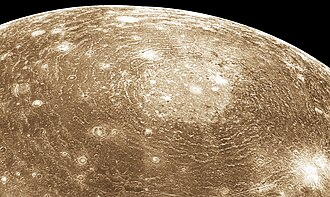
Some of the biggest moons, like Ganymede, Titan, and Callisto, are similar in size or even bigger than the planet Mercury. These moons, along with a few others, are larger and heavier than some small planets. Titan, for example, has a thick atmosphere and lakes of liquid, just like Earth—though on Titan, the liquid is made of methane instead of water.
Dwarf planets
Main article: Dwarf planet
A dwarf planet is a big object that orbits a star and is round because of its own gravity, but it hasn’t cleared out other objects from its path. Some scientists think dwarf planets should be considered a type of planet, but they are currently a separate group.
Planets and exoplanets
Former stars
See also: Disrupted planet § Stars
In some star systems where two stars are close together, one star can lose its material to the other. This shrinking star may then become an object about the size of a planet. One example is a Jupiter-sized object orbiting the pulsar PSR J1719−1438.
Sub-brown dwarfs
Main article: Sub-brown dwarf
Stars form from clouds of gas collapsing together, but smaller objects can form this way too. These are called sub-brown dwarfs. They can float freely in space or orbit a bigger object.
Captured planets
Rogue planets in stellar clusters can sometimes be pulled back into orbit around a star. They usually end up in very wide orbits, far from the star.
Rogue planets
Main article: Rogue planet
See also: Five-planet Nice model
Some computer studies suggest that during the formation of stars and planets, some planet-sized objects can be thrown out into space. These are called rogue planets.
Related articles



This article is a child-friendly adaptation of the Wikipedia article on Planetary-mass object, available under CC BY-SA 4.0.
Images from Wikimedia Commons. Tap any image to view credits and license.