 Safekipedia
Radio wave
Adapted from Wikipedia · Discoverer experience
Radio waves are a type of electromagnetic radiation with the lowest frequencies and the longest wavelengths. They usually have frequencies below 300 gigahertz and wavelengths longer than 1 millimeter, about the size of a grain of rice. Radio waves travel at the speed of light in a vacuum and a little slower in the Earth's atmosphere.
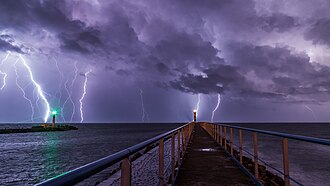
These waves are created when charged particles speed up or slow down, such as in time-varying electric currents. We can find natural radio waves from lightning and astronomical objects. People also make radio waves using a device called a transmitter connected to an antenna, which sends out the waves. Another antenna connected to a radio receiver can pick up these waves.
Radio waves are very important in our daily lives. They are used for many things like radio communication, broadcasting, radar, radio navigation, communications satellites, and wireless computer networks. Different frequencies of radio waves behave differently in the atmosphere, which helps them travel over long distances or around obstacles.
Discovery and exploitation
Main article: History of radio
Radio waves were first predicted in 1867 by a scientist named James Clerk Maxwell. He used math to show that electric and magnetic fields could travel through space as waves. Later, in 1887, another scientist named Heinrich Hertz created these waves in his lab and showed they acted like light. Around 1894–1895, an inventor named Guglielmo Marconi built the first practical radio machines to send and receive these waves. He won a Nobel Prize for this work, and radio became used for business around 1900. The name "radio wave" replaced the older name "Hertzian wave" around 1912.
Generation and reception
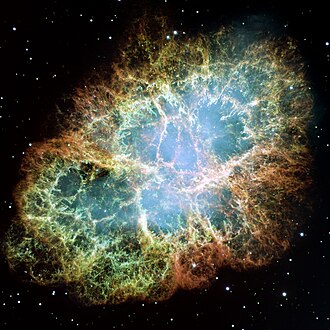
Radio waves are created when charged particles move quickly. Natural sources of radio waves include radio noise from lightning and other processes in Earth's atmosphere, as well as signals from space objects like the Sun, galaxies, and nebulas. Warm objects also give off high-frequency radio waves as part of their natural energy release.
Radio waves can be made by using electric currents — the flow of electrons — in a special metal part called an antenna. A device called a radio transmitter sends these electric currents through the antenna, which then sends out radio waves. These waves can be picked up by another antenna connected to a radio receiver. When the radio waves hit the receiving antenna, they move the electrons back and forth, creating small electric currents that the receiver can detect.
Properties
Radio waves move at the speed of light when they are in a vacuum, which is a space with nothing in it. When they go through materials like air, they slow down a little. The distance from one high point of a wave to the next is called its wavelength. This distance changes depending on how often the wave repeats, which we call its frequency.
An important thing about radio waves is their polarization. This means the direction in which the wave moves up and down. If the wave moves up and down sideways, it is called horizontal polarization. If it moves up and down toward the sky or ground, it is called vertical polarization. Some radio waves circle as they travel, which is called circular polarization. For a radio to get a good signal, it needs to match the polarization of the radio wave it is receiving.
Propagation characteristics
Main article: Radio propagation
Radio waves are used a lot for communication because they can travel through weather, leaves, and buildings. Longer radio waves can bend around things like walls or hills. This makes them useful for many kinds of communication.
When radio waves travel, they can bounce off things, change direction, or get weaker. Different frequencies work better for different uses. For example, cell phones and television use radio waves that travel in straight lines. Other types of radio waves can bend around the Earth or bounce off the sky to reach faraway places. Higher frequency waves, like those used in some modern technologies, can get weaker over long distances because air can block them.
Radio communication
Main article: Radio
In radio communication, we use radio waves to send information through the air. At the start, a radio transmitter takes a signal—like sound from a microphone, pictures from a video camera, or data from a computer—and changes it into radio waves. These waves travel through the air and reach a receiver.
The receiver catches these waves and turns them back into the original signal. It uses special parts to pick out just one station’s signal from many, making it louder and clearer. Finally, the signal can make sounds, pictures, or data that we can see or hear. Each station uses a different frequency so they don’t mix up, just like how tuning forks can vibrate to different notes.
Biological and environmental effects
Further information: Medical applications of radio frequency
Radio waves are a type of non-ionizing radiation, meaning they do not have enough energy to change atoms or molecules or damage DNA. When radio waves are absorbed by materials, they mainly cause heating, similar to the warmth from a space heater or a wood fire. This heating happens because the electric field of the wave makes certain molecules vibrate, which raises the temperature. This principle is used in microwave ovens to cook food, and it has been used for over 100 years in medical treatments to heat deep body tissues and promote healing.
Unlike other types of waves that only heat the surface, radio waves can go inside materials and biological tissues. How far they go in depends on their frequency and the material's properties. Looking directly at a strong source of radio waves, like near a working radio transmitter, can sometimes harm the eye by causing too much heat buildup. Radio waves can be blocked by metal screens or enclosures, known as a Faraday cage, as long as the holes in the screen are very small compared to the wavelength of the waves.
Measurement
Radio waves have both electric and magnetic parts, so we measure them using special units. We use volts per meter (V/m) to measure the electric part and amperes per meter (A/m) to measure the magnetic part. These help us understand how strong the radio wave is at a certain spot.
We also use a unit called power density to describe radio waves. This is used when we are far enough from the source, in what is called the far field zone. Power density tells us how much power there is in a certain area, like milliwatts per square centimeter (mW/cm2). For higher frequencies, like microwaves, power density is often used because we are usually far from the source.
Images
Related articles



This article is a child-friendly adaptation of the Wikipedia article on Radio wave, available under CC BY-SA 4.0.
Images from Wikimedia Commons. Tap any image to view credits and license.