 Safekipedia
Sino-Tibetan languages
Adapted from Wikipedia · Discoverer experience
Sino-Tibetan languages, also called Trans-Himalayan, form a large family of more than 400 languages. They are spoken by about 1.4 billion people, making them the second-largest language family in the world after Indo-European languages. The most widely spoken group within Sino-Tibetan is the Sinitic languages, which include Mandarin and other Chinese dialects, with around 1.3 billion speakers.
Other important Sino-Tibetan languages are Burmese, spoken by about 33 million people, and the Tibetic languages, spoken by around 6 million. Many smaller Sino-Tibetan languages are spoken in the Himalayas, the Southeast Asian Massif, and the eastern edge of the Tibetan Plateau. These languages often have fewer speakers and are found in remote mountain areas, so they are not well known.
While some smaller groups of these languages have been studied and understood, scientists are still working to uncover the common origins of the whole family. Traditionally, Sino-Tibetan languages were split into two main branches: Sinitic and Tibeto-Burman. However, it is still unclear how all these languages are related to each other.
In the past, some linguists included the Kra–Dai and Hmong–Mien languages in this family, but this idea is no longer widely accepted. Instead, experts now think the similarities come from languages influencing each other over time and early borrowing of words. There have been suggestions about links to other language families in Southeast Asia, but none have been widely agreed upon.
History
A connection between Chinese, Tibetan, Burmese, and other languages was first suggested in the early 1800s and is now widely accepted. Scholars began by studying languages with long writing traditions but later expanded to include many less-known languages, some without any writing at all. However, understanding the whole family of languages remains challenging due to their great diversity, lack of changes in many words over time, and effects of languages influencing each other. Many smaller languages are spoken in hard-to-reach mountain areas that are sometimes sensitive border zones. There is no agreement about when and where these languages originated.
During the 1700s, scholars noticed similarities between Tibetan and Burmese, both languages with rich literary histories. Early in the 1800s, researchers like Brian Houghton Hodgson observed that many non-literary languages in the highlands of northeast India and Southeast Asia were also connected to these. The term "Tibeto–Burman" was first used in 1856 by James Richardson Logan, who later included Karen in 1858. The third volume of the Linguistic Survey of India, edited by Sten Konow, focused on the Tibeto–Burman languages of British India.
Studies of the "Indo-Chinese" languages of Southeast Asia from the mid-1800s by Logan and others showed they included four families: Tibeto-Burman, Tai, Mon–Khmer, and Malayo-Polynesian. Julius Klaproth noted in 1823 that Burmese, Tibetan, and Chinese shared common basic vocabulary, unlike Thai, Mon, and Vietnamese. Ernst Kuhn suggested a group with two branches, Chinese–Siamese and Tibeto-Burman. August Conrady called this group Indo-Chinese in his 1896 classification, though he had doubts about Karen. Franz Nikolaus Finck placed Karen as a third branch of Chinese–Siamese in 1909.
Jean Przyluski introduced the French term sino-tibétain in 1924. The English term "Sino-Tibetan" first appeared in a note by Przyluski and Luce in 1931.
In 1935, Alfred Kroeber started the Sino-Tibetan Philology Project at the University of California, Berkeley, supervised by Robert Shafer and later Paul K. Benedict. The project gathered documentation of Sino-Tibetan languages, resulting in a 15-volume work that was never published but provided data for later papers.
Benedict completed his manuscript in 1941 but it was published in 1972. He focused on reconstructing Proto-Tibeto-Burman by comparing five major languages. He found patterns in the beginning sounds of words, though some irregularities remain unexplained.
Old Chinese is the oldest recorded Sino-Tibetan language, with inscriptions from around 1250 BC. However, the Chinese writing system does not show sounds clearly, making it hard to study the sounds of Old Chinese. Scholars compare descriptions from medieval dictionaries, elements in Chinese characters, and early poetry rhymes to understand Old Chinese sounds. Recent studies have simplified earlier reconstructions.
Tibetic has extensive written records from the mid-7th century, while Burmese records like the 12th-century Myazedi inscription are more limited but later developed extensively. Both use scripts derived from the Brahmi script of Ancient India. Tangut, the language of the Western Xia (1038–1227), is recorded in a Chinese-inspired script that is difficult to interpret.
Gong Hwang-cherng compared Old Chinese, Written Tibetan, Burmese, and Tangut to find sound matches. Other languages with historical texts, such as Classical Newar, Loloish languages, Lepcha, and Meiteilon, have also gained attention from linguists recently, though detailed reconstructions for these are still developing.
Descriptions of non-literary languages used earlier were often done by missionaries and colonial administrators with varying skills. Many smaller Sino-Tibetan languages are spoken in remote mountainous areas that are sometimes politically or militarily sensitive. Until the 1980s, the best-studied areas were Nepal and northern Thailand. In the 1980s and 1990s, new surveys were published from the Himalayas and southwestern China, with particular interest in the Qiangic languages of western Sichuan and nearby areas.
| TB | Tibetan | Jingpho | Burmese | Garo | Mizo | S'gaw Karen | Old Chinese |
|---|---|---|---|---|---|---|---|
| *k | k(h) | k(h) ~ g | k(h) | k(h) ~ g | k(h) | k(h) | *k(h) |
| *g | g | g ~ k(h) | k | g ~ k(h) | k | k(h) | *gh |
| *ŋ | ŋ | ŋ | ŋ | ŋ | ŋ | y | *ŋ |
| *t | t(h) | t(h) ~ d | t(h) | t(h) ~ d | t(h) | t(h) | *t(h) |
| *d | d | d ~ t(h) | t | d ~ t(h) | d | d | *dh |
| *n | n | n | n | n | n | n | *n ~ *ń |
| *p | p(h) | p(h) ~ b | p(h) | p(h) ~ b | p(h) | p(h) | *p(h) |
| *b | b | b ~ p(h) | p | b ~ p(h) | b | b | *bh |
| *m | m | m | m | m | m | m | *m |
| *ts | ts(h) | ts ~ dz | ts(h) | s ~ tś(h) | s | s(h) | *ts(h) |
| *dz | dz | dz ~ ts ~ ś | ts | tś(h) | f | s(h) | ? |
| *s | s | s | s | th | th | θ | *s |
| *z | z | z ~ ś | s | s | f | θ | ? |
| *r | r | r | r | r | r | γ | *l |
| *l | l | l | l | l | l | l | *l |
| *h | h | ∅ | h | ∅ | h | h | *x |
| *w | ∅ | w | w | w | w | w | *gjw |
| *y | y | y | y | tś ~ dź | z | y | *dj ~ *zj |
Distribution
Most of the current spread of Sino-Tibetan languages is the result of historical expansions of the three groups with the most speakers – Chinese, Burmese and Tibetic – replacing an unknown number of earlier languages. These groups also have the longest literary traditions of the family. The remaining languages are spoken in mountainous areas, along the southern slopes of the Himalayas, the Southeast Asian Massif and the eastern edge of the Tibetan Plateau.
The branch with the largest number of speakers by far is the Sinitic languages, with 1.3 billion speakers, most of whom live in the eastern half of China. The first records of Chinese are oracle bone inscriptions from around 1250 BC, when Old Chinese was spoken around the middle reaches of the Yellow River. Chinese has since expanded throughout China, forming a family whose diversity has been compared with the Romance languages. Diversity is greater in the rugged terrain of southeast China than in the North China Plain.
Burmese is the national language of Myanmar, and the first language of some 33 million people. Burmese speakers first entered the northern Irrawaddy basin from what is now western Yunnan in the early ninth century, in conjunction with an invasion by Nanzhao that shattered the Pyu city-states. Other Burmish languages are still spoken in Dehong Prefecture in the far west of Yunnan. By the 11th century, their Pagan Kingdom had expanded over the whole basin. The oldest texts, such as the Myazedi inscription, date from the early 12th century. The closely related Loloish languages are spoken by 9 million people in the mountains of western Sichuan, Yunnan, and nearby areas in northern Myanmar, Thailand, Laos, and Vietnam.
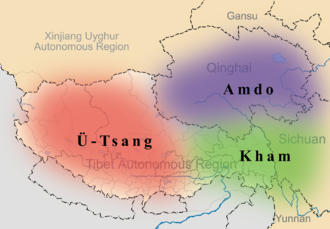
The Tibetic languages are spoken by some 6 million people on the Tibetan Plateau and neighbouring areas in the Himalayas and western Sichuan. They are descended from Old Tibetan, which was originally spoken in the Yarlung Valley before it was spread by the expansion of the Tibetan Empire in the seventh century. Although the empire collapsed in the ninth century, Classical Tibetan remained influential as the liturgical language of Tibetan Buddhism.
The remaining languages are spoken in upland areas. Southernmost are the Karen languages, spoken by 4 million people in the hill country along the Myanmar–Thailand border, with the greatest diversity in the Karen Hills, which are believed to be the homeland of the group. The highlands stretching from northeast India to northern Myanmar contain over 100 highly diverse Sino-Tibetan languages. Other Sino-Tibetan languages are found along the southern slopes of the Himalayas and the eastern edge of the Tibetan plateau. The 22 official languages listed in the Eighth Schedule to the Constitution of India include only two Sino-Tibetan languages, namely Meitei (officially called Manipuri) and Bodo.
There has been a range of proposals for the Sino-Tibetan homeland, reflecting the uncertainty about the classification of the family and its time depth. Three major hypotheses for the place and time of Sino-Tibetan unity have been presented.
The most commonly cited hypothesis associates the family with the Neolithic Yangshao culture of the Yellow River basin, with an expansion driven by millet agriculture. This scenario is associated with a proposed primary split between Sinitic in the east and the Tibeto-Burman languages, often assigned to the Majiayao culture in the upper reaches of the Yellow River on the northeast edge of the Tibetan Plateau.
George van Driem proposes a Sino-Tibetan homeland in the Sichuan Basin before 9000 years BP, with an associated taxonomy reflecting various outward migrations over time, first into northeast India, and later north (the predecessors of Chinese and Tibetic) and south (Karen and Lolo–Burmese).
Roger Blench argues that agriculture cannot be reconstructed for Proto-Sino-Tibetan. Blench and Mark Post have proposed that the earliest speakers of Sino-Tibetan were not farmers but highly diverse foragers in the eastern foothills of the Himalayas in Northeast India, the area of greatest diversity, around 9000 years BP. They then envisage a series of migrations over the following millennia, with Sinitic representing one of the groups that migrated into China.
Zhang et al. (2019) performed a computational phylogenetic analysis of 109 Sino-Tibetan languages to suggest a Sino-Tibetan homeland in northern China near the Yellow River basin. The study further suggests that there was an initial major split between the Sinitic and Tibeto-Burman languages approximately 4,200 to 7,800 years ago (with an average of 5,900 years ago), associated with the Yangshao or the Majiayao culture, or with both. Sagart et al. (2019) performed another phylogenetic analysis based on different data and methods to arrive at an earlier root age of approximately 7,200 years ago, but were not able to identify the top-level split. They arrived at similar conclusions regarding the homeland, associating it with millet farmers of the late Cishan culture and early Yangshao culture. Both of these studies have been criticized by Georg Orlandi (2021) for their reliance on lexical items, which are not seen as robust indicators of language ancestry. Another study, seeking to identify horizontal diffusion rather than phylogenetic descent, also suggested dispersal from the upper Yellow River area.
Hypothesised homeland and dispersal according to Sagart et al. (2019) Hypothesised homeland and dispersal according to van Driem (2005) Hypothesised homeland and dispersal according to Blench (2009) |
Classification
Several smaller groups of Sino-Tibetan languages have been studied well, but the bigger picture of how they all relate to each other is still unclear. Because of this, some experts think there are many small, separate language families, while others try to group them in different ways based on geography or other clues.
In 1937, a scholar named Li Fang-Kuei described the family as having four main branches: Chinese, Tai, Miao–Yao (Hmong–Mien), and Tibeto-Burman. Back then, tones were very important for grouping languages, but later studies showed that some of these similarities came from languages influencing each other over time, not from sharing a common ancestor.
More recent studies have focused on two big branches: Chinese and Tibeto-Burmese. However, some experts argue that Chinese might not be as separate as once thought, and that it could be closely related to some Tibeto-Burmese languages. Different scholars have different ideas about how to organize these languages, and there is still much to learn.
Typology
Sino-Tibetan languages have many different ways of building sentences and using sounds. Most of these languages follow a special order when they speak: they say what happens and then who does it. But some, like Chinese, say who does it and then what happens.
These languages also use tones — changes in how high or low a sound is — to tell words apart. Some languages do this more than others. Scholars study how words change and connect in these languages, finding many interesting patterns. Some languages add extra words to show who is doing what, making their sentences more detailed.
Vocabulary
See also: Old Chinese § Classification
See also: Proto-Sino-Tibetan language § Vocabulary
| gloss | Old Chinese | Old Tibetan | Old Burmese | Jingpho | Garo | Limbu | Kanauri | Tujia |
|---|---|---|---|---|---|---|---|---|
| "one" | 一 *ʔi[t] | – | ac | – | sa | – | id | – |
| 隻 *tek "single" | gcig | tac | – | thik | – | – | ||
| "two" | 二 *ni[j]-s | gnyis | nhac | – | gini | nɛtchi | niš | ne⁵⁵ |
| "three" | 三 *s.rum | gsum | sumḥ | mə̀sūm | gittam | sumsi | sum | so⁵⁵ |
| "four" | 四 *s.li[t]-s | bzhi | liy | mə̀lī | bri | lisi | pə: | ze⁵⁵ |
| "five" | 五 *C.ŋˤaʔ | lnga | ṅāḥ | mə̀ŋā | boŋa | nasi | ṅa | ũ⁵⁵ |
| "six" | 六 *k.ruk | drug | khrok | krúʔ | dok | tuksi | țuk | wo²¹ |
| "seven" | 七 *[tsʰ]i[t] | – | khu-nac | sə̀nìt | sini | nusi | štiš | ne²¹ |
| "eight" | 八 *pˤret | brgyad | rhac | mə̀tshát | chet | yɛtchi | rəy | je²¹ |
| "nine" | 九 *[k]uʔ | dgu | kuiḥ | cə̀khù | sku | sku | sgui | kɨe⁵⁵ |
| "ten" | 十 *t.[g]əp | – | kip | – | – | gip | – | – |
| – | bcu | chay | shī | chikuŋ | – | səy | – |
Proposed external relationships
Beyond the traditionally recognized language families of Southeast Asia, some have suggested possible broader connections for the Sino-Tibetan languages.
One idea is the "Sino-Austronesian" family, which includes Sino-Tibetan and Austronesian languages. This idea has been mostly rejected by other language experts, who think the similarities came from contact rather than being directly related.
Another idea is the "Sino-Caucasian" hypothesis, which suggests a link between Sino-Tibetan and Yeniseian languages. This has been expanded to include Na-Dene languages from North America, but most historical language experts view this as doubtful or incorrect. Recent studies have found some support for a closer link just between Dene and Yeniseian languages.
There have also been suggestions of a link between Sino-Tibetan and Indo-European languages. These ideas have not been widely accepted by most language experts.
Related articles




This article is a child-friendly adaptation of the Wikipedia article on Sino-Tibetan languages, available under CC BY-SA 4.0.
Images from Wikimedia Commons. Tap any image to view credits and license.