 Safekipedia
String quartet
Adapted from Wikipedia · Discoverer experience
A string quartet is a special type of music played by a group of four musicians. This group usually includes two violinists, a violist, and a cellist. Many famous composers, starting from the mid-1700s, wrote music for string quartets.
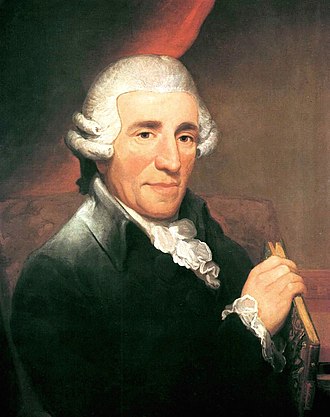
The idea of the string quartet was shaped by an Austrian composer named Joseph Haydn. He helped make this group of four musicians work together as equal partners. Because of this, playing a string quartet has always been seen as a special and challenging task for composers. Famous composers like Mozart, Beethoven, and Schubert also wrote beautiful string quartets.
A typical string quartet has four parts or movements. The first part is usually fast and exciting, followed by a slower, more peaceful piece. Then there is often a minuet and trio, and the last part is lively and energetic.
Some string quartet groups play together for many years and become well-known, almost like a solo performer or an orchestra. The string quartet remains a valued and elegant form of music today.
History and development
Early history
The string quartet started developing in the mid-1700s, mostly thanks to the Austrian composer Joseph Haydn. Before Haydn, some composers like Georg Christoph Wagenseil and Ignaz Holzbauer wrote pieces for two violins, a viola, and a cello. Usually, four musicians would each play one part of an orchestral piece. However, these early works didn't explore the string quartet much.
The idea of a string quartet goes back to the Baroque trio sonata, where two solo instruments played with a bass instrument and keyboard. An early example is a piece by the Italian composer Gregorio Allegri. Later, composers like Alessandro Scarlatti wrote works for two violins, a viola, and a cello without the keyboard, which helped shape the string quartet as we know it today.
Haydn's impact
Music experts sometimes say that Franz Xaver Richter started the "classical" string quartet around 1757, but most believe Joseph Haydn created it in its current form. Haydn began writing string quartets when he was young. He was invited to play music at a nearby castle by a nobleman who asked for new pieces for a small group of musicians. This led to Haydn's first quartets.
Haydn wrote many quartets over the years. His early works had five movements, but later ones developed into a four-movement form that became standard. His quartets from the early 1770s, especially Op. 20, showed new ways of writing for string quartets, with each instrument having an important role and working together in new ways. These pieces were very influential and set a new standard for composers.
After Haydn
After Haydn, many famous composers wrote string quartets. Mozart, Beethoven, and Schubert all created important quartets. Beethoven, in particular, pushed the limits of the form in his later works. His quartets inspired many other composers.
In the 20th century
In the 20th century, string quartets continued to evolve. Composers like Schoenberg, Bartók, and Shostakovich wrote important works for the genre. After World War II, some composers questioned if the string quartet was still relevant, but interest grew again from the 1960s onward.
Composers such as Peter Maxwell Davies wrote many quartets, and others like Margaret Jones Wiles, David Matthews, and Robin Holloway also contributed significantly to the genre. Some modern quartets became very long or experimental, showing the lasting importance of the string quartet in music.
String quartets of the classical period
During the classical period, string quartets usually had four parts, much like a symphony. The order of some parts could change. For example, in Mozart's six quartets dedicated to Haydn, some had a dance-like piece before a slow, calm part, while others did the opposite.
Later, composers like Beethoven changed this pattern. In the 1930s, Bartók wrote quartets with five parts balanced around the middle one. And in the 1970s, Shostakovich’s last quartet had six slow parts.
Variations of string quartet
A string quartet can also have changes, such as adding more instruments or using different ones. For example, a string quintet is like a string quartet but with one more string instrument. Famous composers like Mozart and Schubert wrote beautiful music for these groups.
Other types include the string trio, which has one violin, a viola, and a cello, and the piano trio, which adds a piano to the mix. Some quartets even include instruments like a clarinet or use electric instruments to create new sounds.
Notable string quartets
See also: List of string quartet composers
Many famous composers have written beautiful pieces for string quartets. Some well-known works include:
- Joseph Haydn wrote 68 string quartets, with special ones like Op. 20, Op. 33, and Op. 76.
- Wolfgang Amadeus Mozart created 23 string quartets, including a special set of six dedicated to Haydn.
- Ludwig van Beethoven wrote 16 string quartets, with famous ones like the five "middle" quartets and the five late quartets.
- Franz Schubert is known for quartets such as No. 12 in C minor and No. 14 in D minor, called "Death and the Maiden".
- Johannes Brahms wrote three string quartets, including Op. 51 No. 1 and Op. 51 No. 2.
Many other composers like Felix Mendelssohn, Robert Schumann, Pyotr Ilyich Tchaikovsky, and Antonín Dvořák also created wonderful string quartet music. These pieces are still enjoyed by musicians and listeners today.
String quartets (ensembles)
Main article: List of string quartet ensembles
String quartets are groups of four musicians who play together. Sometimes, individual players come together just for one performance, but many quartets stay together for many years. These long-lasting groups might be named after the main violinist, like the Takács Quartet, after a famous composer such as the Borodin Quartet, or after a place like the Budapest Quartet. Even when members change, the quartet's original name can stay the same.
Related articles


This article is a child-friendly adaptation of the Wikipedia article on String quartet, available under CC BY-SA 4.0.
Images from Wikimedia Commons. Tap any image to view credits and license.