 Safekipedia
Tizen
Adapted from Wikipedia · Discoverer experience
Tizen is a Linux-based operating system mainly created by Samsung Electronics and supported by the Linux Foundation. It was first designed as an HTML5-based platform for mobile devices to continue the work done on MeeGo. Many companies supported it through the Tizen Association.
Samsung combined its earlier Linux-based operating system, Bada, into Tizen. Today, Samsung mostly uses Tizen for devices like smart TVs and wearable devices, though this changed in 2021.
Most of Tizen is open-source software, but some parts of its software development kit are special to Samsung. Some parts also use the Flora License, which is based on the Apache License 2.0.
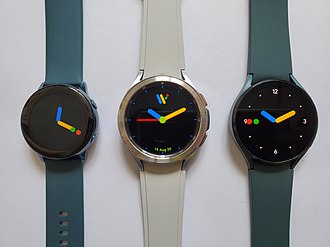
In May 2021, Google announced that Samsung would work with them to bring Tizen features into Google's Android-based Wear OS. After this, Tizen was mostly used for Samsung Smart TVs.
History
The Tizen project started as a mobile version of Linux and was launched by Intel in July 2007. In 2009, Intel handed over the project to the Linux Foundation. Later, it was combined with Nokia’s Maemo to create MeeGo.
In 2011, the Linux Foundation started the Tizen project to continue MeeGo. Big companies like Samsung Electronics, Panasonic Mobile, and Vodafone joined to support it. Tizen was made to work with web apps and aimed at devices like netbooks, smartphones, tablets, smart TVs, and in-car entertainment systems.
In 2013, Samsung planned to make Tizen phones and merged its Bada system into Tizen. The first Tizen tablet came out in Japan in 2013. In 2014, Samsung’s Gear 2 smartwatch used Tizen instead of Android. By 2018, Tizen became the most popular system for smart TVs. In 2021, Samsung agreed to work with Google to connect Tizen with Google’s Wear OS for wearables, but kept using Tizen for smart TVs. The Tizen app store closed in 2021, and Samsung moved its watches to Wear OS 3. As of August 2025, Samsung Smart TVs still use Tizen and get updates from Samsung.
Releases
Tizen is an operating system made by Samsung and supported by the Linux Foundation. It started as a platform for mobile devices.
Here are the major releases of Tizen:
Compatible devices
Smartwatches
- Samsung Galaxy Gear
- Samsung Gear S
- Samsung Gear S2
- Samsung Gear S3
- Samsung Gear 2
- Samsung Gear Fit 2
- Samsung Gear Fit 2 Pro
- Samsung Gear Sport
- Samsung Galaxy Watch
- Samsung Galaxy Watch Active
- Samsung Galaxy Watch Active 2
- Samsung Galaxy Watch 3
Camera
Smartphone
"Samsung Z" redirects here. For the line of foldable smartphones, see Samsung Galaxy Z series.
Samsung Z was a series of low-cost smartphones for growing markets. The first smartphone in the line was launched in 2015 and the last one in 2017.
Television
- Samsung Smart TVs since 2015
- Loewe Smart TVs since 2024
- Bauhn Smart TVs since 2022
- Akai Smart TVs since 2022
- Linsar Smart TVs since 2022
Appliances
- Family Hub 1.0 Refrigerator
- Family Hub 2.0 Refrigerator
- Family Hub 3.0 Refrigerator
- Family Hub 4.0 Refrigerator
- Family Hub 5.0 Refrigerator
- Family Hub 6.0 Refrigerator
- Family Hub 7.0 Refrigerator
- Family Hub 8.0 Refrigerator
LED Wall controllers
- SBB-SNOWJ3U
Controversies
In April 2017, a security expert named Amihai Neiderman found many hidden problems in Tizen’s code. These problems could let hackers take control of Samsung products like Smart TVs and mobile phones. After this was shared online, Samsung contacted him to help fix these issues.
TizenRT
In December 2016, Samsung created TizenRT. This was a special version of a computer system called NuttX. It was made for smart home devices and other internet-connected tools.
Images
Related articles



This article is a child-friendly adaptation of the Wikipedia article on Tizen, available under CC BY-SA 4.0.
Images from Wikimedia Commons. Tap any image to view credits and license.