 Safekipedia
Trade
Adapted from Wikipedia · Discoverer experience
Trade involves the transfer of goods and services from one person or group to another, often in exchange for money. Economists call the system or network that allows trade a market.
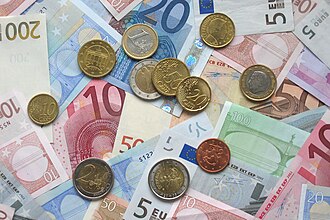
Traders usually negotiate using money or other forms of credit. While some economists see barter — trading things without money — as an early form of trade, money was invented long before written history. Different types of money, like letters of credit, paper money, and non-physical money, have made trade easier by separating buying from selling.
Trade exists because people and groups often specialize in producing one thing well and then trade for other things they need. Different regions may have a comparative advantage in making certain goods, such as natural resources or products made in large amounts. Trading at market price between these places can help everyone involved. Over time, trade has grown, especially since the 1950s, and today we have more open trade than ever before.
Etymology
The word "trade" comes from old languages. It started in Middle English as "trade," meaning a path or way of doing things. Hanseatic merchants brought it into English. It comes from Middle Low German "trade," meaning a track or course. This traces back to Old Saxon "trada," meaning a spoory track, and even further to Proto-Germanic "*tradō," meaning track or way. It is related to the Old English word "tredan," meaning to tread.
The word "commerce" comes from Latin "commercium," formed from "cum," meaning together, and "merx," meaning merchandise.
History
See also: Economic history of the world and Timeline of international trade
Prehistory
Trade began with early humans exchanging goods and services long before money existed. They shared things like tools and food through a system called a gift economy. Researchers have found evidence of trade networks from as far back as 15,000 years ago, when people traded materials like obsidian, a type of glass-like rock.
In places around the Mediterranean Sea, early humans traded goods using rivers like the Danube. During the Stone Age, people traded materials such as obsidian and flint, which were useful for making sharp tools. One famous example is from New Guinea, where trade in obsidian happened around 17,000 BCE.
Ancient history
Mediterranean and Near East
Writing was closely linked to trade. Early writing systems, like clay tokens used for keeping track of goods, date back to around 10,000 BCE in Syria. Ebla was a major trading center around 3000 BCE, connecting places like Anatolia and Mesopotamia.
Long-distance trade routes began in the third millennium BCE. The Sumerians in Mesopotamia traded with the Harappan civilization in the Indus Valley. The Phoenicians were skilled sea traders who traveled across the Mediterranean, even reaching Britain to get tin for making bronze.
Indo-Pacific
The first big sea trade network was created by people from Island Southeast Asia. This network, called the Maritime Jade Road, connected many areas in Southeast and East Asia. It operated for over 3,000 years, starting around 2000 BCE. People traded jade, spices, and boats, reaching as far as East Africa.
Mesoamerica
Trade networks also existed in ancient Mexico and nearby areas. These networks reached north into places called Oasisamerica and had connections with cultures in South America and the Caribbean.
Middle Ages
During the Middle Ages, trade grew in Europe with markets and fairs where people bought and sold luxury goods. Wealth was often moved around using banking systems. Big ports like Bristol in England traded with places as far as Iceland and Spain.
Central Asia was a key part of world trade during this time, especially along the Silk Road. The Sogdians were important traders who helped move goods between East and West.
From the 11th to the 15th centuries, cities like Venice and Genoa became powerful trade centers in the Mediterranean. They controlled trade between Europe and the Near East for many years.
The Age of Sail and the Industrial Revolution
Portuguese explorer Vasco da Gama opened new sea routes for spice trade in 1498 by sailing around Africa. Before this, spices from India were controlled by other powers. The spice trade was very important and helped start the Age of Discovery.
West African kingdoms became important in global trade from the 1070s, trading gold, spices, and other goods. Later, European traders also exchanged goods like cloth and iron for these items.
19th century
In the 1800s, ideas about free trade grew. Economists like David Ricardo showed that free trade could help all countries, even those that were less industrial. Countries began to open their borders to trade, though some still protected new industries to help them grow.
20th century
The Great Depression in the 1930s caused a big drop in trade. After World War II, countries worked together to create rules for fair trade. Agreements like the Bretton Woods Agreement and the General Agreement on Tariffs and Trade (GATT) were made to help prevent economic problems and promote free trade.
21st century
Today, trade is part of a larger system where companies try to make profits by selling products and services at lower costs. International trade has helped the world economy grow, but it has also sometimes made it harder for some local markets to compete.
Free trade
Free trade means that governments do not put extra taxes or restrictions on imports or exports. This idea became stronger in the late 20th century and early 2000s with agreements like the North American Free Trade Agreement (NAFTA) in 1994 and the creation of the World Trade Organization (WTO) in 1995. These agreements aimed to make it easier for countries to trade with each other fairly.
Perspectives
Protectionism
Main article: Protectionism
Protectionism is when a country limits trade with other countries. This is different from free trade, where countries buy and sell freely. Protectionism often uses taxes on imports, called tariffs, and limits on how much can be bought, called quotas. This happened a lot in the 1930s, especially during the Great Depression and before World War II.
Religion
Islamic teachings support trading. Judeao-Christian teachings allow trade but do not allow cheating or using unfair measures.
Development of money
Main article: History of money
The first forms of money were things that had value on their own, like pigs, rare seashells, or cattle. In medieval Iraq, people even used bread as money. In the Aztec Empire, under Montezuma, cocoa beans were used as money.
Later, special pieces of metal called currency were made to make trading easier. These pieces of metal represented stored value and symbols for different goods. This helped people trade for over 1500 years in the Fertile Crescent.
Numismatists have examples of early coins from big societies, which were usually just lumps of precious metal.
Trends
Doha rounds
Main article: Doha round
The Doha round of talks aimed to make it easier for goods to move between countries, especially helping developing countries grow fairly. Rich countries and developing ones disagreed mostly about agricultural subsidies. They did agree on making trade easier.
China
Main articles: China shock, Reform and opening up, and China and the World Trade Organization
Around 1978, the government of the People's Republic of China began changing its economy. They let farmers and businesses work more freely, which helped the country grow. By 2008, China's economy was much bigger than before, and its trade with other countries grew very fast. China joined groups like the Asia-Pacific Economic Cooperation in 1991 and the World Trade Organization in 2001.
International trade
Main articles: International trade and Balance of trade
International trade is the sharing of goods and services between different countries. It is a big part of how many countries grow and stay strong. International trade has been around for a long time, like during the time of the Silk Road and the Amber Road. But it has become even more important in recent years because of new ways to make things, better ways to travel and send things, and more countries working together.
Countries that allow more trade, like South Korea, often do better than countries that keep to themselves, like India. This is because they can share and get things more easily.
Trade sanctions
Sometimes, countries put special rules on others to show they are unhappy. These are called trade sanctions. A very strict rule is called an embargo, where one country stops all trade with another. For example, the United States has had an embargo against Cuba for many years. Embargoes are often temporary. For instance, Armenia stopped buying goods from Turkey for a short time because of worries about food and because of problems between the two countries.
Fair trade
The fair trade movement wants to make sure that people and the environment are treated well when making goods, especially those sold from poorer countries to richer ones. Companies and governments can follow fair trade rules to make this happen. These rules can be simple, like not allowing goods made by forcing people to work, or more complex, like making sure farmers get a good price for their coffee. Groups that are not part of the government also help watch and make sure these rules are followed.
Images
Related articles


This article is a child-friendly adaptation of the Wikipedia article on Trade, available under CC BY-SA 4.0.
Images from Wikimedia Commons. Tap any image to view credits and license.