 Safekipedia
Trafalgar Square
Adapted from Wikipedia · Discoverer experience
Trafalgar Square is a famous public square in the City of Westminster in Central London. It was created in the early 1800s near a place called Charing Cross. The square is named to remember the Battle of Trafalgar, a big sea fight where the British won against France and Spain in 1805.
For many years, the area around Trafalgar Square has been important. People have measured distances from London from Charing Cross since the 1200s. The square has many notable buildings around it, such as the National Gallery, St Martin-in-the-Fields, Canada House, and South Africa House. In the middle of the square stands Nelson's Column, a tall monument honoring Vice-Admiral Horatio Nelson for his victory in the Battle of Trafalgar.
Trafalgar Square is also a place where people gather for events and protests. It has hosted many important demonstrations over the years. Every year, a Christmas tree from Norway is placed there, and it is a spot for New Year's Eve celebrations. The square was once famous for its many pigeons, but they were removed in the early 2000s.
Name
The square is named after the Battle of Trafalgar, a big British naval win during the Napoleonic Wars against France and Spain. This battle happened on October 21, 1805, near Cape Trafalgar in southwest Spain. The square didn’t get its name until 1835.
The word “Trafalgar” comes from Spanish and has Arabic origin. It might mean “cape of the cave” or “extremity of the west.”
Geography
Trafalgar Square is a famous public space in London, owned by the King and looked after by the Greater London Authority. The roads around it are managed by Westminster City Council. In the middle of the square stands Nelson's Column, topped with a statue of Horatio Nelson, the hero of the Battle of Trafalgar. Around the column are beautiful fountains and four large bronze lions.
The square is surrounded by important buildings, including the National Gallery, St Martin-in-the-Fields Church, South Africa House, and Canada House. Nearby, you’ll find the Mall leading to Buckingham Palace, and the busy Charing Cross Road. The square is also a central point for measuring distances from London and has a London Underground station nearby. Many bus routes pass through the area, making it easy to explore.
History
When building on the south side of the square in the late 1950s, workers found old deposits with fossils from a time called the Last Interglacial, around 130-115,000 years ago. These fossils included animals like cave lions, rhinoceroses, straight-tusked elephants, hippopotamuses, and even the droppings of cave hyenas.
The area has been important since the 13th century. It once held the King's Mews, a place where kings kept birds called hawks. After a fire in 1534, the mews became stables and stayed there until they were moved to Buckingham Palace.
In 1826, plans were made to clear a large area to create Trafalgar Square, named after the Battle of Trafalgar, a big naval battle in 1805. Building slowly, the National Gallery was added to the north side between 1832 and 1838.
In 1841, plans added two fountains to the square. The square opened to the public on May 1, 1844.
Nelson's Column
Main article: Nelson's Column
Nelson's Column was built to honor the victory at Trafalgar. It is a tall column with a statue of Nelson on top and four big lion statues around the base. Building began in 1840 and finished in 1843, though the lions were not added until 1867.
The square became a protected historic site in 1996.
Redevelopment
A big project to improve the square was finished in 2003. Changes included closing one road, adding steps, and building new places for people to sit and rest.
Statues and monuments
Main article: List of public art in Trafalgar Square and the vicinity
Trafalgar Square has many statues and monuments. Two empty spaces were planned for sculptures on the north side of the square. In 1843, a bronze statue of King George IV on a horse was placed there, made by two artists. Later, two more statues were added: one of General Sir Charles James Napier in 1855, and another of Major-General Sir Henry Havelock in 1861. In 2000, London’s mayor thought these statues could be replaced with ones that more people would recognize.
The empty space in the north-west corner, called the “fourth plinth”, is now used for temporary art pieces. This idea started with the Royal Society of Arts and continues with the mayor’s commission.
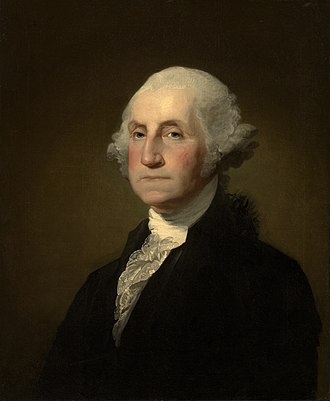
There are also three busts of important admirals along the north wall of the square. These remember John Jellicoe, David Beatty, and Andrew Cunningham. On the south side, there is a bronze statue of King Charles I from 1633. In front of the National Gallery, two more statues stand: one of King James II and another of George Washington, who was given to the square by the U.S. state of Virginia in 1921.
Main article: Fourth plinth
Fountains
In 1841, two fountains were added to Trafalgar Square to help cool the area and make it less likely for large crowds to gather. The water for the fountains came from two wells connected by a tunnel. A steam engine was used to pump the water.
In the late-1930s, the fountains were updated with new designs by Sir Edwin Lutyens. These new designs honored Lord Jellicoe and Lord Beatty. The old designs were given to Canada and are now in Confederation Park in Ottawa and the Wascana Centre in Regina, Saskatchewan.
By May 2009, the fountains got new equipment, including a stronger pump and colorful lights, just in time for the 2012 Summer Olympics.
Events
Street performance
Trafalgar Square is a favorite spot in London for street performers. Its size, many visitors, and great sound make it perfect for shows. In 2012, new rules were set for performers in the square.
Famous leaders of London have supported busking there. In 2015, one leader started Busking Day, with Trafalgar Square as the main event. The next year, another leader kept this tradition with a festival lasting nine days, featuring performers from all over the world.
In 2016, a museum director asked to remove the buskers, saying it was noisy. From 2021, performers needed a license and could only play in certain spots. By March 2025, another square was closed for busking, leaving Trafalgar Square as the only place. But it was closed that year for a holiday market, leaving no spots for loud performances in the busy part of London during Christmas time.
New Year
For many years, people have gathered in the square to welcome the New Year, even without special events. This was partly because leaders worried about too many people coming. Since 2003, fireworks have been shown on the London Eye and South Bank of the River Thames instead. Since 2014, ticketing has been used to control crowds. The fireworks were stopped during the COVID-19 pandemic. An event planned for 2022 was also stopped because of a health concern.
Christmas
Every year since 1947, a Christmas ceremony has been held in the square. Norway’s capital, Oslo, gives London a Christmas tree as a thank-you for help during the Second World War.
The tree is lit up at a ceremony twelve days before Christmas Day. People are welcome to come, and there are carol singing and other events. On the twelfth night of Christmas, the tree is taken down for recycling. In 1980, leaders thought about stopping the tree to save money, but they changed their minds.
Political demonstrations
Trafalgar Square has been an important place for people to gather and show their views. It started in 1848 with a big meeting for workers’ rights. For many years, people could not hold protests there, but this changed in the 1880s.
Many important events happened there, like protests against war and for peace. In 1958, a march against nuclear weapons began in the square. In 1968, thousands protested against the Vietnam War. In the 1980s, people protested against apartheit in South Africa. More recently, there have been protests against wars in Afghanistan and Iraq, and vigils after terrorist attacks.
In 2009, people gathered to talk about climate change. In 2011, protests about government budget cuts turned unsafe. In 2015, a vigil was held after attacks in Paris. In 2019, students protested about climate change. In 2020, some people protested against rules during the coronavirus outbreak.
Sport
In the 2000s, Trafalgar Square has been used for sports events and celebrations. In 2002, thousands watched a football match on screens. In 2003 and 2005, there were celebrations for rugby wins. In 2005, the square was used for a watch party when London tried to host the Olympics. In 2007, it was the start of a famous bike race.
Other uses
Trafalgar Square is a well-known part of London and has been used in movies and TV shows. In 2007, the square was covered in grass to support green spaces in the city. In 2011, the last movie in the Harry Potter series had its first showing there, with fans waiting for days despite rainy weather. This was the first time a movie premiere was held in Trafalgar Square.
Pigeons
See also: Save the Trafalgar Square Pigeons
Trafalgar Square was once well-known for its pigeons, and many people enjoyed feeding them. These birds started coming to the square even before it was fully built, and during the Victorian era, sellers would sell food for them. However, the pigeons caused problems because their droppings damaged the stone structures, and large numbers of them were seen as a health concern.
Over time, rules were put in place to stop people from feeding the pigeons. In 2001, selling bird seed in the square was banned, and other methods were used to keep the pigeons away. By 2003, official rules were made to prohibit feeding them, and later, more areas around the square were included in these rules. Repairs were needed for damage caused by the pigeons, costing a lot of money.
Cultural references
Trafalgar Square has appeared in fun and popular places! In 2019, a Lego set showed models of the National Gallery and Nelson's Column, plus tiny lions, fountains, and double-decker buses.
The square is also a spot on the British Monopoly Board, sitting in the red group with the Strand and Fleet Street. In the famous book Nineteen Eighty-Four by George Orwell, the square is called "Victory Square" and has a big statue of Big Brother.
Other Trafalgar Squares
There is a place called Trafalgar Square in Stepney, as mentioned in a book from 1810 called Lockie's Topography of London.
In Scarborough, North Yorkshire, a part of the North Marine Road cricket ground is named after Trafalgar Square.
A square in Chelsea, London used to be called Trafalgar Square before the famous one in Westminster was made.
In Bridgetown, Barbados, there was a square named Trafalgar Square from 1813 until 1999, when it was changed to National Heroes Square to honor the country's heroes.
There is also a large copy of Trafalgar Square in Bahria Town, Lahore, Pakistan, which many people visit.
Images
Related articles


This article is a child-friendly adaptation of the Wikipedia article on Trafalgar Square, available under CC BY-SA 4.0.
Images from Wikimedia Commons. Tap any image to view credits and license.