 Safekipedia
Trans-Neptunian object
Adapted from Wikipedia · Discoverer experience
A trans-Neptunian object (TNO), also written transneptunian object, is any minor planet in the Solar System that orbits the Sun at a greater average distance than Neptune, which has an orbital semi-major axis of 30.1 astronomical units (AU). These objects are found far beyond the eighth planet, Neptune, and belong to areas like the Kuiper belt, the scattered disc, and even more distant regions.
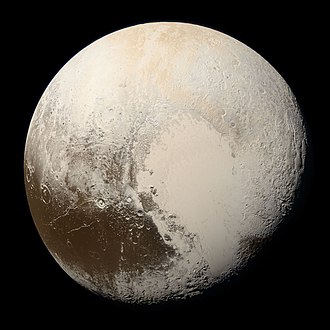
The first trans-Neptunian object to be discovered was Pluto in 1930. It took until 1992 to find a second one, 15760 Albion. Since then, scientists have identified many more of these distant worlds. As of February 2025, there are 1006 numbered and more than 4000 unnumbered TNOs, with nearly 5900 objects known that orbit beyond Neptune.
TNOs vary in color and composition. They are thought to be made of rock, amorphous carbon, and ices like water and methane. Some have moons, or satellites, orbiting them — more than 80 satellites have been found around these distant objects. Scientists study TNOs to learn more about the early solar system and what materials were present when planets formed.
History
Discovery of Pluto
The paths of the planets change a little because of how they pull on each other. In the early 1900s, scientists noticed that Uranus and Neptune were not moving exactly as expected. This made them think there might be more planets even farther out from the Sun. This search led to the discovery of Pluto in February 1930. But Pluto turned out to be too small to explain the differences in the planets' paths. Later, better measurements from the Voyager 2 spacecraft showed that the early ideas about Neptune's size were wrong, and there really was no mystery to solve. Pluto was easier to spot because it is the brightest of all known objects that orbit the Sun beyond Neptune. It also moves in a path closer to the main plane of our solar system, making it easier to find.
Subsequent discoveries
After Pluto was found, the astronomer Clyde Tombaugh kept looking for more objects like it but did not find any for years. For a long time, most people thought Pluto was the only big object beyond Neptune. It wasn't until 1992, when a second object named 15760 Albion was found, that scientists started searching more carefully. They took pictures of a wide area of sky and looked for things that moved slowly. This led to the discovery of hundreds of these far-away objects, ranging in size from about 50 to 2,500 kilometers across. The biggest one found so far is Eris, discovered in 2005. This brought back debates about how to classify these large objects and whether they should be called planets. In 2006, both Pluto and Eris were named dwarf planets by the International Astronomical Union.
Classification
Trans-Neptunian objects (TNOs) are grouped based on their distance from the Sun and how they move around it. There are two main groups: the Kuiper belt objects (KBOs) and the scattered disc objects (SDOs).
The Kuiper belt objects are closer to the Sun, usually between 30 and 55 times the distance from the Earth to the Sun. Some of these are locked in special patterns with Neptune, called resonances. Others move in steady paths without these patterns. The scattered disc objects are farther out and have more stretched and tilted paths around the Sun. Some of these very distant objects are called sednoids, with paths so far out that even the Sun’s neighbors might have influenced them.
Physical characteristics
Studying these distant objects is tricky because they are very faint. Scientists look at their heat and light to learn more. By comparing how bright they look and how their colors change, researchers can guess what these objects are made of. Some are thought to be mixtures of rock and ice, while others might be similar to comets.
Colors and spectra help scientists understand where these objects came from and how they are different from other objects in space. Recent studies using powerful telescopes have shown that many of these objects have carbon dioxide on their surfaces, which was a big surprise. The way these objects reflect light helps scientists group them into different types, each with its own unique surface materials.
Notable objects
For a more comprehensive list, see List of trans-Neptunian objects and List of unnumbered trans-Neptunian objects.
| Object | Description |
|---|---|
| 134340 Pluto | A dwarf planet, the first and largest trans-Neptunian object (TNO) discovered. It was the first TNO found to have an atmosphere. Hosts a system of five satellites and is the prototype plutino. |
| 15760 Albion | The prototype classical Kuiper belt object (KBO), and the first TNO discovered after Pluto. |
| (385185) 1993 RO | The next plutino discovered after Pluto. |
| (15874) 1996 TL66 | The first object identified as a scattered disc object. |
| 1998 WW31 | The first binary KBO discovered after Pluto. |
| 47171 Lempo | A plutino and triple system consisting of a central binary pair of similar size, and a third outer circumbinary satellite. |
| 20000 Varuna | A large classical KBO, known for its rapid rotation (6.3 h) and elongated shape. |
| 28978 Ixion | A large plutino, was considered to be among the largest KBOs upon discovery. |
| 2001 QW322 | The widest known binary system in the Kuiper belt. |
| 50000 Quaoar | A dwarf planet and a large classical KBO. It has an elongated shape, albeit less elongated than Haumea. It has one known moon, Weywot, and two known rings that are both outside Quaoar's Roche limit. |
| (612533) 2002 XV93 | A medium-sized plutino that was found to have an extremely thin atmosphere based on occultation results, making it the second object in the Kuiper Belt confirmed to have an atmosphere. |
| 90377 Sedna | A distant dwarf planet, proposed for a new category named extended scattered disc (E-SDO), detached objects, distant detached objects (DDO) or scattered-extended in the formal classification by DES. |
| 90482 Orcus | A dwarf planet and the second-largest known plutino, after Pluto. Has a relatively large satellite, Vanth. |
| 136108 Haumea | A dwarf planet, the third-largest-known TNO. Notable for its two known satellites, rings, and unusually short rotation period (3.9 h). It is the most massive known member of the Haumea collisional family. |
| 136472 Makemake | A dwarf planet, a classical KBO, and the fourth-largest known TNO. |
| 136199 Eris | A dwarf planet, a scattered disc object, and currently the most massive known TNO. It has one known satellite, Dysnomia. |
| (612911) 2004 XR190 | A detached object whose orbit is highly inclined and lies outside the classical Kuiper belt. |
| 225088 Gonggong | A dwarf planet and the second-largest discovered scattered-disc object. Has one known satellite, Xiangliu. |
| (528219) 2008 KV42 | The first retrograde TNO, having an unusually high orbital inclination of 104°. |
| 471325 Taowu | Another retrograde TNO with an unusually high orbital inclination of 110°. |
| 2012 VP113 | A sednoid with a large perihelion of 80 AU from the Sun (50 AU beyond Neptune). |
| 486958 Arrokoth | A contact binary classical KBO encountered by the New Horizons spacecraft in 2019. |
| 2018 VG18 | A scattered disc object, and the first TNO discovered while beyond 100 AU (15 billion km) from the Sun. |
| 2018 AG37 | The most distant observable TNO at 132 AU (19.7 billion km) from the Sun. |
Exploration
The only mission so far to focus on a trans-Neptunian object was NASA's New Horizons. It launched in January 2006 and visited the Pluto system in July 2015 and 486958 Arrokoth in January 2019.
In 2011, a study looked at sending a spacecraft to Quaoar, Sedna, Makemake, Haumea, and Eris. In 2019, another mission plan included ideas for visiting multiple TNOs.
Some TNOs studied for possible missions were Uni, 1998 WW31, and Lempo.
Scientists have sometimes thought there might be planets beyond Neptune, from small like Earth to much bigger like a brown dwarf. They suggest these could help explain some features of the Kuiper belt and the Oort cloud. Data from New Horizons might help find such a planet.
NASA is planning a special spacecraft for interstellar space, possibly flying by objects like Sedna. These plans suggest a launch in the 2020s, going faster than the Voyagers. A 2018 study included a visit to minor planet 50000 Quaoar in the 2030s.
Extreme trans-Neptunian objects
Main article: Extreme trans-Neptunian object
Extreme trans-Neptunian objects include special objects called sednoids. Four of these have been found: 90377 Sedna, 2012 VP113, 541132 Leleākūhonua, and 2023 KQ14. These objects stay very far from the Sun, even at their closest point, which is more than 70 times the distance from the Earth to the Sun. This keeps them safe from the strong pull of the planet Neptune. Scientists have thought about why these objects stay so far away, and one idea is that they might have been pushed by a planet we haven’t discovered yet, or perhaps by a star that passed close to our Solar System long ago.
Images
Related articles



This article is a child-friendly adaptation of the Wikipedia article on Trans-Neptunian object, available under CC BY-SA 4.0.
Images from Wikimedia Commons. Tap any image to view credits and license.