 Safekipedia
Glacier
Adapted from Wikipedia · Explorer experience
Glaciers
A glacier is a big, slow-moving river of ice. It forms where lots of snow falls and stays on the ground for many years. The snow piles up, gets squished, and turns into ice. Over time, the ice moves downhill because of gravity.
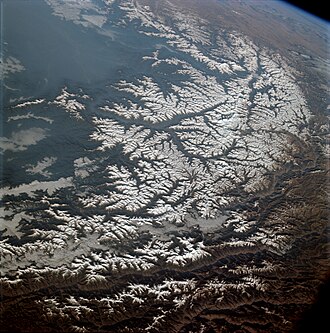
Most of Earth’s big glaciers are in cold places near the polar regions, like Antarctica and Greenland. But smaller glaciers also live high up in mountain ranges all around the world, from the Alps to the Himalayas.
Glacial ice often looks blue. This happens because the ice is very thick and pushes out tiny air bubbles, making it look blue from far away.
The word glacier comes from an old Latin word meaning “ice.” Scientists who study glaciers are called glaciologists, and all the ice on Earth is part of the cryosphere.
Glaciers change the shape of the land. As they move, they can pick up rocks and grind them into fine powder. This makes the land smooth and leaves behind interesting shapes and patterns.
Glaciers are important because they store a lot of the world’s fresh water. They also help scientists learn about Earth’s past climate by looking at tiny air bubbles trapped inside the ice.
Glaciers need cold temperatures and lots of snow to form. Because the world is getting warmer, many glaciers are melting and shrinking. This is why scientists and many people care about protecting these icy giants.
Images
Related articles




This article is a child-friendly adaptation of the Wikipedia article on Glacier, available under CC BY-SA 4.0.
Images from Wikimedia Commons. Tap any image to view credits and license.