 Safekipedia
Hawking radiation
Adapted from Wikipedia · Explorer experience
What Is Hawking Radiation?
Hawking radiation is a special kind of energy that comes from just outside a black hole. This idea was created by the famous scientist Stephen Hawking in 1974. Before this, scientists thought that once energy or light got too close to a black hole, it could never escape.
Hawking radiation happens because of tiny, invisible forces called quantum effects. This radiation is very faint and too weak for our best telescopes to see right now.
If Hawking radiation is real, it would slowly take away mass and energy from black holes. Over a very long time, this could make black holes shrink and eventually disappear. Very small black holes would disappear faster than big ones.
Black Holes and Their Mystery
Modern black holes were first predicted by Einstein’s theory of general relativity. We now have strong evidence for these amazing objects because of their very strong pull of gravity.
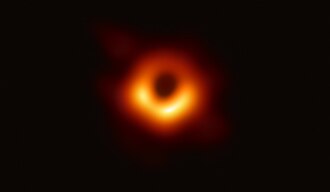
A black hole can form when enough matter or energy is squeezed into a tiny space. This makes the speed needed to escape faster than light. Since nothing can go that fast, nothing inside a certain distance from the black hole can get out. This distance marks the event horizon, the edge around the black hole where even light cannot escape.
Images
Related articles


This article is a child-friendly adaptation of the Wikipedia article on Hawking radiation, available under CC BY-SA 4.0.
Images from Wikimedia Commons. Tap any image to view credits and license.