 Safekipedia
Plasma (physics)
Adapted from Wikipedia · Explorer experience
Plasma is one of the four main types of matter, along with solids, liquids, and gases. It forms when a gas gets very hot or is zapped with electricity. This makes the gas break apart into tiny particles that have electric charges.
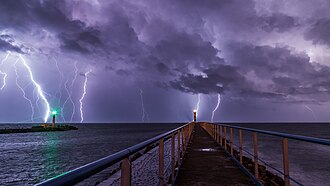
You might see plasma in everyday life without knowing it. Lightning in the sky and the glowing lights inside neon signs are both examples of plasma. Even the bright light from the Sun is made of plasma. In fact, most of the ordinary matter in the universe exists as plasma, even though we don’t see it often here on Earth.
Because plasma contains charged particles, it can conduct electricity and respond to magnetic fields. This special property is used in many useful technologies, such as screens in some old televisions. Scientists also use plasma in laboratories for cutting and shaping materials.
Plasma was first named in 1928 by a scientist named Irving Langmuir. He thought it reminded him of blood plasma, something inside our bodies that helps carry cells. The word plasma comes from an old Greek word about shaping or forming things.
Plasma is very important in space. Stars, like our Sun, are huge balls of plasma. The space between planets is filled with plasma from the Sun’s solar wind. Even the area around black holes and stars contains plasma. Scientists study plasma to learn more about the universe and to create new technologies here on Earth.
Images
Related articles



This article is a child-friendly adaptation of the Wikipedia article on Plasma (physics), available under CC BY-SA 4.0.
Images from Wikimedia Commons. Tap any image to view credits and license.