 Safekipedia
Amsterdam
Adapted from Wikipedia · Adventurer experience
Amsterdam
Amsterdam is the capital and largest city of the Netherlands. It is called the "Venice of the North" because of its many canals. These canals are very famous and are a place important to the world.
Long ago, in the 12th century, Amsterdam started as a small fishing village. It grew big during the Dutch Golden Age in the 17th century. At that time, it became important for money, trade, and art.
Today, people love to visit Amsterdam for places like the Rijksmuseum, the Van Gogh Museum, Dam Square, and the Anne Frank House.
Cycling is a big part of life in Amsterdam. There are many paths for bikes all around the city. Amsterdam is also a place for music, festivals, and fun places to visit. Even though it is the capital, the main government offices are in The Hague. Amsterdam is home to people from many different countries.
History
Main article: History of Amsterdam
For a chronological guide, see Timeline of Amsterdam.
Prehistory
Amsterdam was founded later than other cities because of its wet, peaty land. But people lived in the area as early as 3,000 years ago near the old IJ river and its tributary, the Amstel. These early people lived in a quiet area that later grew into an important settlement. Artefacts from these times have been found under modern Amsterdam streets.
Founding
Amsterdam began with a dam built on the Amstel River around the late 10th century. This area, called Amestelle, meaning "watery area," was where farmers started reclaiming land. A big flood in 1170 changed the river, making the area drier and more attractive for permanent settlement. The dam, called Dam, was built between 1264 and 1275, and the village first appeared in documents in 1275.
Middle Ages
Amsterdam was granted city rights in the early 1300s and became an important place for pilgrimage after a miracle in 1345. The city grew rich from trade, especially with the Hanseatic League, and later developed its own trade routes. Innovations in fishing brought great wealth and helped Amsterdam become a major trading center.
Conflict with Spain
In the 1500s, the Netherlands was part of the Spanish Empire. Many Dutch people rebelled against Spanish rule because of new taxes and religious persecution. This led to a long war for independence, and Amsterdam became a safe haven for many refugees.
Centre of the Dutch Golden Age
The 1600s were Amsterdam's Golden Age. The city became very wealthy and important for trade around the world. Amsterdam had the largest share in Dutch trading companies and became the leading financial center. The city built a stock exchange and a bank in this time.
Decline and modernization
Amsterdam's wealth decreased in the 1700s and early 1800s due to wars with England and France. However, the city began to grow again in the late 1800s with new museums, a railway station, and major building projects like canals connecting Amsterdam to the Rhine and the North Sea.
20th century – present
In the early 1900s, Amsterdam expanded with new suburbs. During World War I, the city faced food and fuel shortages. After the war, the city continued to grow.
During World War II, Amsterdam was occupied by Nazi Germany. Many people risked their lives to protect others, and the city suffered greatly. After the war, new suburbs were built, and efforts were made to restore the city centre. Today, Amsterdam is a popular tourist destination, and the city continues to grow and change while preserving its historic areas.
Geography
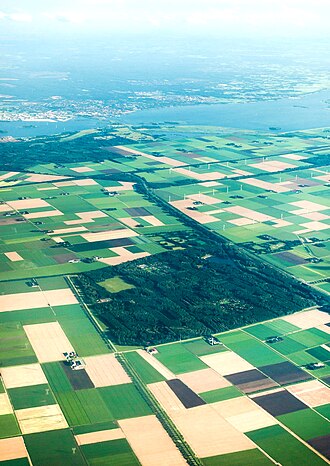
Amsterdam is in the western part of the Netherlands, in the province of North Holland. The river Amstel flows through the city and connects to many canals that lead to the IJ. The city sits about 2 meters below sea level, with flat land around it made from polders. A big man-made forest called the Amsterdamse Bos is in the southwest. Amsterdam links to the North Sea through the North Sea Canal.
The city has many canals, with three main ones: the Prinsengracht, the Herengracht, and the Keizersgracht. In the past, Amsterdam was surrounded by a moat called the Singel, which now shapes the center of the city. Amsterdam is often compared to Venice because it has many islands connected by over 1,200 bridges.
Amsterdam has a mild oceanic climate, affected by the North Sea. Summers are warm but not too hot, and winters are mild with some frost. The city gets a fair amount of rain throughout the year.
Demographics
Historical population
In 1300, Amsterdam had about 1,000 people. Even though many towns lost people during the 1400s and 1500s, Amsterdam grew because of its profitable trade, especially in grain.
By 1600, Amsterdam had around 50,000 people, and by the 1660s, it reached 200,000. The population stayed around 240,000 for most of the 1700s.
In 1750, Amsterdam was the fourth largest city in Western Europe, behind London, Paris, and Naples. Even though it wasn’t the capital or the government seat of the Dutch Republic, it was still very important.
The city’s population dropped in the early 1800s, falling below 200,000 by 1820. But in the late 1800s, industrialization caused growth again. By 1959, Amsterdam had 872,000 people, but then it declined because people moved to nearby areas. The population dropped sharply between 1970 and 1980. By 1985, there were only 675,570 residents. After that, the city started growing again in the 2010s, partly because of people moving in from other countries.
Immigration
In the 1500s and 1600s, many new people came to Amsterdam, including Protestant groups, Jewish people, and others from Germany and Scandinavia. After World War II, Amsterdam saw many people from different countries move in. Today, about half the people in Amsterdam were born outside the Netherlands, and most people have at least one parent born in another country.
Many people came from Indonesia after the Dutch East Indies became independent. In the 1960s, workers from Turkey, Morocco, Italy, and Spain moved to Amsterdam. After Suriname became independent in 1975, many people from there also moved to Amsterdam, especially to an area called Bijlmer. Other immigrants came from many parts of the world.
Religion
Amsterdam has had many different religions over time. In the past, it was mainly Catholic but became Protestant later. Today, people in Amsterdam have many different religions or none at all. In 2015, most people were not affiliated with any religion, but there were also Catholics, Protestants, Muslims, Hindus, Buddhists, and Jews.
The city has had Jewish communities for a long time, and there are still churches and other places of worship for many faiths today.
Cityscape and architecture
See also: List of tallest buildings in Amsterdam
Amsterdam spreads out south from Amsterdam Centraal station and Damrak, the main street leaving the station. The oldest part of the town is called De Wallen, meaning "The Quays". It lies east of Damrak. South of De Wallen is the old Jewish quarter around Waterlooplein.
The medieval and colonial-era canals of Amsterdam, known as grachten, form the heart of the city where homes have unique designs. Beyond the Grachtengordel lie former working-class areas like Jordaan and de Pijp. The Museumplein with major museums, the Vondelpark, a park from the 1800s named after Dutch writer Joost van den Vondel, and the Plantage neighborhood with the zoo are all outside the Grachtengordel.
Many parts of the city and surrounding area are polders. You can recognize them by the suffix -meer, meaning "lake", as in Aalsmeer, Bijlmermeer, Haarlemmermeer and Watergraafsmeer.
Canals
Main article: Canals of Amsterdam
The Amsterdam canal system comes from careful city planning. In the early 1600s, leaders created a plan with four half-circle canals ending at the IJ bay. This is called the Grachtengordel. Three canals were mainly for homes: the Herengracht ("Canal of the Lords"), Keizersgracht ("Emperor's Canal"), and Prinsengracht ("Prince's Canal"). The fourth canal, the Singelgracht, is the outer ring and often not shown on maps.
The canals were used for defense, water management, and travel. They had moats and earthen dikes for protection. Building began in 1613, moving from west to east. Building the southern canals finished in 1656.
Expansion
Main article: Expansion of Amsterdam since the 19th century
After building Amsterdam's canals in the 1600s, the city did not grow for two hundred years. In the 1800s, Samuel Sarphati made a plan inspired by Paris and London to build new homes and streets outside the Grachtengordel.
Later, engineers designed a ring of neighborhoods from the 1800s around the city center. The city kept all land outside the old borders.
At the start of the 1900s, two new plans were made for crowded Amsterdam. These plans created new neighborhoods with homes for all classes.
After World War II, big new areas were built in the west, southeast, and north to give people more space and modern homes. These areas had large apartment blocks around green spaces, connected by wide roads.
Architecture
Amsterdam has a rich building history. The oldest building is the Oude Kerk (Old Church) in the Wallen, built in 1306. In the 1500s, wooden buildings were replaced with brick ones. Many buildings from this time were made in the Renaissance style and have special stepped gables.
The 1600s brought baroque architecture, matching Amsterdam's Golden Age.
In the 1700s, Amsterdam was influenced by French culture, seen in its buildings. Around 1815, architects used different styles. Most Gothic buildings are from this time. At the end of the 1800s, Jugendstil or Art Nouveau became popular. The last popular style before modern times was Art Deco. Amsterdam had its own version called the Amsterdamse School.
Parks and recreational areas
Main articles: List of parks in Amsterdam and List of squares in Amsterdam
Amsterdam has many parks, open spaces, and squares. The Vondelpark, the city's largest park, is in the Oud-Zuid neighborhood. It has an open-air theater, a playground, and several places to eat or drink. In the Zuid area is the Beatrixpark, named after Queen Beatrix. Between Amsterdam and Amstelveen is the Amsterdamse Bos ("Amsterdam Forest"), the city's largest park.
The city has many open squares (plein in Dutch). Dam Square is the main square with the Royal Palace. Museumplein has museums like the Rijksmuseum, Van Gogh Museum, and Stedelijk Museum.
Economy
Amsterdam is the money and business center of the Netherlands. It is one of the best cities in Europe for international businesses. Many big companies and banks have their main offices in Amsterdam, such as AkzoNobel, Heineken International, ING Group, ABN AMRO, TomTom, Delta Lloyd Group, Booking.com and Philips.
The Port of Amsterdam is one of the biggest ports in Europe and the world. It handles lots of cargo and is a popular place for cruise ships.
Amsterdam is a top tourist spot in Europe, welcoming many visitors each year. Most tourists come from Europe, and many also visit from the United States. The city has many hotels, especially in the center, and sometimes has special themes to attract more visitors.
Shops in Amsterdam range from big, fancy stores to small, special shops. Popular shopping areas include P.C. Hooftstraat, Kalverstraat, and the Negen Straatjes. The city also has many open-air markets like the Albert Cuyp Market and Dappermarkt.
Amsterdam is also a place where many fashion designers and models began their careers. The city has a big fashion center and is known for its style and design.
Culture
During the late 1500s, Amsterdam's Chamber of rhetoric held contests for reading poetry and drama. In 1637, Amsterdam's first theatre, Schouwburg, opened on January 3, 1638. The first ballet performances in the Netherlands took place there in 1642. In the 1700s, French theatre became popular. In the 1800s, Amsterdam was influenced by German music, but there were few Dutch opera shows; the Hollandse Opera was built in 1888 to support Dutch opera. Popular culture in the 1800s centered around the Nes area, mainly with vaudeville and music-hall shows. An improved metronome was invented in 1812. The Rijksmuseum (1885) and Stedelijk Museum (1895) were built and opened. In 1888, the Concertgebouworkest orchestra was established. The 20th century brought cinema, radio, and television. Most studios are in Hilversum and Aalsmeer, but Amsterdam still has a strong influence on programming. Many people who work in television live in Amsterdam, and the headquarters of the Dutch SBS Broadcasting Group is there. Amsterdam also has several cultural centers that produce programs about arts, sciences, politics, and history, such as de Balie and the John Adams Institute.
Museums
The most important museums in Amsterdam are located on Museum Square, created in the late 1800s on the grounds of a former World's fair. The square is bordered by the large Rijksmuseum on the northeast side. In front of the Rijksmuseum is a long pond that turns into an ice rink in winter. The northwest side is bordered by the Van Gogh Museum, House of Bols Cocktail & Genever Experience, and Coster Diamonds. The southwest side is Van Baerlestraat, a major street. The Concertgebouw is across this street from the square. To the southeast are several large houses, one with the American consulate. A parking garage and a supermarket are under the square. The square is mostly lawn, with gravel in the northeast part. It was remodeled in 1999 and is a main spot for festivals and outdoor concerts in summer. Plans to remodel it again were made in 2008 because many people in Amsterdam were not happy with how it looked.
The Rijksmuseum has the largest and most important collection of classical Dutch art. It opened in 1885 and has nearly one million objects. Rembrandt, whose work and his students' work are displayed there, is the artist most linked with Amsterdam. The museum also has paintings by artists like Bartholomeus van der Helst, Johannes Vermeer, Frans Hals, Ferdinand Bol, Albert Cuyp, Jacob van Ruisdael, and Paulus Potter. It also has many decorative art pieces, from Delftware to giant dollhouses from the 1700s. The museum building, designed in the gothic revival style, was renovated for ten years and reopened to the public on April 13, 2013. It remains the most visited museum in Amsterdam.
Van Gogh lived in Amsterdam for a short time, and there is a museum dedicated to his work. The museum is in one of the few modern buildings in that area, designed by Gerrit Rietveld. A new building added in 1999, called the performance wing and designed by Japanese architect Kisho Kurokawa, houses temporary exhibitions. Some of Van Gogh's most famous paintings, like The Potato Eaters and Sunflowers, are in the collection. The Van Gogh museum is the second most visited museum in Amsterdam.
Next to the Van Gogh Museum is the Stedelijk Museum, Amsterdam's main museum for modern art. It opened in 1895 and has works by artists like Piet Mondrian, Karel Appel, and Kazimir Malevich. After several years of renovations, it reopened in September 2012 with a new addition called 'The Bathtub' because of its shape.
Amsterdam has many other museums, from small ones like the Verzetsmuseum (Resistance Museum), KattenKabinet ("Cat Cabinet"), Anne Frank House, and Rembrandt House Museum, to larger ones like the Tropenmuseum (Museum of the Tropics), Amsterdam Museum, H'ART Museum, and Joods Historisch Museum (Jewish Historical Museum). The modern-styled Nemo is for child-friendly science exhibits.
Music
Amsterdam has many songs that celebrate the city. The 1949 song "Aan de Amsterdamse grachten" was performed by many artists, with the best-known version by Wim Sonneveld in 1962. In the 1950s, Johnny Jordaan became famous with "Geef mij maar Amsterdam," praising the city above all others. Another well-known song is "Amsterdam" by Jacques Brel from 1964. AFAS Live (formerly Heineken Music Hall) is a concert hall near Johan Cruyff Arena for big pop concerts. Other venues like Paradiso and Melkweg near Leidseplein offer a mix of indie rock, hip-hop, R&B, and more. Jazz is popular in Amsterdam, with Bimhuis as the main venue. Ziggo Dome, also near Amsterdam Arena, opened in 2012 and is a modern indoor music arena.
AFAS Live also hosts many electronic dance music festivals, along with other venues. Armin van Buuren and Tiesto, leading Trance DJs from the Netherlands, often perform in Amsterdam. Each October, the city hosts the Amsterdam Dance Event (ADE), one of the world's leading electronic music conferences and festivals, drawing over visitors. Another popular dance festival is 5daysoff, held at Paradiso and Melkweg. In summer, there are big outdoor dance parties like Awakenings, Dance Valley, Mystery Land, Loveland, A Day at the Park, Welcome to the Future, and Valtifest.
Amsterdam has a world-class symphony orchestra, the Royal Concertgebouw Orchestra, based at the Concertgebouw across Van Baerlestraat from Museum Square. Known for its excellent acoustics, the Concertgebouw has three halls and hosts around 900 concerts and events each year for over people, making it one of the most-visited concert halls in the world. The opera house of Amsterdam is next to the city hall, together often called the Stopera. This large modern complex, opened in 1986, is home to Dutch National Opera, Dutch National Ballet, and Holland Symfonia. Muziekgebouw aan 't IJ is a concert hall near central station, mainly for modern classical music, with Bimhuis nearby for jazz and improvised music.
Performing arts
Amsterdam has three main theatre buildings.
The Stadsschouwburg at Leidseplein is home to Toneelgroep Amsterdam. The current building dates from 1894, and most plays are performed in the Grote Zaal (Great Hall). In 2009, a new hall opened, along with renovations to the front of the theatre.
The Dutch National Opera and Ballet (formerly Het Muziektheater), built in 1986, is the main opera house and home to Dutch National Opera and Dutch National Ballet. Royal Theatre Carré, built as a permanent circus theatre in 1887, is now mainly used for musicals, cabaret performances, and pop concerts.
The recently reopened DeLaMar Theater hosts more commercial plays and musicals. A new theatre, Theater Amsterdam, opened in 2014 in the west part of the city. On the east side, Badhuistheater is a small theatre in a converted bathhouse, often with English programming.
The Netherlands has a tradition of cabaret or kleinkunst, combining music, storytelling, commentary, theatre, and comedy. It dates back to the 1930s, with pioneers like Wim Kan, Wim Sonneveld, and Toon Hermans. In Amsterdam, there are the Kleinkunstacademie (Cabaret Academy) and Nederlied Kleinkunstkoor (Cabaret Choir). Popular contemporary artists include Youp van 't Hek, Freek de Jonge, Herman Finkers, Hans Teeuwen, Theo Maassen, Herman van Veen, Najib Amhali, Raoul Heertje, Jörgen Raymann, Brigitte Kaandorp, and Comedytrain. The English-speaking comedy scene began with Boom Chicago in 1993, which has its own theatre at Leidseplein.
Nightlife
Amsterdam is known for its lively and varied nightlife. The city has many cafés (bars), ranging from large and modern to small and cozy. The typical Bruine Kroeg (brown café) has a more old-fashioned feel with dim lights, candles, and older customers. These cafés usually offer a wide selection of local and international craft beers. Most cafés have outdoor seating in summer. Leidseplein is often full of people enjoying drinks in the summer. Amsterdam also has many restaurants, from luxurious and expensive to simple and affordable, reflecting its multicultural makeup. The city also has many discothèques. The main nightlife areas for tourists are Leidseplein and Rembrandtplein. Paradiso, Melkweg, and Sugar Factory are cultural centers that sometimes turn into discothèques.
Festivals
In 2008, Amsterdam had 140 festivals and events and was named the World Book Capital for one year by UNESCO.
Famous festivals and events in Amsterdam include Koningsdag (King's Day – formerly Queen's Day); the Holland Festival for performing arts; the yearly Prinsengrachtconcert (classical concerto on the Prinsen canal) in August; the 'Stille Omgang' (a quiet Roman Catholic evening procession each March); Amsterdam Gay Pride; the Cannabis Cup; and the Uitmarkt. On Koningsdag, held each year on April 27, hundreds of thousands of people visit Amsterdam to celebrate with residents, buying products from free markets or attending concerts.
The yearly Holland Festival brings international artists and visitors from across Europe. Amsterdam Gay Pride is an annual LGBT boat parade in Amsterdam's canals, held on the first Saturday in August. The Uitmarkt is a three-day cultural event at the start of the cultural season in late August, offering previews of many artists like musicians and poets.
Sports
See also: Football in Amsterdam
Amsterdam is home to the football club AFC Ajax. Ajax plays in the Eredivisie league. Their stadium, the Johan Cruyff Arena, is in the south-east of the city. Before 1996, Ajax played in the De Meer Stadion or the Olympic Stadium.
In 1928, Amsterdam hosted the Summer Olympics. The Olympic Stadium built for that event is now used for cultural and sports activities, including the Amsterdam Marathon. The city also helped host sailing events for the 1920 Summer Olympics in nearby Antwerp, Belgium.
Amsterdam holds popular running events like the Dam to Dam Run and the Amsterdam Marathon. The city has teams for ice hockey, American football, baseball, field hockey, and basketball. Amsterdam also has a rugby club and holds the Amsterdam Sports Awards each year.
Politics
Main article: Government of Amsterdam
Amsterdam is run like other cities in the Netherlands. It has elected leaders, a smaller group to help manage daily tasks, and a mayor to keep things organized and help with important decisions. Since 1981, Amsterdam has been divided into smaller areas called districts. In 2010, the number of districts was reduced to eight: Amsterdam-Centrum, Amsterdam-Noord, Amsterdam-Oost, Amsterdam-Zuid, Amsterdam-West, Amsterdam Nieuw-West, Amsterdam Zuidoost, and Westpoort.
City government
Main articles: Boroughs of Amsterdam and Municipal council (Netherlands)
Amsterdam’s leaders include an elected group, a smaller group to help with daily tasks, and a mayor. The mayor helps keep things organized and is part of the leadership team. In 2018, Femke Halsema became the first woman to serve as Mayor of Amsterdam. She started on July 12, 2018. Before her, Eberhard van der Laan was the mayor until he passed away in 2017.
Metropolitan area
When people talk about Amsterdam, they might mean just the city or a larger area around it. The city of Amsterdam has about 870,000 people. Including nearby towns, the number grows to over one million. A larger area called Greater Amsterdam has about 1.4 million people. The biggest area, called the Metropolitan Region Amsterdam, has around 2.3 million people. All these areas are part of a bigger group of cities known as the Randstad, which has almost 6.7 million people.
National capital
Main article: Capital of the Netherlands
Amsterdam is the official capital of the Netherlands. Even though the Dutch government, the king, and the highest court are in The Hague, Amsterdam is where important ceremonies happen. For example, when a new king or queen takes over, a special event happens in Amsterdam at the Nieuwe Kerk on Dam Square.
Symbols
Main articles: Coat of arms of Amsterdam and Flag of Amsterdam
Amsterdam has a special coat of arms and flag. The coat of arms shows three crossed lines, which also appear on the city’s flag. Long ago, a king allowed Amsterdam to use a special crown on its coat of arms. The city also has a motto: Heldhaftig, Vastberaden, Barmhartig ("Heroic, Determined, Merciful"), given to it by a queen in 1947 for its bravery during a big war.
Transport
Main article: Transport in Amsterdam
Amsterdam has many ways to get around, making it easy to travel. There are sixteen tram routes and five metro routes, all run by the local transport company GVB. They also operate city buses. You can take ferries across the IJ lake to Amsterdam-Noord, or use private water taxis and boat services along the city's canals.
The city has many train stations, with Amsterdam Centraal being the main one. From here, you can travel to places inside the Netherlands and to other countries like France, Germany, and the United Kingdom. Amsterdam Airport Schiphol is the biggest airport in the Netherlands and is just a short train ride from the city centre.
Amsterdam is also very friendly for cyclists. There are many bike paths, and many people ride bicycles to get around because it's convenient and the city is small and flat. The city has many places to park bikes safely.
Education
Amsterdam has two big universities: the University of Amsterdam and the Vrije Universiteit Amsterdam. The city also has special schools for art, design, and more, like the Gerrit Rietveld Academie and the Hogeschool van Amsterdam. There is an old plant garden called the Hortus Botanicus, where you can see many rare plants.
Amsterdam has many primary schools, some using special teaching methods like Montessori. There are also schools based on different religions. The city has schools called gymnasia, where students learn Latin and classical Greek. Amsterdam has schools for students whose families live there but come from other countries, such as the Amsterdam International Community School, British School of Amsterdam, and International School of Amsterdam.
Notable people
Main article: List of people from Amsterdam
Amsterdam has been home to many famous people. These individuals have come from the city and helped make it rich in culture. They include artists, scientists, and leaders who have made a big impact on the world.
Media
Amsterdam is a big city for media in the Netherlands and the world. It has many newspapers, like Het Parool, De Telegraaf, Trouw, de Volkskrant, NRC, De Groene Amsterdammer, Metro, and The Holland Times.
Amsterdam has some television stations, such as SBS6, Net5, and Veronica. But the town of Hilversum is where most radio and television in the Netherlands is made. Many famous movies, like the James Bond film Diamonds Are Forever, were filmed in Amsterdam. The city has also been in video games like Modern Warfare II and Black Ops Cold War.
Housing
Since the late 1960s, many buildings in Amsterdam have been used for homes and community spaces without permission. Some of these places have become famous and are now allowed to stay, like OCCII, OT301, Paradiso, and Vrankrijk.
Sister cities
Amsterdam has friendly relationships with cities around the world. One of these cities is Manchester in the United Kingdom, which became a sister city in 2007. Another is Zapopan in Jalisco, Mexico, which became a sister city in 2011. These partnerships help cities learn from each other and work together.
Images
Related articles



This article is a child-friendly adaptation of the Wikipedia article on Amsterdam, available under CC BY-SA 4.0.
Images from Wikimedia Commons. Tap any image to view credits and license.