 Safekipedia
Android (operating system)
Adapted from Wikipedia · Adventurer experience
Android is an operating system made by Google. It uses parts of the Linux kernel and other free and open-source software. Android was made for devices with screens that you can touch, like smartphones and tablet computers. It came out in 2008 and is now used by more people than any other operating system, especially on smartphones.
The main part of Android is called the Android Open Source Project (AOSP). It is free and open-source software under the Apache License. But most phones use a version made by Google. This version has extra tools like Google Chrome and the Google Play store, where you can get more apps.
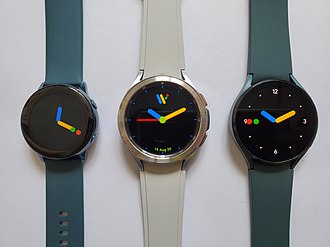
You can find Android on many kinds of devices, not just phones and tablets. There is Android TV for televisions, Wear OS for wearable devices, and Android Automotive for cars. Because Android is open-source, many companies have made their own versions, like Amazon Fire OS and LineageOS.
Apps for Android come in a special format called APK. People usually download them from app stores. The most common is Google Play, but there are others like Amazon Appstore, Samsung Galaxy Store, and Huawei AppGallery. Since 2011, Android has been used by the most people in the world, with over three billion people using it each month.
History
See also: Android version history
2000s
Android Inc. began in Palo Alto, California in October 2003 by Andy Rubin and Chris White, with Rich Miner and Nick Sears joining later. Rubin had worked on the T-Mobile Sidekick with his company Danger, Inc.. They started by trying to make an operating system for digital cameras, but then decided to focus on phones.
In 2005, Google bought Android Inc. for at least $50 million. The team kept working on a mobile platform using the Linux kernel. Google shared this platform with phone makers and carriers, promising a flexible and upgradeable system.
In November 2007, the Open Handset Alliance, a group of technology companies including Google, device makers like HTC, Motorola and Samsung, and wireless carriers like Sprint and T-Mobile, was formed to create an open platform for mobile devices.
The first Android phone, the HTC Dream (also called T-Mobile G1), was announced on September 23, 2008.
Since 2008, Android has been updated regularly with new features and fixes.
2010s
In 2010, Google started the Nexus series, working with device makers to create phones that introduced new Android versions with clean software and quick updates.
In 2014, Google began the Android One program to help device makers create affordable phones, especially for users in developing countries.
In October 2016, Google introduced the Pixel and Pixel XL smartphones, the first phones made by Google, featuring exclusive software like the Google Assistant.
In May 2019, Android's development was affected by trade issues between China and the United States, impacting companies like Huawei.
On August 22, 2019, Google announced that Android would no longer use dessert names for its versions. Android 10 was released on September 3, 2019, for Google Pixel phones first.
2020s
In late 2021, some users had trouble calling for emergency help because of bugs in Android and the Microsoft Teams app. Both companies fixed the problem with updates.
On December 12, 2024, Google announced Android XR, a new operating system for virtual reality and augmented reality devices, developed with Samsung and Qualcomm.
In March 2025, Google planned to focus Android development internally, though the Android source code will still be shared publicly.
Features
Main article: List of features in Android
Android phones are used by touching the screen. You can swipe, tap, and pinch to open apps and play games. The phone can also work with game controllers and keyboards using Bluetooth or USB.
When you turn on an Android phone, you see the home screen. This is like a desktop on a computer, with app icons and small boxes that show information. You can swipe through many home screen pages. Some phone makers change how the home screen looks.
At the top of the screen is a status bar. Pulling this down shows important updates and lets you control things like brightness, WiFi, and Bluetooth.
Android phones come with Google apps like Gmail, Maps, Chrome, and YouTube. Users can also get new apps from the Google Play Store. These apps help the phone do more things, like taking pictures or playing games.
Android phones can have more storage using SD cards. The phone helps save battery by closing apps that aren’t being used when memory gets low. There are special settings for developers, but these are usually hidden.
Hardware
See also: Android hardware requirements
Android works mostly on 64-bit ARM and 32-bit ARMv7-A computers, but it can also run on x86-64 and 32-bit x86 computers. The Android-x86 project helped make this possible before it was official. Since 2012, phones and tablets with Intel processors have been available. Android added support for 64-bit ARM64 computers later, and there was an unofficial version for 64-bit RISC-V computers in 2021. Support for 32- and 64-bit MIPS computers was available at one time.
Smartphones running Android 15 need at least 2 GB of memory if they use the Android Go Edition, or 4 GB for the full version. Android works with many types of graphics systems, including all versions of OpenGL ES and Vulkan.
Android devices can include many extra parts, like cameras, GPS, sensors to know direction, game controls, and touchscreens. Some of these parts are not required for all devices. For example, early Android devices needed microphones for phone calls, but later versions do not require this if the device does not make calls. Android can also run on regular computer hardware with a keyboard and mouse, thanks to projects like Android-x86 and emulators. Some companies in China are making their own versions of Android for computers to work like Microsoft Windows and Android.
Devices
Android is used on many devices, like smartphones, tablets, cars, computers, smart watches, and smart TVs. But most Android devices are smartphones. Unlike some other operating systems, Android phones are made by many different companies. These companies include Samsung, Xiaomi, Vivo, Oppo, iQOO, OnePlus, Honor, Google, Sony, Lenovo, Sharp, Realme, Nothing, and Tecno.
Development
Android is made by Google. When updates are ready, the source code is shared with the Android Open Source Project (AOSP), a group led by Google. The first release of the source code was in 2007. All updates are shared under the Apache License.
The AOSP code is used on some phones, like older Nexus and Android One phones. But many phone makers change the code to work with their hardware.
Android’s source code does not include some parts needed for hardware or Google services. So, most Android phones use a mix of free software and special software made by companies. Some projects try to build full operating systems using only free software based on AOSP, starting with CyanogenMod.
Update schedule
Google releases Android updates every year for new devices and updates for existing devices. The latest major version is Android 16.
Because Android devices have many types of hardware, updating software can take time. Each update must be made for different devices, which can cause delays. Updates often come months after the official release, or sometimes not at all, especially for older devices. Manufacturers focus on newer models, and wireless carriers test updates before releasing them. Sometimes, updates can’t happen because device makers don’t update important parts of the system.
This lack of support has been criticized. In 2011, Google started the Android Update Alliance to promise timely updates for 18 months after a device’s release, but there hasn’t been much news since. In 2012, Google began updating some parts of Android through the Google Play store, separate from the main operating system updates. This helps add new features and fix issues without needing a full system update.
In 2017, Google introduced Project Treble to make updating Android easier and faster for device makers. In 2019, Project Mainline was introduced to allow important security and performance updates to be delivered through the Google Play Store, like app updates.
Google made changes in Android 12 to make it easier to use app stores other than Google Play, addressing concerns from businesses affected by COVID-19.
Linux kernel
Android uses a version of the Linux kernel. As of 2024, Android uses versions 6.1 or 5.15 of the kernel. Android’s version of the Linux kernel has special changes made by Google, such as support for device trees and different ways to manage memory.
Rooting
Some people try to get full control, or “root access,” of their Android devices. This can be done by finding security problems in Android or by unlocking parts of the device that are normally locked. Getting root access lets people change the device more freely, but it can also let harmful software take control. Some phone makers allow users to unlock these parts, but doing so usually erases all data on the phone. Some protection systems, like Samsung Knox, try to stop people from getting root access.
Software stack
Android runs on top of the Linux kernel, with extra parts called middleware and libraries, and apps that use a framework including Java-like tools. Android uses a special runtime called Android Runtime (ART), which compiles apps ahead of time for better performance. Older versions used Dalvik, which used a different way to run apps.
Android uses a special C library called Bionic, made by Google, which is smaller and designed for mobile devices. Android also includes a separate small operating system called Trusty OS for secure tasks like handling payments or protecting personal data.
Open-source community
Because Android’s source code is open, many people and groups have created their own versions of Android. These versions can bring updates to older devices, add new features, or let Android run on devices that originally used other operating systems. These community versions often include changes not provided by the original maker, like letting people change how the device works or improving security.
CyanogenMod was a popular community version, but it stopped in 2016. A new version called LineageOS continued its work. Some device makers and carriers used to oppose these changes, but many now support or encourage this work. Some phones now come with ways to unlock parts of the system, making it easier to use community versions.
Device codenames
Android gives each device a special internal name, called a device codename. This name is not usually shown to users but helps developers know what hardware a device has. For example, the Pixel smartphone’s codename is “sailfish.” This name helps when talking about different versions of the same device.
| Version | Release date |
|---|---|
| 1.0 | September 23, 2008 |
| 1.1 | February 9, 2009 |
| 1.5 (Cupcake) | April 27, 2009 |
| 1.6 (Donut) | September 15, 2009 |
| 2.0–2.1 (Eclair) | October 26, 2009 |
| 2.2 (Froyo) | May 20, 2010 |
| 2.3 (Gingerbread) | December 6, 2010 |
| 3.0 (Honeycomb) | February 22, 2011 |
| 4.0 (Ice Cream Sandwich) | October 18, 2011 |
| 4.1–4.3 (Jelly Bean) | July 9, 2012 |
| 4.4 (KitKat) | October 31, 2013 |
| 5.0–5.1 (Lollipop) | November 12, 2014 |
| 6.0 (Marshmallow) | October 5, 2015 |
| 7.0–7.1 (Nougat) | August 22, 2016 |
| 8.0–8.1 (Oreo) | August 21, 2017 |
| 9 (Pie) | August 6, 2018 |
| 10 | September 3, 2019 |
| 11 | September 8, 2020 |
| 12–12L | October 4, 2021 |
| 13 | August 15, 2022 |
| 14 | October 4, 2023 |
| 15 | October 15, 2024 |
| 16 | June 10, 2025 |
Security and privacy
See also: Mobile security and Comparison of open-source mobile phones
In 2020, Google started the Android Partner Vulnerability Initiative to help keep Android safer. They also made a special team just for Android security.
Common security threats
Researchers found that one problem with Android phones is when people get messages asking them to pay for things they didn’t want. Other problems can be unwanted ads or private information being sent out without the user knowing. Google says these bad things don’t happen as often as some people think, and that very few dangerous problems come from the Google Play store.
In 2021, some people found software that could secretly watch or listen to what someone was doing on their phone. Phones sometimes share more information than needed, and users can’t always stop this.
Security patches
In 2015, Google said that some phones would get monthly updates to fix problems. But not all phones get these updates quickly, especially older or cheaper ones. Google tries to make updating easier, but it still takes time for all phones to get the latest fixes.
Location-tracking
Android phones can find nearby Wi‑Fi spots, which helps apps know where a person is. Some software can see when private information is being sent out from the phone.
Technical security features
Android apps usually run in their own space, so they can’t access other parts of the phone unless the user allows it. Google checks the apps in its store to make sure they’re safe. Users can choose what information each app can see when they first start using it.
Android also has ways to check that the phone’s software hasn’t been changed by someone who wants to cause trouble. Google offers ways to find a lost phone or see where a friend is during emergencies.
Criticism and controversy
Privacy and GDPR compliance
In 2019, Google was fined a lot of money by French officials for not telling people enough about how they use user data.
Later, in 2021, a researcher showed that even when an Android phone was not in use and had no Google account, it still sent some data to Google. In 2022, it was found that Android phones sent details about calls and messages to Google, even when certain settings were turned off.
In 2022, Google was also penalized in Australia for misleading people about how they collect location data from Android phones.
Short software support lifespans
Android devices, especially cheaper ones, often stop getting updates after just one or two years. This happens because companies sometimes don’t want to spend money on updating older devices.
To help fix this, Google created a new system to make updates easier. Some companies like Samsung have started offering longer support for their phones, but many cheaper phones still don’t get updates for very long.
Google's developer verification program
In 2025, Google announced that developers would need to register with Google to share apps on Android phones, whether through the Play Store or other ways. This rule will start in September 2026. Some people are concerned this will give Google too much control over which apps can be used.
Licensing
The source code for Android is open-source. Google builds it and then shares it with everyone. Most of the code uses the Apache License version 2.0, so people can change and share it. But device makers need to get the "Android" name from Google.
Only the main Android system is open-source. Many devices also have special software from Google, like the Google Play Store and Google Search. Device makers need to pay for these extra parts. Some companies make their own versions of Android with new features or apps.
Some people think Android is not totally free because device makers have to pay Google for its branding and services. Google also has rules about how Android can be used. This means device makers cannot always change Android in any way they want.
Reception
Android was first shown in 2007 and people were not sure how it would do. Some experts liked that big companies joined with Google to help make it, but others were worried. They thought Android might not be strong enough to compete with big names like Nokia and Microsoft.
Since then, Android has become the most used phone system in the world. People like that it is open for anyone to use and change. This has let many different companies make their own versions of Android for their devices. It also lets phone owners change how their phones look and work, and people can find apps from many places, not just Google’s store.
Even though Android is very popular, Google has had some trouble making it as big a money maker as they hoped. This is because many phone makers have changed Android a lot, and many people use apps and services that are not Google’s. To help Android grow, Google started making sure phones show the Android logo if they use Google’s special tools.
One big challenge for Android is “fragmentation.” This means there are many different kinds of Android phones, with different hardware and software. This makes it harder for app makers to make programs that work the same on every Android phone. Some say this has helped Android grow because many cheaper phones use older versions, but it can make things harder for app developers.
Market share
Main article: Usage share of operating systems
Android is the most popular phone system in the world. It is used by most people on their phones in many countries, like India. On tablets, Apple’s iPad is a bit more common.
When Android started in 2009, it was used by only a small number of people. But it grew fast and became the top phone system in the world by 2011.
Android’s use changes in different places. In some countries, most people use it, while in others, it is less common. On tablets, Android started slow but later became more popular with cheaper options.
Platform information
Main article: Android version history
Android has more users than Apple’s iOS on tablets and phones. As of 2026, Android 16 is the most used version on phones, and Android 14 is the most used on tablets. Many people use newer versions that get updates. Some people still use older versions that no longer get security fixes.
Application piracy
Paid Android apps used to be easy to copy without paying. Some game makers said many players did not pay, but others said only a few players copied apps, mostly in places where Google Play was not available. Google made tools to help stop this, but some makers said they were not enough. Later, Android added better ways to protect paid apps.
| Version | Release date | API level | Kernel | Launched with |
|---|---|---|---|---|
| 16 | June 10, 2025 | 36 | 6.12 | ? |
| 15 | August 13, 2024 | 35 | 6.6 | ? |
| 14 | October 4, 2023 | 34 | 6.1 | Pixel 4a (5G), Pixel 5, Pixel 5a, Pixel 6, Pixel 6 Pro, Pixel 7, Pixel 7 Pro, Pixel 7a, Pixel 8, Pixel 8 Pro, iQOO 11 Pro, Lenovo Tab Extreme Wi-Fi, Nothing Phone 1, OnePlus 11, Oppo Find N2, Oppo Find N2 Flip, Realme GT 2 Pro, Tecno Camon 20 series, Vivo X90 Pro, Xiaomi 12T, Xiaomi 13, Xiaomi 13 Pro, Xiaomi Pad 6 |
| 13 | August 15, 2022 | 33 | 5.x | Pixel 4, Pixel 4 XL, Pixel 4a, Pixel 4a (5G), Pixel 5, Pixel 5a, Pixel 6, Pixel 6 Pro, Pixel 7, Pixel 7 Pro, Pixel 7a, Asus ZenFone 8, Lenovo P12 Pro, OnePlus 10 Pro, Oppo Find X5 Pro, Vivo X80 Pro, Realme GT2 Pro, Xiaomi 12, Xiaomi 12 Pro, Xiaomi Pad 5, Redmi K50 Pro, Sharp AQUOS sense6, Tecno Camon 19 Pro, ZTE Axon 40 Ultra |
Legal issues
Further information: Smartphone patent wars, Patent troll, and Google litigation
Android has had many legal cases about patents, copyrights, and business rules.
Patent lawsuits
Oracle
Main article: Oracle v. Google
In 2010, Oracle sued Google, saying Android used parts of Java without permission. Oracle wanted money, but the court asked Oracle to change its request. Google said Android did not break Oracle’s patents or copyrights. In 2012, a group of people agreed that Google did not break Oracle’s patents, but a judge said Google might have broken copyright rules. In 2014, a higher court agreed with Oracle about the copyright rules. In 2015, Google changed Android to use a different version of Java. In 2016, a court said Google’s use was allowed. In 2021, the highest court in the United States also said Google’s use of Java was allowed.
Android manufacturers
Besides suing Google, some companies sued Android device makers. Apple and Microsoft both sued several Android device makers. In 2012, Microsoft said it had deals with many Android device makers, including Samsung and HTC. Microsoft also made some of its apps, like Microsoft Office Mobile and Skype, required on Android devices as part of these deals. Google bought many patents from Motorola Mobility and IBM to protect Android from these lawsuits.
Antitrust
Main article: Antitrust cases against Google by the European Union § Android investigation
In 2013, a group supported by Microsoft and Oracle said Google was being unfair with Android. In 2016, the European Union said Google was being unfair by making device makers include Google’s apps and not allow changes to Android. The EU fined Google €4.3 billion and said Google had to change its ways. Google said it would change how it sells Android in Europe, letting device makers choose different apps. Similar fines happened in Russia, Turkey, South Korea, and India for similar reasons.
Other uses
Google has made different versions of Android for special uses. These include Wear OS for watches, Android TV for televisions, Android Things for smart devices, and Android Automotive for cars. Android can also be used on many other gadgets like laptops, cameras, and robots.
Android’s flexibility lets companies use it on many kinds of electronics. Some examples are game consoles, home automation systems, and car stereos. In 2011, Google showed how Android could control home devices like lights and thermostats. Google wanted to bring its services into people’s homes in new ways.
Mascot
The Android mascot is a green robot, which relates to the name of the software. For a long time, it did not have an official name, but Google's Android team called it "Bugdroid." In 2024, a Google blog post gave it the official name, "The Bot."
The robot was designed by Google graphic designer Irina Blok on November 5, 2007, when Android was first announced. Blok said she created it on her own and made it open source. The design became popular with the Android development team. Because it was free to use under a Creative Commons license, Google adopted it as part of the Android logo when the software launched in 2008.
Images
Related articles



This article is a child-friendly adaptation of the Wikipedia article on Android (operating system), available under CC BY-SA 4.0.
Images from Wikimedia Commons. Tap any image to view credits and license.