 Safekipedia
History of Los Angeles
Adapted from Wikipedia · Adventurer experience
The modern history of Los Angeles began in 1781. That year, 44 settlers from central New Spain (now Mexico) started a town in what is today Downtown Los Angeles. They did this because the Spanish Governor of Las Californias, Felipe de Neve, told them to. The leader of Mexico at the time, Viceroy Antonio María de Bucareli, also agreed.
After Mexico gave control to the United States in 1849, Los Angeles changed a lot. The Santa Fe railroad from Chicago reached Los Angeles in 1885. This brought many new people, especially White Protestants from the Midwest and Upland South.
Los Angeles grew fast. The city had a strong economy from farming, oil, tourism, building homes, and movies. Its motion picture industry made the city famous around the world. Then World War II brought more jobs, especially making airplanes. The city built many new areas outside the center and many roads.
Since the 1960s, the city has grown more slowly. Traffic can take a long time. Many new people have moved to Los Angeles, especially from Mexico and Asia. Some older jobs in farming, oil, the military, and airplane making are not as common now. But tourism, entertainment, and high-tech jobs are still important. The city sometimes has dry periods and wildfires, which can make it hard to keep enough water security.
Indigenous history
By 3000 BCE, people who spoke the Hokan language lived in the area. They fished, hunted sea animals, and gathered wild seeds. Later, new people arrived and they spoke a Uto-Aztecan language called Tongva. The Tongva called the Los Angeles region Yaa.
By the 1700s CE, there were many native people in California, including about 5,000 in the Los Angeles basin. The Tongva lived on land covering about 4,000 square miles (10,000 km2), including areas near the Los Angeles and San Gabriel rivers and islands such as Santa Barbara, San Clemente, Santa Catalina, and San Nicolas. They traded with nearby groups like the Chumash, Cahuilla, Mojave, Juaneños, and Luiseños.
The Tongva had their own beliefs and traditions. They believed in gods and held special ceremonies. They used natural plants in their rituals. Their language was called Kizh or Kij. Before Europeans arrived, the Tongva had chosen good places to live, especially near the Los Angeles River, where a village called Yaanga provided food and help to later settlers.
Spanish era
Further information: Pueblo de Los Angeles
In 1542 and 1602, the first Europeans to visit the area were Captain Juan Rodríguez Cabrillo and Captain Sebastián Vizcaíno. The first permanent settlement began when the Portolá expedition arrived on August 2, 1769.
Plans for the pueblo
Although Los Angeles was founded by families from Sonora, it was the Spanish governor who gave the town its name.
In 1777, Governor Felipe de Neve visited Alta California and decided to create towns to support the military. He chose Santa Barbara, San Jose, and Los Angeles for these new towns. His plans followed Spanish city rules made by King Philip II in 1573. These rules helped shape the biggest towns in the area, including Los Angeles.
The Spanish plan called for a central square with a church, government buildings, and streets in a grid. This layout included space for farming and homes.
Pobladores
Main article: Los Angeles Pobladores
The Pobladores were the 22 adults and 22 children from Sonora who founded Los Angeles. Most were of mixed heritage. In December 1777, leaders approved the founding of Los Angeles and a military post at Santa Barbara.
The leader in charge of finding settlers could only gather 12 settlers and 45 soldiers after searching many places. They, like others in New Spain, had mixed backgrounds.
The official founding date of the city is September 4, 1781. The families arrived from New Spain earlier that year, and some had already started working on their land.
Spanish pueblo
The town grew as more people arrived. In 1784, a small chapel was built. By 1800, there were 29 buildings around the central square. By 1821, Los Angeles had become a thriving farming town, the largest in Southern California.
The Spanish gave Los Angeles about five miles of land on each side. Each settler got land for farming. When they arrived, the area had lots of trees, rivers, and animals like deer and bears. There were also many fish in the rivers.
The first settlers built a system of ditches to bring water from the river to their farms. Indians helped bring fresh water and worked for the settlers, who paid them with goods and sometimes money.
In the 1780s, San Gabriel Mission had some problems with Indians who were unhappy with being forced to work on land they used to own.
In 1787, new rules were made to protect Indians and give them more choices about where to live. In 1795, a group traveled through areas now known as the Simi Valley, Conejo-Calabasas region, and San Fernando Valley, observing Indians working on farms and ranches.
Marriages between settlers and Indians began soon after the town was founded. By 1811, Los Angeles had over five hundred people. In 1820, a new road was built connecting Los Angeles to San Francisco Bay.
Mexican era
Mexico became independent from Spain in 1821, and people in Los Angeles celebrated by raising the Mexican flag. This brought new opportunities, and the population grew from about 650 people in 1820 to nearly 1,680 by 1841.
Los Angeles became an official city in 1835 and was the main city of the region. New stores opened, and trade grew, especially after the Mexican government made mission lands available. Many new people arrived from the United States and Europe. One man, Jean-Louis Vignes, planted a big vineyard and made wine, which became very popular in California. 1
1
Early American era
In 1849, Lieutenant Edward Ord checked Los Angeles to arrange and extend the city’s streets. His work started the city’s first real-estate boom and changed Spanish street names to English. Surveys and new street plans created a civic center south of the Plaza.
During the Gold Rush years, Los Angeles supplied beef and food to miners in northern California. Without a legal system, the city became lawless.
John Gately Downey became California’s seventh governor on January 14, 1860, the first governor from Southern California.
Plight of the Indigenous
Los Angeles became a U.S. city on April 4, 1850. Five months later, California joined the United States. The U.S. did not grant citizenship to Native Americans from former Mexican territories for many years. The Constitution of California did not protect Native Americans under the law.
With new U.S. citizens, diseases spread among Native Americans. They were not allowed to stay overnight in the city.
Industrial expansion and growth
In the 1870s, Los Angeles was a small village of about 5,000 people. By 1900, the city had over 100,000 people.
By the 1880s, families moved away from Aliso Street near Chinatown to nicer neighborhoods. Los Angeles became a popular tourist spot in the late 1800s with new transportation and hotels.
Much of Los Angeles County was farmland with cattle, dairy, vegetables, and fruits. After 1945, most farmland became housing.
Early transportation and railroads
The city’s first railroad, the Los Angeles & San Pedro Railroad, started in October 1869. It ran 21 miles between San Pedro and Los Angeles.
Railroads grew slowly at first. They connected to San Francisco in 1876. The Santa Fe system in 1885 brought bigger changes. It connected Los Angeles to the East with lower prices, bringing many new residents and tourists.
The city did not have a modern harbor. Phineas Banning dug a channel at San Pedro Bay in 1871. Harrison Gray Otis, founder of the Los Angeles Times, helped build a harbor at San Pedro.
This caused a conflict with Collis P. Huntington, leader of the Southern Pacific Company.
During the late 1800s, Chinese workers built the Southern Pacific Railroad. It connected Los Angeles to San Francisco and helped the city grow.
In 1876, a railroad tunnel was finished north of Los Angeles, linking San Francisco to Los Angeles. It took 1,500 workers, mostly Chinese, one and a half years to build.
The San Pedro group won, but only after Banning and Downey gave their railroad to Southern Pacific. Work on a breakwater at San Pedro began in 1899 and finished in 1910. In 1909, Los Angeles could include San Pedro and Wilmington.
Streetcars started in Los Angeles in 1874 with horse cars, then cable cars, and later electric streetcars. In 1898, Henry Huntington and others created the Los Angeles Railway and later the Pacific Electric Railway. These railroads connected Los Angeles to many nearby places.
Old Chinatown
Old Chinatown was built in the 1860s near where Union Station stands today. It was centered on Alameda Street, which was also part of the old Red Light district.
In 1984, an excavation found items from Chinese, Euro-American, and Native American people.
There were attacks against Chinese people in the past. In 1871, a violent event happened where many Chinese immigrants were harmed.
Oil discovery
Oil was found by Edward L. Doheny in 1892 near where Dodger Stadium is today. The Los Angeles City Oil Field was the first of many. Later, oil fields were found nearby, and Los Angeles became an important oil center.
Early labor movements
The Los Angeles Times supported expanding the city but also tried to stop unions. Fruit growers and merchants opposed a big workers’ protest in 1894 and formed a group to support this effort.
The labor movement in California was strong in San Francisco but ignored Los Angeles for years. In 1907, a big labor group decided to challenge this. In 1909, public speaking was restricted outside certain areas.
On Christmas Day 1913, police broke up a protest and one person died. The open shop campaign continued, and in 1923, workers in San Pedro protested for better conditions.
Flooding and water supply
The Los Angeles River once flowed clearly, helping Tongva villages. Early settlers faced dry periods and big storms. Floods sometimes changed the river’s path.
Heavy rain sometimes fell in the San Gabriel Mountains. In 1943, a record amount of rain fell there.
Floods in 1938 led the federal government to help. The Army Corps of Engineers built dams and paved riverbeds to control flooding.
The Los Angeles River now mainly helps with flood control.
Pumping water from underground in the San Fernando Valley dried up the river by the 1920s. By 1980, this water was used for drinking, but it was discovered to be dirty.
For many years, the Los Angeles River gave the city enough water. But as the city grew, it needed more. Leaders wanted water from the Owens River, far away.
Between 1899 and 1903, people worked to buy land and water rights in the Owens Valley. They used secret reports to help them. In 1913, after voting for bonds, Los Angeles built the Los Angeles Aqueduct to bring this water to the city.
20th century
Hollywood
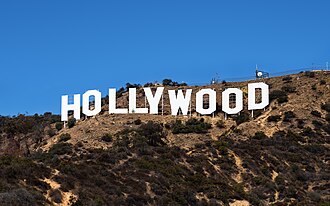
Hollywood has been linked worldwide with movies for over a hundred years. It became a city in 1903 but joined Los Angeles in 1910. In the early 1900s, filmmakers from New York moved there because the sunny weather was perfect for filming. It grew into the heart of movie-making in the United States and became home to many actors, directors, and singers. It also helped grow television and music.
Notable events
Los Angeles hosted the Summer Olympics in 1932. The Los Angeles Memorial Coliseum, opened in 1923, was expanded to hold many people for Olympic events. Olympic Boulevard still honors this time today.
Annexations and consolidations
The City of Los Angeles stayed within its original boundaries until the 1890s. The first big additions were Highland Park and Garvanza to the north, and the South Los Angeles area. In 1906, the city annexed the Shoestring, a narrow strip of land leading to the Port of Los Angeles. The port cities of San Pedro and Wilmington joined in 1909, and Hollywood became part of Los Angeles in 1910. This brought the city up to 90 square miles and gave it a unique shape. More areas joined over the years, growing the city to 450 square miles by 1932.
Civic corruption and police brutality
In the early 1900s, there was corruption in Los Angeles City Hall and the Los Angeles Police Department. Some city leaders took money from business owners. In 1937, a citizen named Clifford Clinton started a campaign to clean up city government. With the help of a judge, changes were made to make the police department better.
LAX: Los Angeles International Airport
Mines Field opened as a private airport in 1930 and was bought by the city in 1937. It was renamed Los Angeles Airport in 1941 and became Los Angeles International Airport in 1949. Before LAX, most flights were at Hollywood Burbank Airport and Grand Central Airport in Glendale. Since then, LAX has grown a lot.
World War II
During World War II, Los Angeles became a key place for making airplanes, ships, and supplies. Many companies helped build aircraft. The city grew quickly because many people came to work in these factories.
Postwar: Baby boomers
After the war, many developers bought land cheaply and built homes, changing Southern California’s main industry to real estate. In 1955, Walt Disney opened Disneyland in Anaheim, and Universal Studios opened a theme park in 1964. Major League Baseball teams moved to Los Angeles and San Francisco in 1958. California’s population grew. Los Angeles became a big center for making cars, tires, furniture, and clothes. Construction boomed with new homes built.
Racially restrictive housing covenants
For many years, housing rules in Los Angeles stopped people of certain races from buying homes in many neighborhoods. These rules were agreements that said only certain people could live in a home. They often kept out people who were not white. These rules were finally stopped by court decisions in the late 1940s and 1950s.
Economic and demographic changes
In the 1990s, many factories in Los Angeles closed down, and jobs moved away. But the film, television, and music industries stayed strong. The ports of Los Angeles and Long Beach became very important for trade, bringing in many jobs. Downtown Los Angeles started to change with new homes and buildings. The city’s population also changed, with more Latino, Asian, and other groups moving in over the years.
1980s
In the 1980s, Los Angeles saw many street gangs grow and drugs become a big problem. There was also a growing difference between rich and poor people in the city. New public transportation systems were built, including subways and light rail, though some plans faced delays.
1990s
In 1992, after a police beating was shown on TV and the officers were not found guilty, riots broke out in Los Angeles. Sadly, many people died and there was damage to property. In 1994, an earthquake hit the city, causing damage. That same year, a famous trial caused a lot of discussion in the city.
21st century
2000s
By the end of the 1900s, some areas of Los Angeles felt disconnected from city decisions. Votes to split the city were rejected in 2002.
James Hahn became mayor in 2001.
Antonio Villaraigosa became mayor in 2005.
In 2007, Hollywood writers stopped working for a while because they wanted to be paid more for movies sold on DVD. This stopped TV and movie making for a time.
2010s
Eric Garcetti became mayor in 2013.
In 2017, Los Angeles was chosen to host the 2028 Summer Olympics. The city promised to improve public transportation, but many projects were delayed by 2024.
In 2018, a big fire damaged parts of Los Angeles. The fire was caused by mistakes made by a utility company.
2020s
In 2020, a helicopter crash happened, and Kobe Bryant, a famous basketball player for the Lakers, was among those who died. Many people in Los Angeles were very sad.
The COVID-19 pandemic began in Los Angeles in 2020. The city closed many places, including schools and parks. A stay-at-home order was put in place.
During the summer of 2020, Los Angeles saw large protests about unfair treatment of Black people. There were some disturbances during these protests.
In 2021, Los Angeles had many cases of COVID-19. The disease returned each summer for a few years after that.
Karen Bass became mayor in 2022.
In 2023, Hollywood writers stopped working again because they were worried about artificial intelligence taking their jobs. TV and movie making stopped, but the writers got some of what they wanted.
In early 2025, a series of wildfires affected the Los Angeles area. These fires caused damage to many homes and forced many people to leave. The fires were made worse by dry weather and strong winds.
In June 2025, Los Angeles had protests, and federal forces were sent to help.
Population history
Los Angeles grew quickly over the years. By 1900, the city had more than 100,000 people. By 1930, it had over a million, and by 1960, more than two million. In 1990, the population passed three million. Around 1982, Los Angeles became the second largest city in the United States, just behind Chicago, with about 3.02 million people.
By 2020, Los Angeles had grown to about 3.9 million residents.
_Sources: Historical Census Populations of Counties and Incorporated Cities in California, 1850–2010
| Year | Population | Growth |
|---|---|---|
| 1790 | 131 | — |
| 1800 | 315 | 184 |
| 1810 | 365 | 50 |
| 1820 | 650 | 285 |
| 1830 | 1,300 | 650 |
| 1840 | 2,240 | 940 |
| 1850 | — | — |
| 1860 | 4,385 | — |
| 1870 | 5,730 | 1,345 |
| 1880 | 11,200 | 5,470 |
| 1890 | 50,400 | 39,200 |
| 1900 | 102,500 | 52,100 |
| 1910 | 319,200 | 216,700 |
| 1920 | 576,700 | 257,500 |
| 1930 | 1,238,048 | 661,348 |
| 1940 | 1,504,277 | 266,229 |
| 1950 | 1,970,358 | 466,081 |
| 1960 | 2,479,015 | 508,657 |
| 1970 | 2,816,061 | 337,046 |
| 1980 | 2,966,850 | 150,789 |
| 1990 | 3,485,398 | 518,548 |
| 2000 | 3,694,820 | 209,422 |
| 2010 | 3,792,621 | 97,801 |
| 2020 | 3,898,747 | 106,126 |
Images
Related articles



This article is a child-friendly adaptation of the Wikipedia article on History of Los Angeles, available under CC BY-SA 4.0.
Images from Wikimedia Commons. Tap any image to view credits and license.