 Safekipedia
Rhea (mythology)
Adapted from Wikipedia · Adventurer experience
In Greek mythology, [Rhea](/wiki/Rhea_(disambiguation) was one of the Titans, born to Uranus, the Sky, and Gaia, the Earth. She was both the sister and wife of Cronus, and together they had six important children: Hestia, Demeter, Hera, Hades, Poseidon, and Zeus.
When Cronus learned he would one day be defeated by his own child, he swallowed each of their children at birth. But when Rhea had their sixth child, Zeus, she saved him by hiding him away in Crete and giving Cronus a stone to swallow instead. Zeus later grew up to defeat Cronus and free his siblings.
After Zeus and the Olympians took power, Rhea still helped in important ways. She assisted at the births of her grandchildren, such as Apollo and Artemis, and cared for another grandson, Dionysus. When Persephone was taken by Hades, Zeus sent Rhea to help Demeter.
The Greeks honored Rhea as the “mother of gods” and linked her closely with Cybele and Gaia. The Romans saw Rhea as similar to their goddess Ops and connected her to Magna Mater, their version of Cybele.
Etymology
The name Rhea might come from a word meaning "ground" or "earth." Some thinkers also think it could be linked to a word meaning "flow" or even words for the pomegranate fruit. Scholars aren't sure where the name really comes from, but it might be from very old languages that came before Greek.
It could also mean something like "daughter of the sky," since her father in the stories is Uranus, the sky god.
Family
Rhea was the sister of the Titans, including Oceanus, Crius, Hyperion, Iapetus, Coeus, Themis, Theia, Phoebe, Tethys, Mnemosyne, and Cronus. She was also the sister of the Cyclopes, the Hecatoncheires, the Giants, the Meliae, and the Erinyes.
Rhea had six children with her brother, Cronus: Hestia, Demeter, Hera, Hades, Poseidon, and Zeus. In some stories, she is also the half-sister of Aphrodite, Typhon, Python, Pontus, Thaumas, Phorcys, Nereus, Eurybia, and Ceto.
Mythology
Rhea was one of the Titans. She was born to the earth goddess Gaia and the sky god Uranus. She was the sister and wife of Cronus. They had six children: Hestia, Demeter, Hera, Hades, Poseidon, and Zeus.
Cronus was told his child would take his place. So, he swallowed each child when they were born. Rhea tricked him with their last child, Zeus. She gave Cronus a stone wrapped in clothes instead. She hid baby Zeus in a cave on Mount Ida in Crete.
After Zeus grew up, he helped Rhea free his brothers and sisters. Rhea stayed close to her children and helped where she could. She was known for helping women with childbirth. She was a kind and wise goddess.
Cult
Rhea was mostly honored on the island of Crete, where she was thought to have cared for the baby Zeus. Her followers celebrated with songs, dances, and a special drum called a tympanon. Priests told stories about her helpers, the Curetes and Dactyls, by clashing bronze shields and cymbals.
Rhea was often called Meter Theon, meaning "Mother of the Gods." Many temples in Ancient Greece were devoted to her under this name, such as those in Megalopolis in Arkadia, on the Acropolis of Ancient Corinth, and in Athens. In Olympia, there was a temple called the Metroion, dedicated to her. Her worship was very strong in Crete, where Mount Ida was believed to be Zeus’s birthplace. There were special places there, like caves, that were considered sacred to Rhea.
Iconography
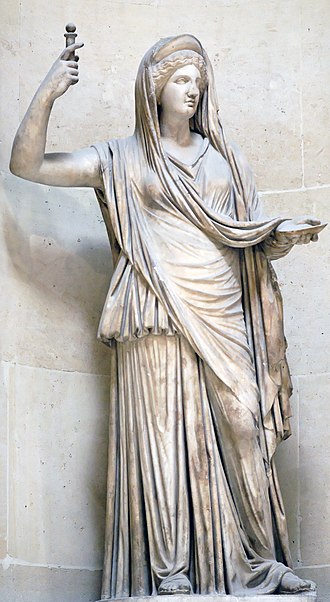
Rhea started appearing in Greek art around the fourth century BC. In these pictures, she looks a lot like a goddess named Cybele. Both are often shown wearing crowns, sitting on thrones with lions nearby, riding lions, or traveling in chariots pulled by lions. In Roman religion, Rhea was connected to a goddess named Cybele, who came from ancient Troy and was later important in Rome. Rhea was also seen as similar to the Roman goddess Ops.
Depiction in ancient literature
In Homer, Rhea is called the mother of the gods. She is not like Cybele, the Phrygian Great Mother, but later, some thought she was the same as Cybele.
In the Argonautica by Apollonius of Rhodes, Rhea is shown as one with the Phrygian Cybele. The seer Mopsus told Jason that when the goddess leaves the mountains and goes to the heavens, even Zeus, her own son, and all the other gods make way for her. Jason went up Mount Dindymon to honor her so the Argonauts could continue their journey. They made an image of the goddess from a vine-stump and called on her as the mother of Dindymon and the mistress of all.
Descendants
Rhea was one of the Titans. She was born from Uranus and Gaia. She was the sister and wife of Cronus. They had many children: Hestia, Demeter, Hera, Hades, Poseidon, and Zeus.
When Cronus heard that one child might take his place, he swallowed each child when it was born.
Significant modern namesakes
The bird called the Rhea is named after the goddess Rhea. One of Saturn’s moons is also called Rhea, after the goddess. A wrestler in WWE, Rhea Ripley, chose her stage name because of the goddess Rhea.
Images
Related articles



This article is a child-friendly adaptation of the Wikipedia article on Rhea (mythology), available under CC BY-SA 4.0.
Images from Wikimedia Commons. Tap any image to view credits and license.