 Safekipedia
Demeter
Adapted from Wikipedia · Adventurer experience
Demeter
In ancient Greek religion and mythology, Demeter is the goddess of the harvest and agriculture. She watches over crops, grains, food, and the fertility of the earth. Demeter is also linked to health, birth, and marriage, and she has ties to the Underworld. She is sometimes called Deo.
Demeter is the daughter of the Titans Rhea and Cronus, and the sister of Hestia, Hera, Hades, Poseidon, and Zeus. She is the mother of Persephone, a goddess who connects life and renewal. One famous story tells how Persephone went to the Underworld and how Demeter’s search for her explained why plants grow in some seasons and not in others.
Demeter was honored in many ways, including a special festival called the Thesmophoria. She and Persephone were important in the Eleusinian Mysteries, which gave people hope. Demeter is also linked to the Anatolian goddess Cybele and the Roman goddess Ceres.
Etymology
Demeter's name may have looked like da-ma-te in very old writings. Scholars think this could be linked to her role in ancient religions.
The word "Demeter" includes meter, meaning "mother" in ancient languages. Many ideas exist about the first part of her name, Da. Some think it means "earth," making her "Mother-Earth." Others think it might come from a different language or refer to her role in giving food.
Iconography
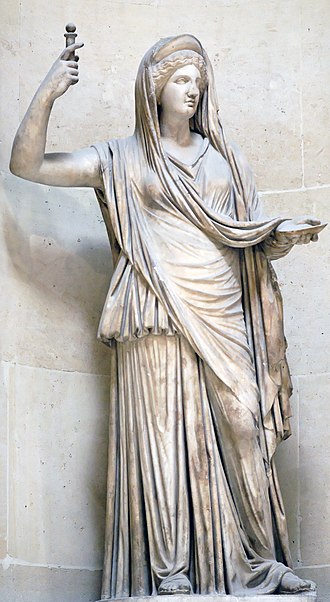
Demeter was often shown with symbols of the harvest, like flowers, fruit, and grain. She was also sometimes shown with her daughter Persephone. In art, the constellation Virgo is linked to her, and it shows a sheaf of wheat, representing her connection to crops.
Description
In the earliest stories, Demeter is the goddess of grain and farming. Over time, her role grew to include the earth itself. She is often linked with the earth goddess Gaia. In many tales, Demeter is called the "Grain-Mother" or the "Earth-Mother." She and her daughter Persephone were connected to life and the underworld.
As the goddess of farming, Demeter gives grain for food and blesses those who harvest it. She was important at Eleusis and became known throughout Greece. In Cyprus, people spoke of "grain-harvesting" in relation to her. Demeter was called the "Mother Earth" who provided grains. Many names describe her role with grain, such as "bringer of sheaves" and "reaper." She was seen as the source of food and plenty.
The central idea in the Eleusinian Mysteries was the reunion of Persephone with Demeter, linking new crops with old seeds, a symbol of eternity. Demeter’s great gifts to people were farming, which led to a settled way of life, and the Mysteries, which gave hope for life beyond this world. These gifts were closely tied together in her stories and rituals. Her symbol is the poppy, a bright red flower that grows among barley.
In addition to farming, Demeter was also seen as a goddess of the earth where crops grow. Her identity was linked to the earth goddess Gaia. In some places, she was called Anesidora, sending gifts up from the underworld.
In Sparta, she was known as Demeter-Chthonia. In Elis, she was called Demeter-Chamyne, linked to old beliefs about the underworld. At Levadia, she was known as Demeter-Europa and tied to Trophonius, an ancient underworld figure.
Pindar used the name Chalkokrotos for her. In central Greece, she was called Amphictyonis, and was the patron goddess of an ancient group of nearby towns. The Athenians called the dead "Demetrioi," showing a link between Demeter and beliefs about death and new life from the earth.
In Arcadia, Demeter had names linking her to darker themes and the underworld. In Pheneus, she was known as Cidaria.
Theocritus described Demeter as a goddess of poppies. Karl Kerényi thought poppies were part of a Cretan worship that later became part of the Eleusinian Mysteries in Classical Greece. He believed the Great Mother Goddess, known as Rhea and Demeter, brought poppies from Crete to Eleusis.
Epithets
See Category:Epithets of Demeter
- Antaea: A name meaning "A goddess whom people can pray to". This name was used for Demeter and also for other goddesses like Rhea and Cybele.
- Amphictyonis: A special form of Demeter honored at Anthela because leaders from Thermopylae would meet there. People made offerings to her when these meetings started.
- Azesia: This name was used in old Greek sayings. One saying, "Amaia looked for Azesia", talked about Demeter’s long search for her daughter. It meant looking for something for a very long time.
- Chloe: Meaning "Blooming" or "fresh green growth", this name celebrated the time when plants start to grow again. A festival called Chloeia was held in Athens in spring to honor her, with happy celebrations and a goat sacrifice.
- Chrysaoros: This name meant "Lady of the Golden Blade", referring to the golden blades of wheat.
- Chthonia: Meaning "Of the earth", this name was used for Demeter and other earth-connected goddesses like Hecate and Nyx.
- Daduchos: Meaning "torch-bearer", this name reminded us of Demeter searching for her lost daughter with a torch. It was also a title for priests at important ceremonies in Rhodes Island, Greece.
- Rharias or Rarias: From the Rarian Field.
Worship
In Crete
In Crete, people honored a goddess of nature who helped plants grow and cared for new life. She was very connected to the earth and the world below. People saw her as a strong mother figure. They believed she was linked to caves and the natural world.
On the Greek mainland
Many cities in Greece had special ceremonies for Demeter. These were important because Demeter was the goddess of crops and food. The city of Eleusis was well-known for its ceremonies to honor Demeter.
Probably the earliest group of cities joined together around the worship of Demeter was at Anthele, near Thermopylae.
Mysian Demeter had a seven-day festival at Pellené in Arcadia. The writer Pausanias visited the shrine to Mysian Demeter and said it was founded by an Argive named Mysius who honored Demeter.
"Saint Demetra"
Main article: Caryatids of Eleusis
Even after rules changed and people could no longer follow old traditions, many in Greece still prayed to Demeter, calling her "Saint Demetra". They believed she helped their crops grow. In the past, people placed flowers at a special statue to keep their fields fertile. This stopped when the statue was moved to a museum.
Festivals
Main articles: Eleusinian Mysteries and Thesmophoria
Demeter had two big festivals. One was called Thesmophoria and was only for women. The other was the Eleusinian mysteries, where anyone could join. Both festivals told stories about Demeter and her daughter Persephone.
Conflation with other goddesses
Later, Demeter was linked with the Roman goddess Ceres. This happened around 205 BC when Rome asked different gods for help. The festivals for Demeter and Ceres were very similar, and both celebrated good crops and healthy families.
Demeter was also sometimes seen as the same as Cybele, a goddess from Phrygia. The stories about Demeter and Persephone were similar to stories about Cybele and Attis.
Some old stories mixed many great goddesses together into one. The writer Apuleius said that Ceres, who we know as Demeter, was really the same as Isis, a goddess honored by the Egyptians.
Mythology
Hesiod’s Theogony describes Demeter as the second child of the Titans Cronus and Rhea, and the sister of Hestia, Hera, Hades, Poseidon, and Zeus. Along with her sisters and brothers, except her youngest brother Zeus, Demeter was swallowed as a newborn by her father because he feared being overthrown by one of his children. She was later freed when Zeus made Cronus disgorge all of his children. Zeus then led his siblings in a war against their father and the other Titans. Cronus was supplanted by this new generation of deities, and Demeter became one of the Olympian gods, the new rulers of the cosmos, alongside her brothers and sisters.
Demeter is known as the mother of Persephone, described as the result of a union with Zeus. There is some evidence that the figures of the Queen of the Underworld and the daughter of Demeter were initially considered separate goddesses. However, they became connected by the time of Hesiod in the 7th century BC. Demeter and Persephone were often worshipped together and were referred to by joint titles. In their cult at Eleusis, they were called “the goddesses,” usually distinguished as “the older” and “the younger.” In Rhodes and Sparta, they were worshipped as “the Demeters.” In the Thesmophoria, they were known as “the thesmophoroi.” In Arcadia they were known as “the Great Goddesses” and “the mistresses.” In Mycenaean Pylos, Demeter and Persephone were probably called the “queens.”
According to Diodorus Siculus, in his Bibliotheca historica written in the 1st century BC, Demeter and Zeus were also the parents of Dionysus. Diodorus described the myth of Dionysus’s double birth and how Demeter gathered up his remains so that he could be born a third time. Diodorus states that Dionysus’s birth from Zeus and his older sister Demeter was a minority belief, as most sources state that the parents of Dionysus were Zeus and Persephone, and later Zeus and Semele.
In Arcadia, a major Arcadian deity known as Despoina (“Mistress”) was said to be the daughter of Demeter and Poseidon. According to Pausanias, a Thelpusian tradition said that during Demeter’s search for Persephone, Poseidon pursued her. Demeter turned into a horse to avoid her younger brother’s advances. However, he turned into a stallion and mated with the goddess, resulting in the birth of the horse god Arion.
Both Homer and Hesiod, writing around 700 BC, described Demeter making love with the agricultural hero Iasion in a ploughed field during the marriage of Cadmus and Harmonia. According to Hesiod, this union resulted in the birth of Plutus.
Abduction of Persephone
Main article: Rape of Persephone
Demeter searched for her missing daughter Persephone for nine days, worried and sad. Hecate told her that while she had not seen what happened to Persephone, she heard her cries. Together the two goddesses went to Helios, the sun god, who witnessed everything that happened on earth. Helios then told Demeter that her brother Hades, god of the Underworld, had taken Persephone to be his wife with the permission of Zeus, the girl’s father. Demeter was very upset, and so the seasons stopped and all living things began to die. To save all life on earth, Zeus sent his messenger Hermes to the Underworld to bring Persephone back to her mother. Hades agreed to release her if she had eaten nothing while in his realm, but Persephone had eaten a small number of pomegranate seeds. This bound her to Hades and the Underworld for certain months of every year, most likely the dry Mediterranean summer, when plant life is threatened by drought.
Demeter at Eleusis
Demeter’s search for her daughter Persephone took her to the palace of Celeus, the King of Eleusis in Attica. She assumed the form of an old woman and asked him for shelter. He took her in, to nurse Demophon and Triptolemus, his sons by Metanira. To reward his kindness, she planned to make Demophon immortal; she secretly anointed the boy with ambrosia and laid him in the hearth’s flames to gradually burn away his mortal self. But Metanira walked in, saw her son in the fire and screamed in fright. Demeter abandoned the attempt. Instead, once Persephone returned from the underworld, she and Demeter taught Triptolemus the secrets of agriculture, and he, in turn, taught them to any who wished to learn them. Thus, humanity learned how to plant, grow and harvest grain.
Demeter and Iasion
Homer’s Odyssey contains perhaps the earliest direct references to the myth of Demeter and her consort Iasion, a Samothracian hero whose name may refer to bindweed, a small white flower that frequently grows in wheat fields. In the Odyssey, Calypso describes how Demeter, “without disguise,” made love to Iasion. However, Ovid states that Iasion lived to old age as the husband of Demeter. In ancient Greek culture, part of the opening of each agricultural year involved the cutting of three furrows in the field to ensure its fertility.
Demeter and Poseidon
In Arcadia, located in what is now southern Greece, the major goddess Despoina was considered the daughter of Demeter and Poseidon Hippios (“Horse-Poseidon”). In the associated myths, Poseidon represents the river spirit of the Underworld, and he appears as a horse. The myth describes how he pursued his older sister, Demeter, who hid from him among the horses of the king Onkios. Poseidon caught and mated with his older sister in the form of a stallion. Demeter was furious at Poseidon’s actions; in this furious form, she became known as Demeter Erinys. Her anger at Poseidon drove her to dress all in black and retreat into a cave to purify herself. Demeter’s absence caused the death of crops, livestock, and eventually of the people who depended on them.
Demeter and Erysichthon
Another myth involving Demeter’s anger resulting in famine is that of Erysichthon, king of Thessaly. The myth tells of Erysichthon ordering all of the trees in one of Demeter’s sacred groves to be cut down. Demeter punished the king by calling upon Limos, the spirit of hunger, to enter his stomach. The more the king ate, the hungrier he became. Eventually, he ate himself.
Wrath myths
According to Ovid, Demeter gave the Sirens, the companions of Persephone, wings to search for her daughter when she was abducted by Hades.
While travelling far and wide looking for her daughter, Demeter arrived exhausted in Attica. A woman named Misme took her in and offered her a cup of water. Demeter, in her thirst, swallowed the drink clumsily. Witnessing that, Misme’s son Ascalabus laughed, mocked her, and asked her if she would like a deep jar of that drink. Demeter then poured her drink over him and turned him into a gecko.
Demeter pinned Ascalaphus under a rock for reporting to Hades that Persephone had consumed some pomegranate seeds. Later, after Heracles rolled the stone off Ascalaphus, Demeter turned him into a short-eared owl instead.
Before Hades abducted Persephone, he had kept Minthe as his mistress. But after he married Persephone, he set Minthe aside. Minthe would often brag about being lovelier and more queenly than Persephone. Demeter, hearing that insult towards her daughter, grew angry and trampled Minthe; from the earth then sprang a lovely-smelling herb named after the nymph.
In an Argive myth, when Demeter travelled to Argolis, a man named Colontas refused to receive her in his house, whereas his daughter Chthonia disapproved of his actions. Colontas was punished by being burnt along with his house, but Demeter took Chthonia to Hermione, where she built a sanctuary for the goddess.
Once, the Colchian princess Medea ended a famine that plagued Corinth by making sacrifices to Demeter and the nymphs.
Favour myths
During her wanderings, Demeter came upon the town of Pheneus; to the Pheneates that received her warmly and offered her shelter, she gave all sorts of pulse, except for beans. Two of the Pheneates, Trisaules and Damithales, had a temple of Demeter built for her. Demeter also gifted a fig tree to Phytalus, an Eleusinian man, for welcoming her in his home.
Demeter gave Triptolemus her serpent-drawn chariot and seed and bade him scatter it across the earth. Triptolemus rode through Europe and Asia until he came to the land of Lyncus, a Scythian king. Demeter then saved Triptolemus by turning Lyncus into a lynx and ordered Triptolemus to return home airborne.
When her son Philomelus invented the plough and used it to cultivate the fields, Demeter was so impressed by his good work that she immortalized him in the sky by turning him into a constellation, the Boötes.
In the tale of Eros and Psyche, Demeter, along with her sister Hera, visited Aphrodite.
Hierax, a man of justice and distinction, set up sanctuaries for Demeter and received plenteous harvests from her in return.
Besides giving gifts to those who were welcoming to her, Demeter was also a goddess who nursed the young; all of Plemaeus’s children born by his first wife died in a cradle; Demeter took pity on him and reared himself his son Orthopolis. Plemaeus built a temple to her to thank her. Demeter also raised Trophonius, the prophetic son of either Apollo or Erginus.
Other accounts
Demeter seems to have accompanied Dionysus when he descended into the Underworld to retrieve his mother Semele.
Once Tantalus, a son of Zeus, invited the gods over for dinner. Tantalus, wanting to test them, cut his son Pelops, cooked him and offered him as a meal to them. They all saw through Tantalus’s crime except Demeter, who ate Pelops’s shoulder before the gods brought him back to life.
| Offspring | Father | Source | Date | |
|---|---|---|---|---|
| Persephone | Zeus | Hes. Theog. | 8th cent. BC | |
| Dionysus | Diod. Sic. | 1st cent. BC | ||
| Arion, Despoina | Poseidon | Paus. | 2nd cent. AD | |
| Plutus | Iasion | Hes. Theog. | 8th cent. BC | |
| Philomelus | Hyg. De astr. | 1st cent. BC/AD | ||
| Hecate | No father mentioned | Orphic frr. | ||
| Eubuleus | Diod. Sic. | 1st cent. BC |
Genealogy
Demeter is the daughter of two important gods: Cronus and Rhea. She is the sister of other powerful gods, including Zeus, who rules the heavens. Demeter has children, and the most well-known is Persephone. Persephone spends part of each year with her below the earth.
Images
Related articles


This article is a child-friendly adaptation of the Wikipedia article on Demeter, available under CC BY-SA 4.0.
Images from Wikimedia Commons. Tap any image to view credits and license.