 Safekipedia
SPQR
Adapted from Wikipedia · Adventurer experience
SPQR or S.P.Q.R. stands for Senatus Populusque Romanus, which means "The Senate and People of Rome." This Latin phrase was very important in ancient Rome. It showed the power of the Roman Republic.
You can find SPQR on many old Roman buildings and statues. It was used to show that the government of Rome approved of these works. Famous writers like Cicero and Livy also used this phrase when they wrote about Rome's history.
This short set of letters has become a symbol of ancient Rome and its way of governing. Even today, people remember SPQR when they think about the powerful Roman Republic.
Translation
In Latin, Senātus means "Senate". The word Populusque joins Populus, meaning "the People", with -que, a small word that means "and". The last word, Rōmānus, means "Roman" and talks about both the Senate and the People. So, the phrase can be translated as "The Roman Senate and People", or more simply as "The Senate and People of Rome".
Historical context
The phrase SPQR first appeared in old writings during the Late Republic, around 80 BC. Before that, coins showed the name ROMA. The phrase was used until the time of Emperor Constantine the Great, who ruled from 312 to 337 AD and supported Christianity.
During the Roman Empire, emperors were seen as the representatives of the people. Even though the Senate made rules, the emperor had the real power. The Roman people were known for their dignity, majesty, authority, and freedom. They believed all authority came from the people.
The government was split into the Senate and the comitia centuriata, a group that helped protect the people’s will. This idea of the people having power influenced later revolutions.
Medieval use
In 1184, Rome's leaders began putting the words SENATVS P Q R on their coins. Later, from 1414 to 1517, the Roman Senate used coins with a special shield that showed the letters SPQR.
Modern use
SPQR is still used today on the official symbol of Rome and in important papers for the city of Rome. In Italy, people sometimes joke that SPQR stands for "Sono Pazzi Questi Romani" which means "They're crazy, these Romans." SPQR also appears on the symbol of a special part of the Italian army.
In business, especially in English-speaking countries, SPQR is sometimes used in a funny way to mean "Small Profits, Quick Returns," usually by people who learned Latin in school.
Civic references
SPQx is sometimes used to show love and pride for a city. For example, the town of Reggio Emilia uses SPQR on its symbol, where it means Senatus Populusque Regiensis. There are historic examples of cities and towns using the "SPQx" style in many places.
| City | Country | SPQx | Latin | Where has it been used | Image |
|---|---|---|---|---|---|
| Alkmaar |  Netherlands Netherlands | SPQA | On the façade of the Waag building | ||
| Amsterdam | Netherlands | SPQA | Senatus Populusque Amstelodamensis | At the Stadsschouwburg theater on Leidseplein and some of the bridges | 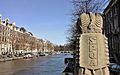 |
| Antwerp |  Belgium Belgium | SPQA | Senatus Populusque Antverpensis | On Antwerp City Hall and other public buildings and schools |  |
| Ascoli Piceno |  Italy Italy | SPQA | Senatus Populusque Asculum | On the wall above the south loggia of the Piazza del Popolo | |
| Basel |  Switzerland Switzerland | SPQB | Senatus Populusque Basilea | On the Webern-Brunnen in Steinenvorstadt | |
| Benevento | Italy | SPQB | Senatus Populusque Beneventanus | On manhole covers | |
| Bologna | Italy | SPQB | Senatus Populusque Bonononiensis | On the Fountain of Neptune | |
| Bremen |  Germany Germany | SPQB | In Bremen City Hall. | ||
| Bruges | Belgium | SPQB | On its coat of arms | ||
| Brussels | Belgium | SPQB | Senatus Populusque Bruxellensis (of the city) or Senatus Populusque Belgicus (of the country) | Repeatedly on the Palace of Justice, over the main stage of the Royal Theatre of La Monnaie, and on the ceiling of the hemicycle of the Belgian Senate in the Palace of the Nation. | |
| Capua | Italy | SPQC | |||
| Catania | Italy | SPQC | On manhole covers | ||
| Chicago |  United States United States | SPQC | Senatus Populusque Chicago | On the George N. Leighton Cook County Criminal Courthouse | |
| Dublin |  Ireland Ireland | SPQH | Senatus Populusque Hibernicus | On the City Hall, built in 1769 | |
| Florianópolis |  Brazil Brazil | SPQF | Senatus Populusque Florianopolitanus | ||
| Franeker | Netherlands | SPQF | At the a gate on the Westerbolwerk and Academiestraat 16 | ||
| Freising | Germany | SPQF | Above the door of the town hall | ||
| Ghent | Belgium | SPQG | Senatus Populusque Gandavensis | On the opera house, theatre and some other major buildings, inscribed on a shield on coins struck in Ghent in 1583, during the Dutch Revolt |  |
| Groningen | Netherlands | SPQG | Above the entrance of the Der Aa-kerk | ||
| The Hague | Netherlands | SPQH | Above the stage in the Koninklijke Schouwburg | ||
| Hamburg | Germany | SPQH | On a door in the city hall (Hamburg Rathaus) |  | |
| Hanover | Germany | ||||
| Haarlem | Netherlands | SPQH | On the façade of the town hall at the "Grote Markt" | ||
| Hasselt | Belgium | SPQH | |||
| Hindeloopen | Netherlands | SPQH | Senatus Populusque Hindelopia | On a stone pole next to the Oosterdijk, a road between Hindeloopen and Workum. |  |
| Istanbul |  Turkey Turkey | SPQC | Senatus Populusque Constantinopolitanus | ||
| Kortrijk | Belgium | SPQC | Senatus Populusque Cortoriacum | On the City hall | |
| Kraków |  Poland Poland | SPQC | Senatus Populusque Cracoviensis | Over the Waza Gate in Wawel Castle |  |
| La Plata |  Argentina Argentina | SPQR | On a monument outside of the city's casco urbano | ||
| Leeuwarden | Netherlands | SPQL | Senatus Populusque Leovardia | On the mayor's chain of office | |
| Leuven | Belgium | SPQL | Senatus Populusque Leuvensis | Over the painting of Jesus in the back reception room inside Leuven Town Hall | |
| Liverpool |  United Kingdom United Kingdom | SPQL | Senatus Populusque Liverpudliensis | On various gold doors in St George's Hall | |
| City of London | United Kingdom | SPQL | Senatus Populusque Londiniensis | On historic variants of the City's coat of arms | |
| Lübeck | Germany | SPQL | Senatus Populusque Lubecensis | On the Holstentor |  |
| Lucerne | Switzerland | ||||
| Madrid |  Spain Spain | SPQM | Senatus Populusque Matritensis | On the Fuente de Apolo, built in 1780 | |
| Milan | Italy | SPQM | The Holy Roman Emperor Charles V struck coins at Milan with the inscription S P Q Mediol Optimo Principi. | ||
| Modica | Italy | SPQM | On the coat of arms | ||
| Molfetta | Italy | SPQM | On the coat of arms | ||
| Naples | Italy | SPQN | Senatus Populusque Neāpolis | Inscribed on a shield on coins struck during Masaniello's 1647 revolt | |
| Noto | Italy | SPQN | Senatus Populusque Netum | On the coat of arms and the façade of Noto Cathedral. | |
| Nuremberg | Germany | SPQN | Senatus Populusque Norimbergensis | On the Charles Bridge (one of the major bridges over river Pegnitz in the inner city) |  |
| Oudenburg | Belgium | SPQO | Senatus Populusque Odenburgensis | On its water pump next to the market square | |
| Olomouc |  Czech Republic Czech Republic | SPQO | Senatus Populusque Olomucensis | On the coat of arms | |
| Palermo | Italy | SPQP | |||
| Penne, Abruzzo | Italy | SPQP | |||
| Pontecorvo | Italy | SPQF | Used as motto for municipal coat of arms | ||
| Rieti | Italy | SPQS | Senatus Populusque Sabinus | On the coat of arms, present also in the modern composite Lazio coat-of-arms | |
| Rotterdam | Netherlands | SPQR | Mural in the Burgerzaal of Rotterdam City Hall |  | |
| Severn Beach | United Kingdom | SPQR | On the crest of Pilning & Severn Beach Parish Council | ||
| Seville | Spain | SPQH | Senatus Populusque Hispalensis | On the historic banner of the city | |
| Siena | Italy | SPQS | On the base of a statue of the Capitoline Wolf | ||
| Solothurn | Switzerland | SPQS | Senatus Populusque Solodori | On the Cathedral of St Ursus and Victor | |
| Terracina | Italy | SPQT | |||
| Tivoli, Lazio | Italy | SPQT | |||
| Toruń | Poland | SPQT | Senatus Populusque Thorunensis | On the City Hall | |
| Valencia | Spain | SPQV | Senatus Populusque Valentinus | In several places and buildings, including the Silk Exchange and the University of Valencia Historic Building. | |
| Verviers | Belgium | SPQV | On the Grand Theatre | ||
| Vienna |  Austria Austria | SPQV | Senatus Populusque Viennensis | Above the main entrance of the civic armoury (Bürgerliches Zeughaus) at Am Hof, with a dedication to Holy Roman Emperor Charles VI (Imperante Carolo VI. instauravit) |  |
| Winschoten | Netherlands | SPQW | Senatus Populesque Winschotanus | On the façade of the municipal office (stadhuis) of Oldambt |  |
| Workum | Netherlands | SPQW | On a stone pole next to the Oosterdijk, a road between Hindeloopen and Workum. |  |
Related articles


This article is a child-friendly adaptation of the Wikipedia article on SPQR, available under CC BY-SA 4.0.
Images from Wikimedia Commons. Tap any image to view credits and license.