 Safekipedia
Winter solstice
Adapted from Wikipedia · Adventurer experience
The winter solstice, or hibernal solstice, is a special moment in the year when one of Earth's poles tilts the farthest away from the Sun. This happens twice every year, once in each part of the world (Northern and Southern). During the winter solstice, the place where the solstice happens has the shortest day and the longest night of the year. The Sun also appears the lowest in the sky all year long.
In the Northern Hemisphere, the winter solstice happens in December, usually on December 21 or 22. In the Southern Hemisphere, it happens in June, usually on June 20 or 21. Many people think of this time as the middle of winter, and it is sometimes called "midwinter."
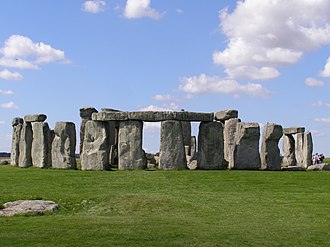
Since ancient times, many cultures have celebrated the winter solstice with special festivals and events. Some very old buildings like Newgrange, Stonehenge, and Cahokia Woodhenge are built in a way that they line up with the sunrise or sunset on the winter solstice.
History and cultural significance
The winter solstice is the time when the Sun stops getting lower in the sky and starts to climb higher again. In ancient Europe, people thought this meant the Sun was born again or a Sun god was coming back to life.
Many cultures saw the winter solstice as an important time. They used it to plan farming, like when to plant seeds or when animals should mate. Because animals were often killed in winter so they wouldn’t need to be fed, this was also a special time for feasts with plenty of fresh meat.
Neolithic Europe
Important ancient buildings like Stonehenge in England and Newgrange in Ireland were built to show the winter solstice. Newgrange has a special window that lets sunlight shine into the main room only on the winter solstice. At Stonehenge, the stones are lined up to point toward the sunset on the winter solstice. The Goseck Circle in Germany also has openings that point to the sunrise and sunset on the winter solstice.
Ancient Egypt
Some temples in ancient Egypt, like the Temple of Amun-Ra at Karnak, are lined up with the winter solstice sunrise. People in Egypt told stories about gods being born on the winter solstice. They celebrated this time by bringing out statues of child gods and holding special ceremonies.
Ancient Roman world
In ancient Rome, December 25 was the winter solstice. Roman writers described this as the middle of winter or the beginning of the “new Sun.” In the year 274, the emperor Aurelian made this day a festival called Dies Natalis Solis Invicti, meaning the birthday of the “Invincible Sun.” This festival became part of the happy Roman holiday season called Saturnalia. The winter solstice also influenced the choice of December 25 as the date for Christmas.
Germanic
Main article: Midwinter
In Scandinavia, people celebrated a big festival after the winter solstice to welcome back the daylight. In Anglo-Saxon England, the winter solstice was called midwinter and was linked to Christmas. The Anglo-Saxons had a festival called Mōdraniht (‘Mothers’ Night’) around this time. They also used the word Giuli, an early form of “Yule,” to describe the winter solstice period. In North Germanic peoples cultures, Yule (Jól) was a winter holiday. After Christianity spread, Yule became part of Christmas celebrations.
Albanian
Albanian traditional festivities around the winter solstice celebrate the Sun’s return and longer days ahead. These celebrations include special fires, rituals for good luck, and traditional foods. One important celebration is Nata e Buzmit, or “Yule log’s night,” which takes place between December 22 and January 6.
East Asian
Main article: Dongzhi Festival
In East Asia, the winter solstice is celebrated as Dongzhi (冬至) in Chinese, one of the Twenty-four Solar Terms. In Japan, people have a custom of soaking in a special hot bath with yuzu fruit to stay warm in winter.
Indian
Main article: Makar Sankranti
Makara Sankranti, also called Maghi, is a Hindu festival that marks the Sun’s move into Capricorn. It occurs in January and celebrates the end of the winter solstice and the beginning of longer days.
Iranian
Main article: Yaldā Night
In Iran, the winter solstice night is called Yalda night, meaning the “longest and darkest night of the year.” Families gather to eat, drink, and enjoy poetry. Special foods like nuts, pomegranates, and watermelons are part of the celebration.
Judaic
An old story from Jewish tradition tells how the first person, Adam, noticed the days getting shorter and thought the world was ending. He fasted for eight days, then when the days began to grow longer again at the winter solstice, he celebrated for eight days. This idea later influenced other festivals.
Observation
Main article: Solstice § Solstice determination
The exact moment of the winter solstice can be found with special tools, but it is hard to see it happen just by looking outside. The Sun moves very slowly and seems to pause for a moment, which is what "solstice" means.
We know the exact time now because we have tools that track the stars and planets.
We cannot see the exact moment the solstice happens because we only notice the Sun has stopped moving after we see it change direction. To know the solstice happened on a particular day, we watch for small changes in where the Sun rises or sets. This can be done by watching the sunrise and sunset or by using special instruments. The dates for the earliest sunset and latest sunrise are different from the solstice and depend on where you live on Earth.
List of winter solstice festivals and observances
Many cultures around the world have special festivals during the winter solstice. Some of these are Alban Arthan from Druidism, Blue Christmas in Western Christian traditions, and Dies Natalis Solis Invicti from Ancient Rome. Other celebrations include the Dongzhi Festival in East Asia, Inti Raymi of the Inca, and Koliada and Korochun from Slavic traditions.
There are also Midwinter Day observed in Antarctica, Mōdraniht from Anglo-Saxon paganism, and Shalako of the Zuni people. Festivals such as Uttarayana in India, We Tripantu from the Mapuche, and Willkakuti of the Aymara people mark this time of year. Yalda Night is celebrated in western and Central Asia, while Yule comes from Germanic traditions. Ziemassvētki is observed in Latvia, and Pongal takes place in Tamil Nadu, India.
Other related festivals
Other festivals linked to the winter solstice include the Feast of Ezid among the Yazidi, celebrated on the last Friday before the solstice. In Ancient Rome, Saturnalia and Brumalia were held. Wren Day is observed in Ireland and the Isle of Man. Saint Lucy's Day, a Christian celebration, once fell on the winter solstice but is now observed on December 13. The Cold Food Festival in Greater China and Korea occurs 105 days after the winter solstice. Makar Sankranti in India is a harvest festival held 24 days after the solstice. Modern festivals such as Burning the Clocks in England and the Winter at Tantora Festival in Saudi Arabia also take place around this time. In the southern hemisphere, Saint John's Eve is celebrated.
Images
Related articles


This article is a child-friendly adaptation of the Wikipedia article on Winter solstice, available under CC BY-SA 4.0.
Images from Wikimedia Commons. Tap any image to view credits and license.