 Safekipedia
Yukon River
Adapted from Wikipedia · Adventurer experience
The Yukon River is a big river in northwestern North America. It starts in British Columbia and flows through the Canadian territory of Yukon. The lower part of the river goes through the U.S. state of Alaska and ends in the Bering Sea at the Yukon–Kuskokwim Delta. The river is very long, about 3,190 kilometres (1,980 miles).
It was an important way to travel during the Klondike Gold Rush. People used paddle-wheel riverboats on the river until the 1950s, when the Klondike Highway was built. After the United States bought Alaska, the Alaska Commercial Company set up places along the river.
Today, there have been some problems with pollution in the Yukon River, but it is still considered to have good water quality. The Yukon River Inter-Tribal Watershed Council works with many First Nations and tribes to keep the river safe and clean.
Name
The name Yukon comes from a phrase used by the Gwich’in people. It means white water river. This describes the pale colour of the river’s water from glacial runoff. In the 1840s, people had different ideas about what the name meant. Some thought it meant big river, while others thought it meant white water river. Over time, the name Yukon became the common name for the river.
The upper part of the Yukon was once called the Lewes River, from Marsh Lake to where the Pelly River meets it at Fort Selkirk.
Course
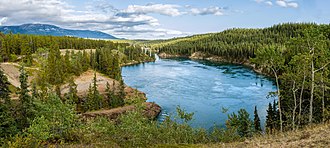
The Yukon River is a long river in northwestern North America. It begins in the Coast Mountain range in British Columbia. From there, it flows through Yukon and then into Alaska.
The river passes many towns and villages. It flows by Whitehorse, Dawson City, and many places in Alaska. Near the end, the river spreads out into smaller channels before reaching the ocean.
Hazards
The Yukon River has some places that can make travel tricky. Two notable spots are the Five Finger Rapids and Rink Rapids, both found downstream from Carmacks.
Bridges
The Yukon River is very long, but there are only four bridges for cars crossing it. The bridges are:
- The Lewes Bridge, north of Marsh Lake, Yukon, on the Alaska Highway;
- The Robert Campbell Bridge, linking the Whitehorse suburb of Riverdale to the downtown area;
- The Yukon River Bridge in Carmacks, Yukon, on the Klondike Highway; and
- The Yukon River Bridge, north of Fairbanks, Alaska on the Dalton Highway.
In summer, a car ferry crosses the river at Dawson City; in winter, an ice bridge is used instead. Plans for a permanent bridge were announced but stopped because it cost too much.
There are also two bridges just for walking in Whitehorse, plus a dam and a hydroelectric power station. Building the dam filled in the White Horse Rapids, which is why the city is named Whitehorse, and created Schwatka Lake.
In summer, boats called barges carry heavy goods, oil, and vehicles along the river to places such as Tanana on the Yukon River and Nenana on the Tanana River. This service is run by Ruby Marine.
Ecology
The upper slopes of the Yukon River watershed, such as the Nulato Hills, are home to Black Spruce trees. This area near the Seward Peninsula is where the Black Spruce is found farthest west. It is one of the most common trees in northern North America.
The Yukon River flows through several important protected areas and wildlife refuges, including:
- Innoko National Wildlife Refuge
- Nowitna National Wildlife Refuge
- Yukon-Charley Rivers National Preserve
- Yukon Delta National Wildlife Refuge
- Yukon Flats National Wildlife Refuge
Discharge
The Yukon River at Pilot Station has different levels of water flow. There are records of the least water, the usual amount, and the most water that flows through this part of the river.
| Water year | Discharge (Period: 1975/10/01 – 2024/09/30) | ||||||
|---|---|---|---|---|---|---|---|
| Min | Mean | Max | |||||
| cfs | m3/s | cfs | m3/s | km3 | cfs | m3/s | |
| 1975/76 | 65,000 | 1,840 | 218,300 | 6,182 | 195 | 700,000 | 19,800 |
| 1976/77 | 44,000 | 1,250 | 204,100 | 5,779 | 182 | 669,000 | 18,900 |
| 1977/78 | 42,000 | 1,190 | 185,300 | 5,247 | 166 | 465,000 | 13,200 |
| 1978/79 | 40,000 | 1,130 | 224,200 | 6,349 | 200 | 587,000 | 16,600 |
| 1979/80 | 50,000 | 1,420 | 236,900 | 6,708 | 212 | 660,000 | 18,700 |
| 1980/81 | 40,000 | 1,130 | 229,600 | 6,502 | 205 | 563,000 | 15,900 |
| 1981/82 | 38,000 | 1,080 | 240,800 | 6,819 | 215 | 866,000 | 24,500 |
| 1982/83 | 45,000 | 1,270 | 218,900 | 6,199 | 196 | 554,000 | 15,700 |
| 1983/84 | 35,000 | 990 | 231,900 | 6,567 | 207 | 642,000 | 18,200 |
| 1984/85 | 40,000 | 1,130 | 239,200 | 6,773 | 214 | 1,100,000 | 31,150 |
| 1985/86 | 50,000 | 1,420 | 231,400 | 6,553 | 207 | 585,000 | 16,600 |
| 1986/87 | 47,000 | 1,330 | 223,800 | 6,337 | 200 | 649,000 | 18,400 |
| 1987/88 | 50,000 | 1,420 | 218,700 | 6,193 | 195 | 680,000 | 19,300 |
| 1988/89 | 55,000 | 1,560 | 225,500 | 6,385 | 202 | 800,000 | 22,650 |
| 1989/90 | 47,000 | 1,330 | 235,400 | 6,666 | 210 | 900,000 | 25,500 |
| 1990/91 | 50,000 | 1,420 | 249,800 | 7,074 | 223 | 1,070,000 | 30,300 |
| 1991/92 | 46,000 | 1,300 | 239,500 | 6,782 | 214 | 788,000 | 22,300 |
| 1992/93 | 50,000 | 1,420 | 240,400 | 6,807 | 215 | 854,000 | 24,200 |
| 1993/94 | 50,000 | 1,420 | 253,700 | 7,184 | 227 | 660,000 | 18,700 |
| 1994/95 | 42,000 | 1,190 | 218,300 | 6,182 | 195 | 696,000 | 19,700 |
| 1995/96 | 36,000 | 1,020 | 209,700 | 5,938 | 187 | 502,000 | 14,200 |
| 1996/97 | No incomplete data have been used for statistical calculation | ||||||
| 1997/98 | |||||||
| 1998/99 | |||||||
| 1999/00 | |||||||
| 2000/01 | 46,000 | 1,300 | 249,500 | 7,067 | 223 | 901,000 | 25,500 |
| 2001/02 | 38,000 | 1,080 | 210,400 | 5,958 | 188 | 884,000 | 25,000 |
| 2002/03 | 48,000 | 1,360 | 236,500 | 6,697 | 211 | 543,000 | 15,400 |
| 2003/04 | 46,500 | 1,320 | 211,800 | 5,998 | 189 | 648,000 | 18,350 |
| 2004/05 | 41,000 | 1,160 | 254,600 | 7,209 | 228 | 1,240,000 | 35,100 |
| 2005/06 | 45,000 | 1,270 | 252,300 | 7,144 | 226 | 920,000 | 26,050 |
| 2006/07 | 38,000 | 1,080 | 213,600 | 6,048 | 191 | 531,000 | 15,000 |
| 2007/08 | 40,500 | 1,150 | 231,600 | 6,558 | 207 | 775,000 | 21,950 |
| 2008/09 | 48,000 | 1,360 | 231,900 | 6,567 | 207 | 1,090,000 | 30,900 |
| 2009/10 | 42,000 | 1,190 | 205,600 | 5,822 | 184 | 675,000 | 19,100 |
| 2010/11 | 47,000 | 1,330 | 227,000 | 6,428 | 203 | 670,000 | 19,000 |
| 2011/12 | 44,000 | 1,250 | 247,700 | 7,014 | 221 | 660,000 | 18,700 |
| 2012/13 | 48,500 | 1,370 | 231,700 | 6,561 | 207 | 820,000 | 23,200 |
| 2013/14 | 45,000 | 1,270 | 266,400 | 7,544 | 238 | 553,000 | 15,700 |
| 2014/15 | 55,000 | 1,560 | 229,400 | 6,499 | 205 | 621,000 | 17,600 |
| 2015/16 | 58,000 | 1,640 | 274,600 | 7,776 | 245 | 603,000 | 17,100 |
| 2016/17 | 46,700 | 1,320 | 214,900 | 6,085 | 192 | 562,000 | 15,900 |
| 2017/18 | 48,000 | 1,360 | 257,600 | 7,294 | 230 | 669,000 | 18,900 |
| 2018/19 | 60,900 | 1,730 | 233,300 | 6,606 | 208 | 647,000 | 18,300 |
| 2019/20 | 52,400 | 1,480 | 290,900 | 8,237 | 260 | 704,000 | 19,900 |
| 2020/21 | 50,900 | 1,440 | 262,200 | 7,425 | 234 | 589,000 | 16,700 |
| 2021/22 | 49,400 | 1,400 | 269,900 | 7,643 | 241 | 682,000 | 19,300 |
| 2022/23 | 64,900 | 1,840 | 300,900 | 8,520 | 269 | 1,140,000 | 32,300 |
| 2023/24 | 63,000 | 1,780 | 266,700 | 7,552 | 238 | 664,000 | 18,800 |
Fisheries
The Yukon River is home to one of the longest salmon journeys in the world. Every year, Chinook, coho, and chum salmon travel back to streams in Alaska, the Yukon Territory, and British Columbia. These fish need lots of energy for their long trip.
Villages along the Yukon River have depended on salmon for their culture, food, and jobs. People traditionally dry, smoke, and freeze salmon to eat later, and they also use it to feed their sled dogs. Fishing methods on the Yukon include set gillnets, drift nets, dip nets, and fish wheels.
In recent years, the number of returning salmon has dropped, causing concern. Scientists are studying why this is happening, looking at factors like climate change. Groups from both the U.S. and Canada work together to protect the salmon and support local communities.
Tributaries
The Yukon River has many smaller rivers that flow into it, called tributaries. These rivers join the Yukon in both Canada and the United States.
In Yukon Territory, some important tributaries include the Takhini River, Big Salmon River, Teslin River, Pelly River, Stewart River, and White River.
In Alaska, notable tributaries include the Kandik River, Charley River, Porcupine River, Christian River, Tanana River, and Koyukuk River.
-
Little Salmon River (Yukon)
-
Nordenskiold River
-
- Nadaleen River
- Lansing River
- Hess River
- Mayo River
- McQuesten River
-
- Donjek River
- Kluane River
- Nisling River
- Beaver Creek
- Donjek River
-
Koyukuk River
- Workyard Creek
- Gisasa River
- Kateel River
- Dulbi River
- Huslia River
- Nulitna River
- Tom Cook Slough
- Billy Hawk Creek
- Cutoff Slough
- Hogatza River
- Clear Creek
- Batza River
- Matthews Slough
- Little Indian River
- Indian River
- Calamity Creek
- Pocahontas Creek
- Kanuti River
- Discovery Creek
- Alatna River
- Siruk Creek
- South Fork Koyokouk River
- Jim River
- Jane Creek
- John River
- North Fork Koyukuk River
-
Nulato River
-
Khotol River
-
- Stuyahok River
-
- Paimiut Slough
- Reindeer River
- Iditarod River
- Yetna River
- First Chance Creek
- Mud River
- Dishna River
- Coffee Creek
- Tolstoi Creek
- Madison Creek
- Mastodon Creek
- Hurst Creek
- Taft Creek
- Finland Creek
- Scandinavian Creek
- North Fork Innoko River
- Tango Creek
- West Fork North Fork Innoko River
- Colorado Creek
- Paimiut Slough
-
Kako Creek
-
Engineer Creek
-
Reindeer River
-
Kashunuk River (distributary)
List of major tributaries
The main river and tributaries are (sorted in order from the mouth heading upstream):
*Period: 1971–2000
| Left tributary | Right tributary | Length (km) | Basin size (km2) | Average discharge (m3/s)* |
|---|---|---|---|---|
| Yukon | 3,190 | 854,700 | 7,000 | |
| Yukon Delta | ||||
| Nanvaranak Slough | 1,735 | 28.1 | ||
| Archuelinguk | 56 | 705 | 12.8 | |
| Lower Yukon | ||||
| Andreafsky | 193 | 5,369 | 91.4 | |
| Kashunuk (distributary) | 362 | 2,906 | 51.7 | |
| Atchuelinguk | 266 | 5,439 | 73.8 | |
| Reindeer | 97 | 1,191 | 22 | |
| Talbiksok | 129 | 1,857 | 26.5 | |
| Kako Creek | 550 | 9.8 | ||
| Innoko | 805 | 36,517 | 335.5 | |
| Koserefski | 48 | 897 | 13.1 | |
| Bonasila | 201 | 3,108 | 43.7 | |
| Anvik | 225 | 4,610 | 65 | |
| Khotol | 137 | 2,331 | 40.1 | |
| Nulato | 114 | 2,287 | 54.2 | |
| Koyukuk | 805 | 81,326 | 770 | |
| Bear Creek | 789 | 10.8 | ||
| Kala Creek | 893 | 13 | ||
| Yuki | 137 | 2,771 | 33.4 | |
| Melozitna | 217 | 7,045 | 67.6 | |
| Big Creek | 814 | 4.6 | ||
| Nowitna | 455 | 18,596 | 102.4 | |
| Blind | 34 | 587 | 3.4 | |
| Boney Creek | 72 | 788 | 3.9 | |
| Tozitna | 134 | 4,248 | 28.2 | |
| Tanana | 1,061 | 113,959 | 1,246 | |
| Middle Yukon | ||||
| Hess Creek | 80 | 3,082 | 15.6 | |
| Ray | 69 | 1,751 | 14.2 | |
| Dall | 129 | 3,714 | 17.6 | |
| Old Lost Creek | 10.3 | |||
| Hodzana | 201 | 4,323 | 19.5 | |
| Beaver Creek | 290 | 5,426 | 54.9 | |
| Hadweenzic | 150 | 2,422 | 19.4 | |
| Birch Creek | 241 | 13,064 | 127 | |
| Chandalar | 328 | 24,165 | 141.8 | |
| Christian | 225 | 8,827 | 67.8 | |
| Porcupine | 916 | 116,431 | 623 | |
| Charley | 142 | 4,377 | 22.7 | |
| Kandik | 132 | 2,840 | 19.7 | |
| Nation | 113 | 2,411 | 24.6 | |
| Tatonduk | 110 | 15.6 | ||
| Upper Yukon | ||||
| Seventymile | 93 | 7.5 | ||
| Fortymile | 97 | 16,602 | 79.4 | |
| Klondike | 161 | 8,044 | 63.9 | |
| Indian | 2,242 | 20.4 | ||
| Sixtymile | 137 | 3,719 | 25.4 | |
| Stewart | 533 | 51,023 | 510 | |
| White | 322 | 46,900 | 566 | |
| Pelly | 608 | 48,174 | 412 | |
| Nordenskiöld | 6,371 | 16 | ||
| Little Salmon | 3,626 | 9.7 | ||
| Big Salmon | 240 | 6,760 | 67.6 | |
| 393 | 35,014 | 331 | ||
| Takhini | 180 | 6,993 | 103.1 | |
| Atlin | 6,812 | 110 | ||
In media
The Yukon River was the main setting for a 2015 TV series called Yukon River Run on the National Geographic Channel.
Images
Related articles


This article is a child-friendly adaptation of the Wikipedia article on Yukon River, available under CC BY-SA 4.0.
Images from Wikimedia Commons. Tap any image to view credits and license.