 Safekipedia
Afroasiatic languages
Adapted from Wikipedia · Discoverer experience
The Afroasiatic languages (also known as Afro-Asiatic, Afrasian, Hamito-Semitic, or Semito-Hamitic) are a language family of about 400 languages spoken mostly in West Asia, North Africa, the Horn of Africa, and parts of the Sahara and Sahel. Over 500 million people speak these languages as their first language, making it the fourth-largest language family after Indo-European, Sino-Tibetan, and Niger–Congo.
Most experts split this family into six groups: Berber, Chadic, Cushitic, Egyptian, Omotic, and Semitic. The languages are mainly found in Africa, except for the Semitic group, which began in West Asia.
The five most spoken Afroasiatic languages are Arabic, Hausa language, Oromo language, Amharic, and Somali language. Many older Afroasiatic languages, like Egyptian and Akkadian, are no longer spoken.
Experts are not sure exactly where or when the first Afroasiatic language was spoken, but they think it might have been in Eastern North Africa or Northern East Africa. Some believe it could have been in the Levant. Even the earliest possible dates for this language make Afroasiatic one of the oldest language families known.
Afroasiatic languages share some special features, like certain pronouns and ways to change verbs into nouns. They also have similar ways to show if something is male or female and if there is one or many of something. Some of these languages also have special verb forms that show if something is done to itself, caused to happen, or happened to someone else.
Name
The Afroasiatic language family has several names. The most common ones today are Afroasiatic and Hamito-Semitic. Another older name is Semito-Hamitic.
The name Hamito-Semitic was first used by Friedrich Müller in 1876. It comes from the Bible, where Shem and Ham were sons of Noah. Shem was linked to people like the Jews and Arameans, while Ham was linked to people like the Egyptians and Cushites. However, this biblical idea does not match how we understand languages today.
The name Afroasiatic was popularized by Joseph Greenberg in 1960. It was first used by Maurice Delafosse in 1914. This name highlights that Afroasiatic is the only major language family found in both Africa and Asia. Some scholars, especially in Russia, prefer the name Afrasian. Other less common names include Lisramic and Erythraean.
Distribution and branches
Scholars generally think that the Afroasiatic languages have between five and eight branches. The five that all experts agree on are Berber (also called "Libyco-Berber"), Chadic, Cushitic, Egyptian, and Semitic. Most experts think the Omotic languages are a sixth branch. Because the branches are very different from each other, many scholars call Afroasiatic a "linguistic phylum" instead of a "language family".
M. Victoria Almansa-Villatoro and Silvia Štubňová Nigrelli say there are about 400 languages in Afroasiatic; Ethnologue lists 375 languages. Many scholars think there are fewer languages; the exact number changes depending on how "language" and "dialect" are defined.
Berber
Main article: Berber languages
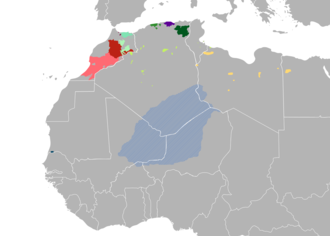
The Berber (or Libyco-Berber) languages are spoken today by maybe 16 million people. Some think they are one language with many dialects. Others think they are about twelve different languages, as different from each other as Romance or Germanic languages. In the past, Berber languages were spoken all over North Africa except in Egypt; since the 7th century CE, though, they have been affected by Arabic and replaced by it in many places.
Two old languages might be related to modern Berber. The first is the Numidian language, known from over a thousand short writings in the Libyco-Berber alphabet, found all over North Africa from the 2nd century BCE. The second is the Guanche language, once spoken on the Canary Islands and gone by the 17th century CE.
The first longer written examples of modern Berber come from the 16th or 17th centuries CE.
Chadic
Main article: Chadic languages
Chadic languages number between 150 and 190, making Chadic the largest group in Afroasiatic by number of languages. The Chadic languages are usually divided into three big groups: East Chadic, Central Chadic, and West Chadic. Most Chadic languages are in the Chad Basin, except for Hausa. Hausa is the largest Chadic language, spoken by many people in Northern Nigeria. It might have as many as 80 to 100 million speakers. Eight other Chadic languages have around 100,000 speakers; other Chadic languages often have few speakers and might be disappearing. Only about 40 Chadic languages have been fully studied by experts.
Cushitic
Main article: Cushitic languages
There are about 30 Cushitic languages, maybe more if Omotic is included, spoken around the Horn of Africa, and in Sudan and Tanzania. The Cushitic group is usually split into four parts: the single language of Beja (about 3 million speakers), the Agaw languages, Eastern Cushitic, and Southern Cushitic. Only one Cushitic language, Oromo, has more than 25 million speakers; other languages with more than a million speakers include Somali, Afar, Hadiyya, and Sidaama. Many Cushitic languages have few speakers. Cushitic does not seem related to the old written languages from its area, Meroitic or Old Nubian. The oldest text in a Cushitic language is probably from around 1770; written forms were made for some Cushitic languages only in the early 20th century.
Egyptian
Main articles: Ancient Egyptian language and Coptic language
The Egyptian group is the stages and forms of one language, Egyptian (often called "Ancient Egyptian"), once spoken in the lower Nile Valley. Egyptian is first seen in writing around 3000 BCE and finally disappeared around 1300 CE, making it the language with the longest writing history in the world. Egyptian is usually split into two big periods, Earlier Egyptian (about 3000 – 1300 BCE), which is further divided into Old Egyptian and Middle Egyptian, and Later Egyptian (1300 BCE – 1300 CE), which is further divided into Late Egyptian, Demotic, and Coptic. Coptic is the only stage written alphabetically to show vowels, while Egyptian was written in Egyptian hieroglyphs, which show only consonants. In the Coptic time, there is evidence for six big dialects, which probably existed before but are hidden by pre-Coptic writing; also, Middle Egyptian seems based on a different dialect than Old Egyptian, which in turn looks similar to Late Egyptian. Egyptian was replaced by Arabic as the spoken language of Egypt, but Coptic is still the special language of the Coptic Orthodox Church.
Omotic
Main article: Omotic languages
The about 30 Omotic languages are still mostly not studied well by experts. They are all spoken in southwest Ethiopia except for the Ganza language, spoken in Sudan. Omotic is usually split into North Omotic (or Damotic) and South Omotic (or Aroid), with the latter more affected by the Nilotic languages; it is not clear if the Dizoid group of Omotic languages belongs to the Northern or Southern group. The two Omotic languages with the most speakers are Wolaitta and Gamo-Gofa-Dawro, each with about 1.2 million speakers.
Most experts think Omotic is a sixth branch of Afroasiatic. Omotic was once thought to be part of Cushitic; some experts still think that. Others have asked if it is even Afroasiatic, because it lacks some typical features of Afroasiatic languages.
Semitic
Main article: Semitic languages
There are between 40 and 80 languages in the Semitic family. Today, Semitic languages are spoken across North Africa, West Asia, and the Horn of Africa, as well as on the island of Malta, making them the only Afroasiatic group with languages outside Africa. Arabic, spoken in both Asia and Africa, is by far the most spoken Afroasiatic language today, with around 300-411 million native speakers, while the Ethiopian Amharic language has around 25-35 million; together, Semitic is the largest group of Afroasiatic by number of speakers now.
Most experts split Semitic into two groups: East Semitic, which includes the old Akkadian language, and West Semitic, which includes Arabic, Aramaic, the Canaanite languages (including Hebrew), as well as the Ethiopian Semitic languages such as Geʽez and Amharic. The split inside West Semitic is still being debated. The only group with an African origin is Ethiopian Semitic. The oldest written examples of Semitic languages come from Mesopotamia, Northern Syria, and Egypt and date to about 3000 BCE.
Other proposed branches
There are also other suggested groups, but none has yet convinced most scholars:
- Expert H. Fleming suggested that the almost-gone Ongota language is a separate group of Afroasiatic; however, this is only one of several ideas. About half of current ideas about Ongota's origins link it to Afroasiatic in some way.
- Robert Hetzron suggested that Beja is not part of Cushitic, but a separate group. The common view, though, is that Beja is a part of Cushitic.
- The old Meroitic language has been suggested to be a group of Afroasiatic. Though an Afroasiatic link is sometimes thought to be disproven, it is still argued by experts such as Edward Lipiński.
- The Kujarge language is usually seen as part of the Chadic languages; however, Roger Blench has suggested that it might be a separate group of Afroasiatic.
Further subdivisions
There is no agreement on how the different Afroasiatic groups relate to and split from each other. While Marcel Cohen (1947) said he saw no proof of internal splits, many other experts have made ideas, with Carsten Peust counting 27 as of 2012.
Common ideas as of 2019 include using common or missing grammar features to argue that Omotic was the first to split off, often followed by Chadic. Unlike experts who think Chadic split early from Afroasiatic, experts of the Russian school often think Chadic and Egyptian are closely related, and experts who look at shared words often group Chadic with Berber. Three experts who agree on an early split between Omotic and the other groups, but little else, are Harold Fleming (1983), Christopher Ehret (1995), and Lionel Bender (1997). In contrast, experts who look at shared words often make a Cushitic-Omotic group. Also, the small group of experts who think Afroasiatic started in Asia often place Semitic as the first to split off. Disagreement on which features are new and which came from the original Proto-Afroasiatic makes very different family trees, as can be seen by comparing the trees made by Ehret and Igor Diakonoff.
In answer to this, Tom Güldemann points out that trying to find splits based on common or missing grammar features is not useful for Afroasiatic, because it cannot be proven that groups now missing certain features did not have them in the past; this also means that the presence of grammar features cannot be used to define a group. Peust says that other things that can hide family ties between languages include the poor record and understanding of some language families (historically with Egyptian, now with Omotic). Gene Gragg also says that more still needs to be learned about Omotic, and that Afroasiatic experts have still not found strong proof isoglosses to base family splits on.
One way to avoid deciding which features are original and which are inherited is to use a computer method such as lexicostatistics, with one of the first tries by Fleming in 1983. This is also the method used by Alexander Militarev and Sergei Starostin to make a family tree. Fleming (2006) was a more recent try by Fleming, with a different result from Militarev and Starostin. Hezekiah Bacovcin and David Wilson say this method is not right for finding language family relationships. They say the method cannot find various strong links even between well-studied groups of AA.
Natufian Spread-Vector Hypothesis
It has been suggested that if the original Afroasiatic-speaking people really came from southern Egypt, Central Sudan and/or Ethiopia, they might have moved up the Nile and mixed with the Natufian people living in the Levant and parts of the Sinai peninsula. This made a spread path in and outside Africa into the Levant, Middle East and Arabian peninsula which created a higher-level group shared by both Cushitic and Semitic. As these people would have "flowed down" the coast of the Red Sea into the Arab peninsula some went over into what is now Djibouti and Ethiopia and through the rest of the Horn of Africa, making another spread path which became the Cushitic group; this helps explain the seeming difference between other groups on the African mainland and Cushitic, sharing more links with the Semitic group, which would not be the case if the original Proto-Cushitic speaking people came directly from the Afro-Asiatic speakers of East-Central Africa or during a backward move from Egypt.
On the other side of the Red Sea, the original Afroasiatic-speaking people would have had the next big split with some moving further west into the Sahara (probably during its "green period") creating a possible Berbero-Chadic group, which again split into two between its original speakers and a mixed group of darker-skinned sub-Saharans. The variety spoken by those who stayed in the Northeast of the continent would become Egyptian over time.
Omotic might have been a different "south Cushitic" group as first thought, but in light of this idea and the above difference Omotic may have come from people who moved back up the (blue) Nile into Ethiopia before or after the first Berbero-Chadic split thus possibly making two groups - Omotic-Egyptian and Berbero-Chadic or Omotic and Berbero-Chadic-Egyptian.
Official status
| Fleming 1983 | Ehret 1995 | Bender 1997 | Diakonoff 1988 | Militarev 2005 |
|---|---|---|---|---|
Omotic Afroasiatic Semitic Old East Africa Cushitic Erythraic Cushitic Beja Egyptian Berber-Chadic Berber Chadic | Omotic Erythraean Cushitic North Erythrean Chadic Boreafrasian Egyptian Berber Semitic | Omotic Chadic Central Afroasiatic Egyptian Macro-Cushitic Berber Cushitic Semitic | East–West Afrasian Semitic Cushitic Berber (Berbero-Libyan) North-South Afrasian Egyptian Chadic Omotic | Cushomotic Cushitic Omotic North Afrasian Semitic African North Afrasian Egyptian Chado-Berber Chadic Berber |
| Language | Branch | Official status per country |
|---|---|---|
| Berber | Berber | Algeria, Morocco |
| Hausa | Chadic | Niger, Nigeria (national) |
| Afar | Cushitic | Ethiopia, Djibouti (national) |
| Oromo | Ethiopia | |
| Somali | Somalia, Ethiopia, Djibouti (national) | |
| Amharic | Semitic | Ethiopia |
| Arabic | Algeria, Bahrain, Comoros, Chad, Djibouti, Egypt, Eritrea, Iraq, Jordan, Kuwait, Lebanon, Libya, Mali, Mauritania, Morocco, Oman, Palestine, Qatar, Saudi Arabia, Somalia, Sudan, Syria, Tunisia, UAE, Yemen, Israel (special status) | |
| Hebrew | Israel | |
| Maltese | Malta | |
| Tigrinya | Ethiopia, Eritrea (national) |
Classification history
People have noticed connections between some languages for a very long time. As early as the 9th century, a scholar named Judah ibn Quraysh saw links between Hebrew, Arabic, Aramaic, and Berber languages. Later, other scholars also found similarities.
In the 1800s, researchers began grouping these languages together. Some called the group "Semitic," while others used the name "Hamitic." Over time, these ideas changed. In the 1940s, a scholar named Joseph Greenberg suggested a new way to organize these languages into a family he called Afroasiatic. Today, most experts agree this family includes six main groups: Berber, Chadic, Cushitic, Egyptian, Omotic, and Semitic.
The study of these languages continues to grow, with scholars working to understand how they are all connected.
Origin
Main article: Proto-Afroasiatic language
Timeline
We do not know exactly when the first Afroasiatic language was spoken. Some experts think it could have been as early as 18,000 years ago, while others believe it was closer to 4,000 years ago. No matter when it started, Afroasiatic is one of the oldest known language families. Some experts think that languages can change very quickly when people from different places start speaking together, which might explain how some Afroasiatic languages became so different from one another.
Location
Main article: Proto-Afroasiatic homeland
Scholars are not sure where the first Afroasiatic language was spoken. Some think it started in Africa, while others think it began in West Asia. Many experts believe it started in Africa, perhaps in the southeastern Sahara or nearby areas. The languages spoken in Africa are quite different from each other, but the languages in the Semitic group are very similar, suggesting that Semitic languages spread quickly from Africa. Some experts, like Alexander Militarev, believe the language started in West Asia among early farmers and then spread into Africa.
Phonological characteristics
Afroasiatic languages share many sounds and sound patterns.
Most of these languages need every part of a word, called a syllable, to start with a consonant sound, except for some small word parts. Some languages allow a syllable to start with a vowel sound, but many still need verbs to start with a consonant. In some languages, a special sound called a glottal stop or glottal fricative may be added to stop a word from starting with a vowel. Usually, syllables start with just one consonant.
All Afroasiatic languages allow syllables that end in a vowel and syllables that end in a consonant, but many do not allow a syllable to end in a consonant. Most words end in a vowel in some languages, making consonant clusters at the end of words rare.
Afroasiatic languages often have many different consonant sounds. They all include stops and fricatives, and some have extra types like affricates and lateral consonants. These languages often have special throat sounds, and many share certain consonant sounds. Consonants can be made at different places in the mouth and throat, and the glottal stop is common. There is usually no difference between certain pairs of sounds in these languages.
Most Afroasiatic languages can tell apart sounds made without voice, with voice, and made deeper in the throat. This special way of making sounds affects many words. Some languages also have rules about which consonant sounds can go together in words.
There are many different vowel sounds in Afroasiatic languages, but each language usually has only a few basic vowels. The most common vowel is a short, unstressed sound. Some languages add extra vowels to break up clusters of consonants, and several show vowel harmony, where vowels in a word must match in certain ways.
Most Afroasiatic languages use tones, where the pitch of a sound changes its meaning, especially in some languages. Tone mainly helps show grammar and meaning in words, not just different words. Some experts think the original Afroasiatic language may have used tone, while others think it developed later.
| consonant | cannot occur with |
|---|---|
| p | b, f, m, h |
| r | ꜣ, b |
| ḫ | h, ḥ, ẖ, q, k, g, ṯ, ḏ |
| s | ḥ, z |
| t | ꜥ, z, q, g, d, ḏ |
| Language | Examples | ||
|---|---|---|---|
| Somali (Cushitic) | díbi bull, absolutive case | dibi bull, nominative case | dibí bull, genitive case |
| ínan, boy | inán girl | ||
| Bench (Omotic) | k'áyts' work! do it! (active imperative) | k'àyts' be done! (passive imperative) | |
| Hausa (Chadic) | màatáa woman, wife | máatáa women, wives | |
| dáfàa to cook (infinitive) | dàfáa cook! (imperative) | ||
Similarities in grammar, syntax, and morphology
Afroasiatic languages share many common features in how they form words and sentences. However, it is hard to know which features are original because these languages have changed over time and borrowed from each other and other languages.
One common feature is the use of suffixes, infixes, and changes in vowel sounds to change word meanings. Some languages also change the tone of words to show different meanings.
Many Afroasiatic languages have verbs with a special structure where consonants form the root of the word, and vowels are added around them. For example, in Semitic languages, most verbs have three consonants. Some languages have verbs with two consonants.
The order of words in a sentence can vary. Some languages put the verb first, while others put it at the end. Reduplication, where a word or part of a word is repeated, is used in many Afroasiatic languages to change meanings, like showing an action happening many times.
Afroasiatic languages often group nouns into masculine and feminine groups. Many use endings to show when a noun is plural, or they change the vowels inside the word. Some languages have special forms for nouns when they are used with other words.
In many Afroasiatic languages, adjectives, nouns, and adverbs do not have a strict difference. Adjectives can sometimes change to match the gender and number of the nouns they describe.
Verbs in these languages can show different tenses and aspects, like whether an action is completed or ongoing. Some languages use prefixes to show who is doing the action, and others use suffixes. There are also special forms for commands and other uses.
Many Afroasiatic languages use prefixes or suffixes to add extra meanings to verbs, such as making an action happen to someone else or showing that something is done to oneself.
A special ending called "nisba" is used to create adjectives from nouns in some Afroasiatic languages. This ending helps show relationships or descriptions.
| Language | Akkadian (Semitic) | Berber | Beja (Cushitic) | Ron/Daffo (Chadic) | Coptic (Egyptian) |
|---|---|---|---|---|---|
| Root | p-r-s to divide | k-n-f to roast | d-b-l to gather | m-(w)-t to die | k-t to build |
| Templates | iprus- (preterite) | ǎknəf (aorist) | -dbil- (past) | mot (perfective) | kôt (infintive) |
| iparras- (present) | əknǎf (perfective) | -i:-dbil- (aorist) | mwaát (imperfective) | kêt (qualitative) | |
| iptaras (perfect) | əkǎnnǎf (imperfective) | i:-dbil- (modal) | |||
| əknəf (neg. perfective) | da:n-bi:l (present sg) | ||||
| əkənnəf (neg. imperfective) | -e:-dbil- (present pl) | ||||
| -dabi:l- (negative) |
| Kabyle (Berber) | Hausa (Chadic) | Beja (Cushitic) | Egyptian | Arabic (Semitic) |
|---|---|---|---|---|
| wəl-t 'daughter' | yārinyà-r̃ 'the girl' (r̃ | ʔo:(r)-t 'a daughter' t-ʔo:r 'the daughter' | zꜣ-t 'daughter' | bin-t 'daughter' |
| Language | Meaning | Singular | Plural |
|---|---|---|---|
| Geʽez (Semitic) | king | nɨgus | nägäs-t |
| Tashelhiyt (Berber) | country | ta-mazir-t | ti-mizar |
| Afar (Cushitic) | body | galab | galo:b-a |
| Hausa (Chadic) | stream | gulbi | gulà:be: |
| Mubi (Chadic) | eye | irin | aràn |
| Case | Oromo (Cushitic) | Berber | Akkadian (Semitic) | Wolaitta (Omotic) | ||||
|---|---|---|---|---|---|---|---|---|
| Masculine | Feminine | Masculine | Feminine | Masculine | Feminine | Masculine | Feminine | |
| Nominative/bound | nam-(n)i boy | intal-t-i girl | u-frux boy | t-frux-t girl | šarr-u-m king | šarr-at-u-m queen | keett-i house | macci-yo woman |
| Accusative/absolutive/unbound | nam-a | intal-a | a-frux | t-a-frux-t | šarr-a-m | šarr-at-a-m | keett-a | macci-ya |
| Language | Free/absolute state | Construct State | Additional state |
|---|---|---|---|
| Aramaic (Semitic) | malkā(h) queen | malkat | Emphatic: malkətā |
| Coptic (Egyptian) | jôj head | jaj- | Pronominal: jô- |
| Iraqw (Cushitic) | afee mouths | afé-r | – |
| Riffian (Berber) | a-ryaz man | – | Annexed: wə-ryaz |
| Language | meaning | Masculine | Feminine | Plural |
|---|---|---|---|---|
| Old South Arabian (Semitic) | this | ð-n | ð-t | ʔl-n |
| Egyptian | this | (p-n) | t-n | n-n |
| Beja (Cushitic) | this | be-n | be-t | bal-īn |
| Tuareg (Berber) | relative verb form | ilkəm-ən | təlkəm-ət | ilkəm-ən-in |
| Hausa (Chadic) | possessive base | na- | ta- | na- |
| Number | Person | Gender | Akkadian (Semitic) | Berber | Beja (Cushitic) | ||||
|---|---|---|---|---|---|---|---|---|---|
| Preterite | Present | Aorist | Imperfective | "Old Past" | "Old Present" | "New Present" | |||
| Singular | 1 | a-prus | a-parras | ăknəf-ăʕ | əkănnăf-ăʕ | ʔ-i:-dbíl | ʔ-a-dbíl | ʔ-a-danbí:l | |
| 2 | m | ta-prus | ta-parras | t-ăknəf-ət | t-əkănnăf-ət | t-i:-dbíl-a | t-i-dbíl-a | danbí:l-a | |
| f | ta-prus-i: | ta-parras-i | t-i:-dbíl-i | t-i-dbíl-i | danbí:l-i | ||||
| 3 | m | i-prus | i-parras | y-ăknəf | y-əkănnăf | ʔ-i:-dbíl | ʔ-i-dbíl | danbí:l | |
| f | ta-prus | ta-parras | t-ăknəf | t-əkănnăf | t-i:-dbíl | t-i-dbíl | |||
| Plural | 1 | ni-prus | ni-parras | n-ăknəf | n-əkănnăf | n-i:-dbíl | n-i-dbíl | n-e:-dbíl | |
| 2 | m | ta-prus-a: | a-parras | t-ăknəf-ăm | t-əkănnăf-ăm | t-i:-dbíl-na | t-i-dbíl-na | t-e:-dbíl-na | |
| f | ta-parras | t-ăknəf-măt | t-əkănnăf-măt | ||||||
| 3 | m | i-prus-u: | ta-parras-i: | ăknəf-ăn | əkănnăf-ăn | ʔ-i:-dbíl | ʔ-i-dbíl | ʔ-e:-dbíl-na | |
| f | i-prus-a: | i-parras | ăknəf-năt | əkănnăf-năt | |||||
| Number | Person | Gender | Akkadian (Semitic) | Egyptian | Berber | Afar (Cushitic) |
|---|---|---|---|---|---|---|
| Singular | 1 | pars-a:ku | sḏm-kw | măttit-ăʕ | miʕ-iyo-h | |
| 2 | m | pars-a:ta | sḏm-tj | măttit-ət | miʕ-ito-h | |
| f | pars-a:ti | |||||
| 3 | m | paris | sḏm-w | măttit | meʕ-e-h | |
| f | pars-at | sḏm-tj | măttit-ăt | |||
| Plural | 1 | pars-a:nu | sḏm-wjn | măttit-it | miʕ-ino-h | |
| 2 | m | pars-a:tunu | sḏm-tjwnj | miʕ-ito:nu-h | ||
| f | pars-a:tina | |||||
| 3 | m | pars-u: | sḏm-wj | moʕ-o:nu-h | ||
| f | pars-a: | |||||
| Language | Root | Agent/Instrument | Place/Abstract |
|---|---|---|---|
| Egyptian | swr to drink | m-swr drinking bowl | – |
| Arabic (Semitic) | k-t-b to write | mu-katib-un writer | ma-ktab-un school |
| Hausa (Chadic) | hayf- to give birth | má-hàif-íi father | má-háif-áa birthplace |
| Beja (Cushitic) | firi to give birth | – | mi-frey birth |
| Tuareg (Berber) | äks to eat | em-äks eater | – |
| Language | Causative *s- | Reflexive/middle *t- | Passive *n- |
|---|---|---|---|
| Akkadian (Semitic) | u-š-apris 'make cut' | mi-t-gurum 'agree (with one another)' | i-p-paris (> *i-n-paris) 'be cut' |
| Figuig (Berber) | ssu-fəɣ 'let out' | i-ttə-ska 'it has been built' | mmu-bḍa 'divide oneself' |
| Beja (Cushitic) | s-dabil 'make gather' | t-dabil 'be gathered' | m-dabaal 'gather each other' |
| Egyptian | s-ꜥnḫ 'make live' | pr-tj 'is sent forth' | n-hp 'escape' |
| Language | Noun/preposition | Derived adjective |
|---|---|---|
| Hebrew (Semitic) | yārēaḥ moon | yərēḥī lunar |
| Egyptian | nṯr god | nṯr.j divine |
| ḥr upon | ḥr.j upper, which is upon |
Vocabulary comparison
Afroasiatic languages have stable pronoun forms that help show if a language belongs to this family. These languages often have special "independent" pronouns that are different from subject pronouns. They also use dependent or affix pronouns for direct objects and possession. In most branches, first person pronouns include a nasal consonant (like n or m), and third person pronouns include a sibilant consonant (like s or sh). There are usually masculine and feminine forms for the second and third persons.
Unlike Indo-European or Austronesian languages, Afroasiatic numerals do not come from a single original system. Cushitic and Chadic languages may have started with a base-5 system, while Berber, Egyptian, and Semitic have their own words for numbers 6 through 9. Some Afroasiatic languages have borrowed numbers from others, such as Arabic or Nilotic languages, which makes comparing their numeral systems tricky.
Afroasiatic languages share some vocabulary from a common origin, but finding these shared words is difficult because the languages have changed over thousands of years and often borrowed words from each other. Two etymological dictionaries exist, but they have different ideas about the original words and are debated by scholars.
| Meaning | North Omotic (Yemsa) | Beja Cushitic (Baniamer) | East Cushitic (Somali) | West Chadic (Hausa) | East Chadic (Mubi) | Egyptian | East Semitic (Akkadian) | West Semitic (Arabic) | Berber (Tashelhiyt) |
|---|---|---|---|---|---|---|---|---|---|
| 'I' (ind.) | tá | aní | aní-ga | ni: | ndé | jnk | ana:ku | ʔana | nkki |
| 'me, my' (dep.) | -ná- -tá- | -u: | -ʔe | na | ní | -j wj | -i: -ya | -i: -ni: | -i |
| 'we' (ind.) | ìnno | hinín | anná-ga inná-ga | mu: | ána éné | jnn | ni:nu: | naħnu | nkkwni |
| 'you' (masc. sing. ind.) | né | barú:k | adí-ga | kai | kám | nt-k | at-ta | ʔan-ta | kiji |
| 'you' (fem. sing. ind.) | batú:k | ke: | kín | nt-ṯ | at-ti | ʔan-ti | kmmi (f) | ||
| 'you' (masc. sing., dep.) | -né- | -ú:k(a) | ku | ka | ká | -k | -ka | -ka | -k |
| 'you' (fem. sing., dep.) | -ú:k(i) | ku | ki | kí | -ṯ | -ki | -ki | -m | |
| 'you' (plural, dep.) | -nitì- | -ú:kna | idin | ku | ká(n) | -ṯn | -kunu (m) -kina (f) | -kum (m) -kunna (f) | -un (m) -un-t (f) |
| 'he' (ind.) | bár | barú:s | isá-ga | ši: | ár | nt-f | šu | huwa | ntta (m) |
| 'she' (ind.) | batú:s | ijá-ga | ita | tír | nt-s | ši | hiya | ntta-t | |
| 'he' (dep.) | -bá- | -ūs | – | ši | à | -f sw | -šu | -hu | -s |
| 'she' (dep.) | ta | dì | -s sy | -ša | -ha: | ||||
| Meaning | Egyptian | Tuareg (Berber) | Akkadian (East Semitic) | Arabic (West Semitic) | Beja (North Cushitic) | West Central Oromo (Cushitic) | Lele (East Chadic) | Gidar (Central Chadic) | Bench (North Omotic) | |
|---|---|---|---|---|---|---|---|---|---|---|
| One | m. | wꜥ | yiwən, yan, iğ | ištēn | wāḥid | gáal | tokko | pínà | tákà | mat' |
| f. | wꜥ.t | yiwət, išt | ištiāt | wāḥida | gáat | |||||
| Two | m. | sn.wj | sin, sən | šinā | ʔiṯnāni | máloob | lama | sò | súlà | nam |
| f. | sn.tj | snat, sənt | šittā | ʔiṯnatāni | máloot | |||||
| Three | m. | ḫmt.w | ḵraḍ, šaṛḍ | šalāšat | ṯalāṯa | mháy | sadii | súbù | hókù | kaz |
| f. | ḫmt.t | ḵraṭt, šaṛṭ | šalāš | ṯalāṯ | mháyt | |||||
| Four | m. | (j)fd.w | kkuẓ | erbet(t) | ʔarbaʕa | faḍíg | afur | pórìn | póɗó | od |
| f. | (j)fd.t | kkuẓt | erba | ʔarbaʕ | faḍígt | |||||
| Five | m. | dj.w | səmmus, afus | ḫamšat | ḫamsa | áy | šani | bày | ɬé | ut͡ʃ |
| f. | dj.t | səmmust | ḫamiš | ḫams | áyt | |||||
| Six | m | sjs.w | sḍis | šiššet | sitta | aságwir | jaha | ménéŋ | ɬré | sapm |
| f. | sjs.t | sḍist | šiš(š) | sitt | asagwitt | |||||
| Seven | m | sfḫ.w | sa | sebet(t) | sabʕa | asarámaab | tolba | mátàlíŋ | bùhúl | napm |
| f. | sfḫ.t | sat | seba | sabʕ | asarámaat | |||||
| Eight | m. | ḫmn.w | tam | samānat | ṯamāniya | asúmhay | saddet | jurgù | dòdòpórò | nyartn |
| f. | ḫmn.t | tamt | samānē | ṯamānin | asúmhayt | |||||
| Nine | m. | psḏ.w | tẓa | tišīt | tisʕa | aššaḍíg | sagal | célà | váyták | irstn |
| f. | psḏ.t | tẓat | tiše | tisʕ | aššaḍígt | |||||
| Ten | m. | mḏ.w | mraw | ešeret | ʕašara | támin | kuḍan | gòrò | kláù | tam |
| f. | mḏ.t | mrawt | ešer | ʕašr | támint | |||||
| Meaning | Proto-Afroasiatic | Omotic | Cushitic | Chadic | Egyptian | Semitic | Berber | |
|---|---|---|---|---|---|---|---|---|
| Ehret 1995 | Orel & Stolbova 1995 | |||||||
| to strike, to squeeze | – | *bak- | Gamo bak- 'strike' | Afar bak | Wandala bak 'to strike, beat'; (possibly) Hausa bùgaː 'to hit, strike | bk 'kill (with a sword)' | Arabic bkk 'to squeeze, tear' | Tuareg bakkat 'to strike, pound' |
| blood | *dîm- *dâm- | *dam- | Kaffa damo 'blood'; Aari zomʔi 'to bleed' | (cf. Oromo di:ma 'red') | Bolewa dom | (cf. jdmj 'red linen') | Akkadian damu 'blood' | Ghadames dəmm-ən 'blood' |
| food | – | *kamaʔ- / *kamay- | – | Afar okm- 'to eat' | Hausa ka:ma:ma: 'snack'; Tumak ka:m 'mush' | kmj 'food' | – | – |
| to be old, elder | *gâd-/gûd- | *gad- | – | Oromo gada 'age group, generation'; Burji gad-uwa 'old man' | Ngizim gad'e 'old' | – | Arabic gadd- 'grandfather, ancestor' | – |
| to say | *geh- | *gay- | Sheko ge 'to say'; Aari gai- 'to say' | – | Hausa gaya 'to say' | ḏwj 'to call, say' | (cf. Hebrew gʕy 'to shout') | – |
| tongue | *lis'- 'to lick' | *les- 'tongue' | Kaffa mi-laso 'tongue' | – | Mwaghavul liis tongue, Gisiga eles 'tongue Hausa halshe(háɽ.ʃè) 'tongue'; lashe 'to lick' | ns 'tongue' | Akkadian liša:nu 'tongue' | Kabyle iləs 'tongue' |
| to die | *maaw- | *mawut- | – | Rendille amut 'to die, to be ill' | Hausa mutu 'to die', Mubi ma:t 'to die' | mwt 'to die' | Hebrew mwt, 'to die' Geʽez mo:ta 'to die' | Kabyle əmmət 'to die' |
| to fly, to soar | *pîr- | *pir- | (cf. Yemsa fill- 'to jump'; Dime far 'to jump') | Beja fir 'to fly' | Hausa fi:ra 'to soar'; Mafa parr, perr 'bird's flight' | pꜣ 'to fly'; prj 'to soar, rise' | Ugaritic pr 'to flee'; Arabic frr 'to flee' | Ahogar fərə-t 'to fly' |
| name | *sǔm / *sǐm- | *süm- | – | – | Hausa su:na: 'name'; Sura sun 'name'; Ga'anda ɬim 'name' | – | Akkadian šumu 'name' | |
| to sour | *s'ăm- | – | Mocha č'àm- 'to be bitter' | PEC *cam- 'to rot' | *s'am 'sour'; Hausa (t)sʼáː.mí 'sour' | smj 'curds' | Arabic sumūț 'to begin to turn sour' | – |
| to spit | *tuf- | *tuf- | – | Beja tuf 'to spit'; Kemant təff y- 'to spit'; Somali tuf 'to spit' | Hausa tu:fa 'to spit' | tf 'to spit' | Aramaic tpp 'to spit'; Arabic tff 'to spit' | – |
| to rend, tear | *zaaʕ- | – | Gamo zaʔ 'to rend, split' | Dahalo ḏaaʕ- 'to rend, to tear (of an animal tearing its prey)' Kw'adza daʔ- 'to bite' | Ngizim dáar- 'to cut into long strips' | Arabic zaʕy- 'to snatch violently from, tear out' | – | |
Related articles



This article is a child-friendly adaptation of the Wikipedia article on Afroasiatic languages, available under CC BY-SA 4.0.
Images from Wikimedia Commons. Tap any image to view credits and license.