 Safekipedia
Calculator
Adapted from Wikipedia · Discoverer experience
A calculator is typically a portable electronic device used to perform calculations, ranging from basic arithmetic to complex mathematics.
The first solid-state electronic calculator was created in the early 1960s. Pocket-sized devices became available in the 1970s, especially after the Intel 4004, the first microprocessor, was developed by Intel for the Japanese calculator company Busicom. Modern electronic calculators vary from cheap, give-away, credit-card-sized models to sturdy desktop models with built-in printers. They became popular in the mid-1970s as the incorporation of integrated circuits reduced their size and cost. By the end of that decade, prices had dropped to the point where a basic calculator was affordable to most and they became common in schools.
In addition to general-purpose calculators, there are those designed for specific markets. For example, there are scientific calculators, which include trigonometric and statistical calculations. Some calculators even have the ability to do computer algebra. Graphing calculators can be used to graph functions defined on the real line, or higher-dimensional Euclidean space. As of 2016[update], basic calculators cost little, but scientific and graphing models tend to cost more.
Computer operating systems as far back as early Unix have included interactive calculator programs such as dc and hoc, and interactive BASIC could be used to do calculations on most 1970s and 1980s home computers. Calculator functions are included in most smartphones, tablets, and personal digital assistant (PDA) type devices. With the very wide availability of smartphones and the like, dedicated hardware calculators, while still widely used, are less common than they once were. In 1986, calculators still represented an estimated 41% of the world's general-purpose hardware capacity to compute information. By 2007, this had diminished to less than 0.05%.
Design
Calculators are small electronic devices that help with math. They have a keyboard with buttons for numbers and operations like adding or subtracting. Some calculators even have special buttons for big numbers.
Most calculators use liquid-crystal displays to show results. They often show large numbers to make them easier to read. Some can show fractions like 1⁄3 as decimals, such as 0.33333333.
Calculators can also remember numbers. Simple ones remember just one number, while more advanced ones can remember many. They use small batteries, solar power, or electricity to work. Some have a switch to turn them on and off, while others turn off after a while of not being used.
| MC or CM | Memory Clear | Typical layout of a basic pocket calculator 0 |
| MR, RM, or MRC | Memory Recall | |
| M− | Memory Subtraction | |
| M+ | Memory Addition | |
| C or AC | All Clear | |
| CE | Clear (last) Entry; sometimes called CE/C: a first press clears the last entry (CE), a second press clears all (C) | |
| ± or CHS | Toggle positive/negative number aka CHange Sign | |
| % | Percent | |
| ÷ | Division | |
| × | Multiplication | |
| − | Subtraction | |
| + | Addition | |
| . | Decimal point | |
| √ | Square root | |
| = | Result |
Internal workings
A basic electronic calculator has a few important parts. It needs a power source, like mains electricity, a battery, or a solar cell. It also has a keypad where you press keys to enter numbers and choose what you want to calculate, such as addition or multiplication. The answers show up on a display panel, which could be a liquid-crystal display or other types of screens.
Inside the calculator, there is a small processor chip that does the thinking for the calculator. This chip controls how the calculator works and helps it do math problems quickly.
The speed of the processor chip is called its clock rate. For simple calculators, this speed can be quite slow, but it’s just right for doing basic math.
When you do a simple calculation like 25 + 9, the calculator follows a few steps to get the answer. It takes the numbers you enter, remembers which operation to use, and then adds them together to show the result, which is 34.
Most small calculators use a special way to store numbers called binary-coded decimal (BCD). This helps make it easier to show the numbers on the screen. For more complicated tasks, like finding square roots, the calculator uses special steps called algorithms to get accurate answers.
| Unit | Function |
|---|---|
| Scanning (Polling) unit | When a calculator is powered on, it scans the keypad waiting to pick up an electrical signal when a key is pressed. Polling is usually implemented in software. |
| X register and Y register | Memory where numbers are stored temporarily while doing calculations. All numbers go into the X register first; the number in the X register is shown on the display. Usually implemented in RAM. |
| Flag register | The function for the calculation is stored here until the calculator needs it. Usually implemented in RAM. |
| Permanent memory (ROM) | The instructions for in-built functions (arithmetic operations, square roots, percentages, trigonometry, etc.) are stored here in binary form. These instructions are programs, stored permanently, and cannot be erased. |
| User memory (RAM) | Location where numbers can be stored by the user. User memory contents can be changed or erased by the user. |
| Arithmetic logic unit (ALU) | The ALU executes all arithmetic and logic instructions, and provides the results in binary coded form. |
| Binary decoder unit | Converts binary code into 1-of-n code to simplify scanning the display and keyboard. |
History
Precursors to the electronic calculator
Main article: Mechanical calculator
See also: Human computer
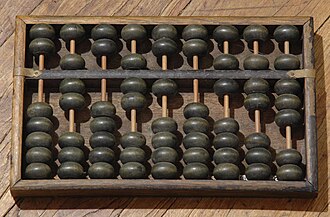
The first tools used for calculations were bones, pebbles, and counting boards, and the abacus, used by Sumerians and Egyptians before 2000 BC. Except for the Antikythera mechanism (an astronomical device), the development of computing tools began in the 17th century with inventions like the geometric-military compass, logarithms, Napier bones, and the slide rule.
The Renaissance brought the invention of the mechanical calculator by Wilhelm Schickard in 1623 and later by Blaise Pascal in 1642. Pascal's calculator could add and subtract numbers directly and could multiply and divide by repeating these actions. Schickard's machine used mechanized multiplication tables to help with multiplication and division. There is debate about who should be credited as the inventor of the first calculating machine because of differences in their designs. Schickard and Pascal were followed by Gottfried Leibniz, who spent many years designing a four-operation mechanical calculator but couldn't create a fully working machine. There were also five unsuccessful attempts to design a calculating clock in the 17th century.
The 18th century brought improvements, such as Poleni's first fully functional calculating clock and four-operation machine. Luigi Torchi invented the first direct multiplication machine in 1834. Real developments began in the 19th century during the Industrial Revolution. Although machines capable of all four arithmetic functions existed before the 19th century, improvements in manufacturing made large-scale production of compact, modern units possible. The Arithmometer, invented in 1820 and released in 1851, was the first commercially successful unit.
The familiar push-button user interface was developed in 1902 with the Dalton Adding Machine.
In 1921, Edith Clarke invented the "Clarke calculator," a simple graph-based calculator for solving line equations involving certain functions. This helped electrical engineers simplify calculations for inductance and capacitance in power transmission lines.
The Curta calculator was developed in 1948 and became popular for its portability. It could perform addition, subtraction, multiplication, and division. By the early 1970s, electronic pocket calculators ended the production of mechanical calculators, though the Curta remains a popular collector's item.
Development of electronic calculators
The first mainframe computers, using vacuum tubes and later transistors, appeared in the 1940s and 1950s. Electronic circuits developed for computers also had uses for electronic calculators.
The Casio Computer Company in Japan released the Model 14-A calculator in 1957, the world's first all-electric compact calculator. It was based on relay technology and built into a desk. The IBM 608 plugboard programmable calculator was IBM's first all-transistor product, released in 1957.
In October 1961, the world's first all-electronic desktop calculator, the British Bell Punch/Sumlock Comptometer ANITA, was announced. This machine used vacuum tubes, cold-cathode tubes, and Dekatrops in its circuits, with 12 cold-cathode "Nixie" tubes for its display. The ANITA sold well because it was the only electronic desktop calculator available at the time, and it was silent and quick.
The tube technology of the ANITA was replaced in June 1963 by the U.S.-made Friden EC-130, which had an all-transistor design and displayed numbers on a cathode ray tube. In 1964, more all-transistor electronic calculators were introduced, such as the Sharp CS-10A and the IME 84 from Industria Macchine Elettroniche of Italy.
Following this, many manufacturers like Canon, Mathatronics, Olivetti, SCM, Sony, Toshiba, and Wang introduced electronic calculator models. Early calculators used hundreds of germanium transistors, which were cheaper than silicon transistors, on multiple circuit boards. Display types included CRT, cold-cathode Nixie tubes, and filament lamps. Memory technology was usually based on delay-line memory or magnetic-core memory.
Bulgaria's ELKA 6521, introduced in 1965, was the first calculator in the world to include the square root function. Later that year, the ELKA 22 and ELKA 25 were released, and the first pocket model, the ELKA 101, came out in 1974.
Programmable calculators
Main article: Programmable calculator
The first desktop programmable calculators were produced in the mid-1960s. They included the Mathatronics Mathatron and the Olivetti Programma 101, both of which could be programmed by the user and print out results. The Programma 101 saw wider distribution and had the feature of storing programs on magnetic cards.
Another early programmable desktop calculator was the Casio (AL-1000) from 1967. It featured a nixie tubes display and had transistor electronics and ferrite core memory.
The Monroe Epic programmable calculator came on the market in 1967. It could perform many computer-like functions but lacked conditional branch logic.
The first Soviet programmable desktop calculator ISKRA 123 was released at the start of the 1970s.
1970s to mid-1980s
Electronic calculators of the mid-1960s were large and heavy desktop machines due to their use of many transistors on several circuit boards, requiring a large power consumption and an AC power supply. Efforts focused on reducing the number of integrated circuits (chips) needed for a calculator, and calculator electronics was at the forefront of semiconductor development. U.S. semiconductor manufacturers led in large-scale integration (LSI) semiconductor development, partnering with Japanese calculator manufacturers.
Pocket calculators
"Pocket calculator" redirects here. For the song, see Computer World.
Released in 1947, the first pocket calculator that could perform the four basic arithmetic functions with digital precision was the Curta, a mechanical device operated by a crank. It had a digital readout with eleven digits of precision.
By 1970, calculators could be made using just a few chips of low power consumption, allowing portable models powered by rechargeable batteries. The first handheld calculator was a 1967 prototype called Cal Tech, led by Jack Kilby at Texas Instruments. It could add, multiply, subtract, and divide, and its output was on a paper tape.
The first commercially produced portable calculators appeared in Japan in 1970 and were soon marketed worldwide. These included the Sanyo ICC-0081 "Mini Calculator," the Canon Pocketronic, and the Sharp QT-8B "micro Compet." The Canon Pocketronic had no traditional display; its output was on thermal paper tape.
Sharp introduced the Sharp EL-8 in January 1971, also marketed as the Facit 1111. It weighed 1.59 pounds, had a vacuum fluorescent display, rechargeable NiCad batteries, and initially sold for US$395.
Integrated circuit development led to the first "calculator on a chip," the MK6010 by Mostek, followed by Texas Instruments later that year. These advances led to cheap pocket calculators available to everyone.
In 1971, Pico Electronics and General Instrument introduced their first collaboration in ICs, a full single chip calculator IC for the Monroe Royal Digital III calculator. Pico and GI had significant success in the handheld calculator market.
The first truly pocket-sized electronic calculator was the Busicom LE-120A "HANDY," marketed in early 1971. Made in Japan, it was the first calculator to use an LED display, the first handheld calculator to use a single integrated circuit, the Mostek MK6010, and the first electronic calculator to run on replaceable batteries.
The first European-made pocket-sized calculator, DB 800, was made in May 1971 by Digitron in Buje, Croatia. It had four functions and an eight-digit display.
The first American-made pocket-sized calculator, the Bowmar 901B, came out in autumn 1971. It had four functions and an eight-digit red LED display, for US$240. In August 1972, the four-function Sinclair Executive became the first slimline pocket calculator.
The first Soviet-made pocket-sized calculator, the Elektronika B3-04, was developed at the end of 1973 and sold at the start of 1974.
One of the first low-cost calculators was the Sinclair Cambridge, launched in August 1973. It retailed for £29.95 or £5 less in kit form, and later models included some scientific functions.
Scientific pocket calculators
Main article: Scientific calculator
Meanwhile, Hewlett-Packard had been developing a pocket calculator. Launched in early 1972, it was the first pocket calculator with scientific functions that could replace a slide rule. The $395 HP-35 used reverse Polish notation (RPN). It had 35 buttons and was based on the Mostek Mk6020 chip.
The first Soviet scientific pocket-sized calculator, the "B3-18," was completed by the end of 1975.
In 1973, Texas Instruments introduced the SR-10, an algebraic entry pocket calculator using scientific notation for $150. It was followed by the SR-11 with a key for entering pi (π), and then the SR-50, which added log and trig functions. In 1977, the mass-marketed TI-30 line was introduced and is still produced.
In 1978, Calculated Industries arose, focusing on specialized markets. Their first calculator, the Loan Arranger, was marketed to the real estate industry. In 1985, CI launched the Construction Master for the construction industry.
Adler 81S pocket calculator with vacuum fluorescent display (VFD) from the mid-1970s.
The Casio CM-602 Mini electronic calculator provided basic functions in the 1970s.
The 1972 [Sinclair Executive](/wiki/Sinclair_Executive) pocket calculator.
The [HP-35](/wiki/HP-35), the world's first scientific pocket calculator by Hewlett Packard (1972).
Canon Pocketronic calculator prints output using paper tape (1971).
Programmable pocket calculators
The first programmable pocket calculator was the HP-65, in 1974; it had a capacity of 100 instructions and could store and retrieve programs with a built-in magnetic card reader. Two years later, the HP-25C introduced continuous memory, retaining programs and data during power-off. In 1979, HP released the first alphanumeric, programmable, expandable calculator, the HP-41C. It could be expanded with RAM and ROM modules, and peripherals like bar code readers, microcassette and floppy disk drives, paper-roll thermal printers, and communication interfaces.
The first Soviet pocket battery-powered programmable calculator, Elektronika B3-21, was developed at the end of 1976 and released at the start of 1977. The successor, the Elektronika B3-34, wasn't backward compatible with B3-21 but kept reverse Polish notation. It defined a new command set used in later Soviet calculators. Despite limited abilities, people wrote various programs for them, including adventure games and libraries of functions for engineers. Hundreds, perhaps thousands, of programs were written for these machines, from practical software used in offices and labs to fun games for children. The Elektronika MK-52 calculator was used in the Soviet spacecraft program as a backup for the board computer.
This series of calculators was noted for many undocumented features, exploited by applying normal arithmetic operations to error messages and jumping to nonexistent addresses. Monthly publications like the popular science magazine Nauka i Zhizn featured columns dedicated to optimization methods for calculator programmers and updates on undocumented features for hackers, which grew into an esoteric science named "yeggogology." The error messages on those calculators appeared as the Russian word "YEGGOG," translated to "Error."
A similar hacker culture in the US revolved around the HP-41, which was also noted for many undocumented features and was more powerful than the B3-34.
Technical improvements
Through the 1970s, handheld electronic calculators underwent rapid development. Red LED and blue/green vacuum fluorescent displays consumed a lot of power, often leading to short battery life or larger sizes to accommodate higher-capacity batteries. In the early 1970s, liquid-crystal displays (LCDs) were in their infancy, and there was concern about their short operating lifetime. Busicom introduced the Busicom LC with LCD but it never went on sale. The first successful calculators with LCDs were manufactured by Rockwell International and sold from 1972 by other companies.
A more successful series of calculators using reflective DSM-LCD was launched in 1972 by Sharp Inc with the Sharp EL-805, a slim pocket calculator. This used Sharp's Calculator On Substrate (COS) technology.
In the mid-1970s, the first calculators appeared with field-effect, twisted nematic (TN) LCDs with dark numerals against a grey background, often with a yellow filter to cut out ultraviolet rays. LCDs are passive light modulators reflecting light, requiring much less power than light-emitting displays like LEDs or VFDs. This led to the first credit-card-sized calculators, such as the Casio Mini Card LC-78 of 1978, which could run for months on button cells.
Improvements to the electronics inside calculators also occurred. Logic functions were squeezed into the first "calculator on a chip" integrated circuits (ICs) in 1971, but this was leading-edge technology with low yields and high costs. Many calculators continued to use two or more ICs, especially scientific and programmable ones, into the late 1970s.
The power consumption of ICs was reduced, especially with the introduction of CMOS technology. Seen in the Sharp "EL-801" in 1972, CMOS IC transistors used power only when changing state. LED and VFD displays often required added driver transistors or ICs, whereas LCDs could be driven directly by the calculator IC.
With low power consumption came the possibility of using solar cells as a power source, realized around 1978 by calculators like the Royal Solar 1, Sharp EL-8026, and Teal Photon.
The interior of a Casio fx-20 scientific calculator from the mid-1970s, using a VFD. The processor integrated circuit (IC) is made by [NEC](/wiki/NEC) (marked μPD978C). Discrete electronic components like [capacitors](/wiki/Capacitor) and [resistors](/wiki/Resistor) and the IC are mounted on a [printed circuit board](/wiki/Printed_circuit_board) (PCB). This calculator uses a battery pack as a power source.
The processor chip (integrated circuit package) inside a 1980s Sharp pocket calculator, marked SC6762 1•H. An LCD is directly under the chip. This was a PCB-less design. No discrete components are used. The battery compartment at the top can hold two [button cells](/wiki/Button_cell).
Inside a Casio scientific calculator from the mid-1990s, showing the processor chip (small square; top-middle; left), keypad contacts, right (with matching contacts on the left), the back of the LCD (top; marked 4L102E), battery compartment, and other components. The solar cell assembly is under the chip.
- pocket calculator. It uses a button battery in combination with a solar cell. The processor is a "Chip on Board" type, covered with dark epoxy.")
The interior of a newer (c. 2000) pocket calculator. It uses a button battery in combination with a solar cell. The processor is a "Chip on Board" type, covered with dark [epoxy](/wiki/Epoxy).
Mass-market phase
At the start of the 1970s, handheld electronic calculators were very costly, at two or three weeks' wages, making them a luxury item. The high price was due to their construction requiring many mechanical and electronic components, and production runs that were too small to exploit economies of scale. Many firms saw profits in the calculator business with such high prices. However, the cost of calculators fell as components and production methods improved, and economies of scale were achieved.
By 1976, the cost of the cheapest four-function pocket calculator had dropped to a few dollars, about 1/20 of the cost five years before. This made pocket calculators affordable, and it became difficult for manufacturers to profit from them, leading many firms to drop out of the business or close. Surviving firms tended to produce higher-quality calculators or high-specification scientific and programmable calculators.
Mid-1980s to present
The first calculator capable of symbolic computing was the HP-28C, released in 1987. It could solve quadratic equations symbolically. The first graphing calculator was the Casio fx-7000G released in 1985.
The leading manufacturers, HP and TI, released increasingly feature-laden calculators during the 1980s and 1990s. By the turn of the millennium, the line between a graphing calculator and a handheld computer was not always clear, as some advanced calculators could differentiate and integrate functions, solve differential equations, run word processing and PIM software, and connect to other calculators/computers.
The HP 12c financial calculator is still produced. Introduced in 1981, it is still made with few changes. In 2003, several new models were released, including an improved version of the HP 12c, the "HP 12c platinum edition," which added more memory, more built-in functions, and the addition of the algebraic mode of data entry.
Calculated Industries competed with the HP 12c in the mortgage and real estate markets by differentiating key labeling, not using reverse Polish notation. However, CI's more successful calculators involved a line of construction calculators, which evolved and expanded in the 1990s to present. According to Mark Bollman, a mathematics and calculator historian and associate professor of mathematics at Albion College, the "Construction Master is the first in a long and profitable line of CI construction calculators" which carried them through the 1980s, 1990s, and to the present.
Use in education
Students in many countries use calculators for schoolwork. Some people worried that using calculators might make it harder to do simple math in your head. Because of this, some schools only allow students to use calculators after they have learned certain skills. Others focus more on teaching how to estimate numbers and solve problems.
Research shows that if teachers don’t guide students well on how to use calculators, it might limit the kinds of math problems students can solve. Some believe that using calculators too much can make it harder to understand more advanced math topics. In 2011, a leader in the UK expressed concern that children might rely too much on calculators, so plans were made to review how calculators are used in school. In the United States, many math teachers and school boards support using calculators from early grades all the way through high school.
Sometimes, calculators are allowed in exams at school or college. In the UK, there are rules about which calculators can be used in exams to make sure everyone plays fair. Some calculators have a special setting called “exam mode” that makes them follow these rules.
Personal computers
Many personal computers have a special program that looks and works like a calculator. These programs use the screen to show a calculator that you can use. Examples include the Windows Calculator, Apple's Calculator, and KDE's KCalc. Most personal data assistants and smartphones also have a similar feature.
Calculators compared to computers
The main difference between a calculator and a computer is that a computer can be changed to do different tasks based on results, while calculators are made to do specific jobs like addition, multiplication, and logarithms. Some special calculators, called programmable calculators, can also be changed to do more things, sometimes using programming languages like RPL or TI-BASIC.
Calculators often use simpler ways to do math, like using code stored in memory instead of special parts for multiplying numbers. They also use a design that works step by step, which makes them easier to make but slower than the designs used in most computers. However, some advanced calculators use the same types of chips that are found in computers.
Software calculators
See also: Comparison of software calculators and Software calculator
Images
Related articles


This article is a child-friendly adaptation of the Wikipedia article on Calculator, available under CC BY-SA 4.0.
Images from Wikimedia Commons. Tap any image to view credits and license.