 Safekipedia
Gera
Adapted from Wikipedia · Discoverer experience
Gera is a city in the German state of Thuringia. It is the third-largest city in Thuringia, after Erfurt and Jena, and has around 93,000 people living there. The city is part of a line of six big cities called the Thüringer Städtekette, stretching from Eisenach in the west to Gera in the east.
First mentioned in the year 995, Gera grew into a city during the 1300s. It was an important home for the Ducal House of Reuss and later the capital of the Principality of Reuss-Gera and the People's State of Reuss. Over the 1800s, Gera became known for its textile industry and grew quickly. After World War II, it was an important administrative centre in the GDR.
Since 1990, Gera has worked hard to restore its buildings and improve its economy. Today, visitors can see old buildings from its royal history and many beautiful structures from its busy industrial days between 1870 and 1930. The famous painter Otto Dix was born in Gera in 1891.
History
Middle Ages
The name Gera first appeared in a document from the year 995. It was named after the area around the Elster river valley where the city now stands. In 999, Emperor Otto III gave the area to the Quedlinburg Abbey. By 1209, the area was given to the Vogts of Weida, who were ancestors of the Reussians. The Reussians ruled Gera until 1918. Gera was first called a town in 1237. In the 13th century, the town was surrounded by walls, and a castle was built. In 1450, much of Gera was destroyed during a war but quickly rebuilt because the growing textile trade brought wealth.
Early modern period
The Reformation came to Gera in 1533. In 1673, the Reussians became Imperial Counts, giving them full control. Sadly, big fires in 1686 and 1780 destroyed many buildings, but the town was rebuilt in a uniform style. In 1806, Napoleon used Gera as his headquarters and sent a letter that led to a big battle nearby.
Since 1815
In 1802, the Gera line of Reussians ended, and a new ruler came from Schleiz in 1848. From 1848 to 1918, Gera was the capital of the Principality of Reuss-Gera. With the growth of factories, Gera expanded quickly. By the early 1900s, it was the largest city in Thuringia. After World War I, a new government formed, and Gera became part of Thuringia in 1920.
After World War II, Gera became part of East Germany. In 1952, it became the capital of a new district. Many new homes were built during this time. After Germany reunited in 1990, many factories closed, causing hard times for the city's economy. In 2007, Gera hosted a big gardening show called the Bundesgartenschau.
Geography and demographics
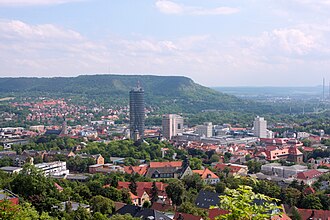
Gera is a city in the German state of Thuringia. It sits in a hilly landscape near the White Elster river, between higher lands and flat areas. The city has a mix of forested and farm areas.
Gera has a climate where summers are warm and winters are cold, with some very cold nights in winter. Snow falls during winter but does not stay long. The city grew from a small town to a larger one over the years, reaching its highest population in 1988. After 1990, the population went down, partly because many people moved to other cities. Today, Gera has a small number of people from other countries, mostly from nearby areas and some from faraway places. The city has fewer religious people than many other places.
The 12 statistical districts are: |
1 – Stadtmitte 2 – Debschwitz 3 – Gera-Ost 4 – Gera-Nord/Langenberg 5 – Bieblach-Ost 6 – Bieblach/Tinz | 7 – Untermhaus 8 – Gera-Westvororte 9 – Zwötzen/Liebschwitz 10 – Lusan-Laune 11 – Lusan-Zentrum 12 – Lusan-Brüte |
Culture, sights and cityscape
Museums
Gera has several interesting museums to explore:
- The Orangerie at Orangerieplatz shows art from the Middle Ages to today.
- The Otto-Dix-Haus (“Otto Dix House”) at Mohrenplatz 4, where artist Otto Dix was born and grew up, displays his drawings, prints, paintings, and sketchbooks, along with exhibits about his life.
- The Museum für Angewandte Kunst (Museum for Applied Arts) at Greizer Straße features 20th-century art inside "Ferber House". It includes Bauhaus ceramics by artists Otto Lindig and Theodor Bogler, architectural works by Thilo Schoder, and photographs by Aenne Biermann.
- The Museum für Naturkunde (Natural History Museum) at Nicolaiberg has a natural history exhibit inside the "Schreiber House", the oldest building in the city, with an adjacent botanical garden, the Botanischer Garten Gera.
- The Stadtmuseum (city museum) at Museumsplatz shows Gera's history.
- The Haus Schulenburg (Schulenburg House) at Straße des Friedens is a mansion built in 1913/14 by architect Henry van de Velde. It displays furniture and decoration and is open for visits.
Cityscape
Gera, like its neighbor Jena, stretches along a wide valley from south to north. The old city center is small and lies between Sorge in the north, Nicolaistraße in the east, Stadtgraben in the south, and Reichsstraße in the west. It survived World War II, but in the 1960s and 1970s, the government tore down parts of the old city to build modern concrete buildings, which still shape the northwestern part of the center today. From 1870 to 1930, the city grew in all directions. Unlike other German cities, Gera does not separate where workers and upper-class people live; instead, mansions and smaller homes are mixed together across the city. Hills, rivers, and parks are home to more upscale homes, while areas near railways and factories have more working-class homes. Gera’s architecture from the early 1900s is special, and many buildings were repaired after 1990. The city also has some Bauhaus buildings from the 1920s. During a certain time, new housing areas were built on the edges of the city, like Lusan in the south and Bieblach in the north. Almost half of Gera’s buildings date back to World War II.
Sights and architectural heritage
Churches
- The St. Saviour's Church at Nicolaiberg is the main church of Gera, built between 1717 and 1720 in Baroque style.
- The Trinity Church at Heinrichstraße has been an evangelical church since 1886, built between 1609 and 1611 as a cemetery church.
- The St. John's Church at Clara-Zetkin-Straße was built between 1881 and 1885 in neo-Gothic style.
- The St. Mary's Church at Untermhaus district dates back to around 1450.
- The St. Elizabeth's Church at Kleiststraße is the Catholic church of Gera, built in 2000 in modern style.
- The St. Martin's Church at Zwötzen district was built in 1895 in neo-Gothic style.
- The Fourteen Holy Helpers Church at Langenberg district was rebuilt in the 1750s.
Other sights
-
The town hall at Marktplatz is one of Germany’s largest Renaissance town halls, with a tower almost 60 meters high, built between 1573 and 1576. The Marktplatz itself has beautiful 18th-century houses.
-
The Stadttheater (city theatre) at Küchengartenallee was built in 1902 by Heinrich Seeling in neo-Baroque style.
-
The Stadtapotheke (city pharmacy) is a Renaissance building at Marktplatz with a lovely bay window, established in 1592.
-
The Küchengarten (“Kitchen Garden”) with the Orangerie is a park west of the city center, created in 1732.
-
The Höhler is a network of cellars under the city center, about 9 km long, built in the 17th and 18th centuries for storing beer. Part of it can be visited at Nicolaiberg 3.
-
The Schloss Tinz (Tinz Castle) was a summer home built in 1748 in Baroque style with a surrounding park.
-
The Schloss Osterstein (Osterstein Castle) was the main home built in the 16th century in Renaissance style. It was damaged by bombs in 1945 and partly torn down in 1962. Only the tower remains.
-
The old city wall was mostly torn down in the 19th century, but a small part near Stadtgraben is still standing.
Economy and infrastructure
Basic economic data
In 2022, 22,544 people had full-time jobs in Gera, and the average salary was EUR 2,595.34. People in Gera earn about 10% less than the average in eastern Germany.
Agriculture, industry and services
Farming plays a role in the countryside around Gera, especially in the north and east. About 57% of the land in Gera is used for farming, growing crops like maize and raising cattle.
Gera has many factories and businesses. Some make machines, security locks, optics, and electrical equipment. There are also companies that make margarine and food products. Gera also has shops and hospitals, but its economy is not as strong as nearby cities like Jena or Zwickau.
Transport
By rail
Since the 1800s, Gera has been an important place for trains. Trains go to many cities, including Göttingen, Leipzig, Altenburg, Glauchau, Zwickau, Greiz, Hof, and Saalfeld. Some trains stop at Gera main station, and others at Gera southern station. There are also smaller stations in different parts of the city.
By road
The city is close to two major highways, Bundesautobahn 4 and Bundesautobahn 9. There are also three important roads that connect Gera to other places. A new road was built in 2007 to help traffic move better.
By aviation
The nearest airports are Leipzig/Halle Airport and Erfurt-Weimar Airport. There is a small airfield in Gera for private planes.
By bike
Cycling is getting more popular in Gera. There are special paths for bicycles that connect different places of interest. Some streets also have bike lanes for everyday riding.
Trams and buses
Gera has trams that go through the city. There are three tram lines with different schedules. Buses help people get around areas that don’t have trams and connect to nearby towns.
Education
Gera has colleges for health studies and a branch of a cooperative state college. The city also has four state-owned schools for older students, including one that focuses on music.
Politics
The first mayor elected freely after Germany reunited was Ralf Rauch, who was not part of any political party. He served from 1994 to 2006. Norbert Vornehm from the Social Democratic Party took over and served until 2012. Viola Hahn was elected in 2012 but did not win again in 2018. Julian Vonarb served from 2018 to 2024 but also did not win re-election. Kurt Dannenberg from the Christian Democratic Union became the new mayor.
The most recent elections for the mayor and city council were held on 26 May 2024, with a second round for the mayor on 9 June.
Twin towns – sister cities
See also: List of twin towns and sister cities in Germany
Gera has friendly partnerships with cities in several countries. These include:
- Arnhem in the Netherlands
- Fort Wayne in the United States
- Goražde in Bosnia and Herzegovina
- Kuopio in Finland
- Pskov in Russia
- Rostov-on-Don in Russia
- Saint-Denis in France
- Skierniewice in Poland
- Sliven in Bulgaria
- Timișoara in Romania
Notable people
Gera is home to many famous people from different fields. Some well-known individuals include Heinrich Reinhold, a painter and engraver, and Otto Dix, a famous painter and printmaker. There are also notable politicians like Rudolf Paul and Thilo Sarrazin, as well as athletes such as Heike Drechsler, an Olympic gold medalist in long jumping, and John Degenkolb, a racing cyclist.
Images
Related articles


This article is a child-friendly adaptation of the Wikipedia article on Gera, available under CC BY-SA 4.0.
Images from Wikimedia Commons. Tap any image to view credits and license.