 Safekipedia
Thuringia
Adapted from Wikipedia · Discoverer experience
Thuringia, officially called the Free State of Thuringia, is a state in central Germany. It has about 2.1 million people and covers 16,171 square kilometers, making it the 12th largest by population and 11th largest by area in Germany. The capital and largest city is Erfurt, with other important cities including Jena, Gera, and Weimar. Thuringia is often called "the green heart of Germany" because of its many forests.
Thuringia has a rich history. The Frankish Duchy of Thuringia was founded around 631 AD by King Dagobert I. The modern state was created in 1920 by the Weimar Republic. After World War II, it became part of the Soviet occupation zone and later the German Democratic Republic. Thuringia was dissolved in 1952 but re-established in 1990 after German reunification.
Thuringia is known for its natural beauty and cultural heritage. It is home to Rennsteig, Germany's most famous hiking trail, and the winter resort of Oberhof, a popular destination for winter sports. Many famous people were born or lived there, including Johann Sebastian Bach, Johann Wolfgang von Goethe, and Friedrich Schiller. The state also has several universities, such as the University of Jena and Bauhaus University of Weimar.
Etymology and symbols
The name Thuringia comes from an old Germanic tribe called the Thuringii. They lived during a time when many groups moved around Europe, called the Migration Period. We do not know much about where they came from, but they were known for their great horses.
Thuringia had its own leaders and lands for many years. Later, the area was part of different smaller states, but people still called the region Thuringia. Today, Thuringia has its own special symbols. Its coat of arms shows a lion, and its flag is white and red, colors that come from old Thuringian leaders. The people of Thuringia are also famous for their tasty grilled sausages, called bratwurst, and for their beautiful forests that cover much of the land.
History
Thuringia has a long history dating back to around AD 300, when it was named after the Thuringii, a Germanic tribe. By the 6th century, the region came under Frankish control. Over time, Thuringia was divided into smaller states and duchies, such as the Ernestine and Albertine branches, which often changed due to inheritances and treaties.
During the Protestant Reformation, Thuringia largely became Protestant, with Roman Catholicism surviving mainly in the Eichsfeld district. In 1920, after World War I, many small states in the area merged to form the State of Thuringia, with Weimar as its capital. After World War II, Thuringia was controlled by the Soviet Union and later became part of East Germany. The modern Free State of Thuringia was reestablished in 1990 after German reunification.
For the earlier history of the region, see Thuringii and Duchy of Thuringia.
Geography
Thuringia is a state in central Germany that shares borders with Lower Saxony, Saxony-Anhalt, Saxony, Bavaria, and Hesse. The landscape changes a lot across the state. In the far north are the Harz mountains, followed by a fertile floodplain called the Goldene Aue around Nordhausen. The central area is the Thuringian Basin, a flat and fertile region around the Unstrut river, surrounded by hills and forests. To the south lies the Thuringian Forest, home to the highest mountain, Großer Beerberg, standing at 983 meters tall.
Thuringia has a temperate climate with moist winds from the west. As you move toward the southeast, winters can be colder and summers warmer, with dry spells common, especially in the basin area. It is Germany’s driest region, receiving only 400 to 500 mm of rain each year.
The state’s natural environment has been shaped by human activity for centuries. Originally, forests covered the land, mainly with beech trees, but today many areas are used for farming or have forests of spruce and pine. Efforts since 1990 have improved forests, rivers, and air quality. Protected areas like the Hainich mountains and the Rhön Biosphere Reserve help preserve nature.
Demographics
During the Middle Ages, Thuringia was located between areas where Germanic and Slavic people lived, separated by the Saale river. Over time, many Slavic people in the area became part of German society. The number of people in Thuringia grew a lot during the 1700s but slowed down after World War I. Since 1990, the population has been slowly decreasing.
Today, Thuringia has about 2.1 million people. Many people live in cities like Erfurt and Jena, while smaller villages have lost many residents. In 2020, the population was decreasing by about 0.5% each year. Only about 1.9% of people in Thuringia are from other countries, which is one of the smallest numbers in Germany. The largest groups of foreigners come from Russia, Poland, Turkey, and Ukraine.
Thuringia has more men than women in some age groups because many young women move to cities or other places. The population is also getting older, which makes it harder for people to find jobs. Fewer babies are being born each year than people who pass away, so the population continues to shrink slowly. Many people are moving from small villages to larger cities like Erfurt, Gera, Jena, Eisenach, and Weimar.
Most people in Thuringia do not follow any religion. Before Germany was divided, many people were Protestant, but that number has dropped a lot. Today, only about 21% are Protestant and 8% are Catholic. The rest of the people either follow other religions or have no religious beliefs. Some smaller groups include Muslims and Jewish people, mostly from other countries.


| Rank | City | District | Pop. 31 December 2020 | Change* | CoA | Image |
|---|---|---|---|---|---|---|
| 1 | Erfurt | independent | 213,692 | +0.68 | ||
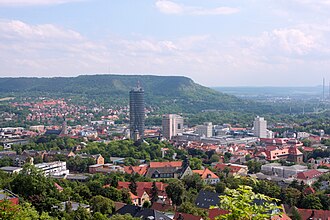
| 2 | Jena | independent | 110,731 | +0.47 | ||
| 3 | Gera | independent | 92,126 | −0.55 | ||
| 4 | Weimar | independent | 65,098 | +0.35 | ||
| 5 | Gotha | Gotha | 45,273 | −0.05 | ||
| 6 | Nordhausen | Nordhausen | 40,969 | −0.35 | ||
| 7 | Eisenach | Wartburgkreis | 41,970 | −0.12 | ||
| 8 | Suhl | independent | 36,395 | −1.68 | ||
| 9 | Mühlhausen | Unstrut-Hainich-Kreis | 35,799 | −0.38 | ||
| 10 | Altenburg | Altenburger Land | 31,101 | −1.27 |
Politics
Thuringia has seen some important election results recently. In national elections, the Alternative for Germany (AfD) party has become quite strong, getting more votes over time.
In state elections, Thuringia has been special because both the The Left party and the AfD have been able to come in first place at different times. In the September 2024 election, the AfD got the most votes, but they were not part of the government team. Instead, the government was formed by the Christian Democratic Union (CDU), the Sahra Wagenknecht Alliance (BSW), and the SPD.
Thuringia is divided into 17 districts and has five important urban areas, including Erfurt, Gera, Jena, Suhl, and Weimar.
Economy
Thuringia's economy changed a lot after Germany reunited. Many factories closed, and unemployment got very high in 2005. But since then, things have started to improve.
Agriculture and forestry are still important, even though they aren't as big as in other parts of Germany. About half of Thuringia is used for farming. People grow crops like wheat, barley, and sugar beets, and raise animals like pigs and cows. There are also farms that grow fruits like apples and strawberries.
Thuringia has a long history of industry. After the big changes in 1990, many big factories closed, but smaller ones stayed. Today, important industries include making machines, cars, and food. Cities like Jena and Eisenach are known for their factories. Mining used to be big too, especially for potash and lignite, but many mines closed after reunification.
Tourism is also important. Thuringia has many famous places to visit, like Wartburg Castle and the beautiful Thuringian Forest. Cities like Erfurt and Weimar are growing as popular spots for visitors.
The unemployment rate was highest in 2005 but has gone down since then. However, wages are still lower than in some nearby areas, so many people from Thuringia work in other parts of Germany. The economy varies a lot between different parts of Thuringia, with cities doing better than rural areas.
Infrastructure
Transport
Thuringia is in the middle of Germany, making it a key place for travel. After World War II, the roads and railways were in poor condition. Since 1990, lots of money has been spent to fix them up.
In the 1930s, the first big roads, called motorways, were built. The A4 goes east to west, linking Berlin to southwest Germany. The A9 goes north to south, connecting Berlin to Munich. These roads pass through important Thuringian cities like Erfurt and Jena. New roads were added in the 1990s and 2000s, including the A71, which crosses the Thuringian Forest with big tunnels and bridges.
Thuringia’s railways began in the 1840s. By 1920, it had many train tracks. After World War II, many smaller lines were removed, but main lines were fixed up. Today, important trains run between cities like Erfurt and Dresden. New high-speed lines will open soon, making travel faster.
Thuringia has small airports, with Erfurt–Weimar Airport offering flights to holiday spots. Bigger airports nearby include Frankfurt, Berlin, and Munich.
Energy and water supply
Thuringia used to get energy from lignite, but now uses more clean energy like wind and biomass. Solar power and small dams also help. Two big stations store extra energy for later use.
Thuringia gets its water from large dams in the Thuringian Forest, making it a place that can share its clean water with others.
Health
Health in Thuringia got better after 1990, but people here often eat foods that are not always healthy, which can affect their overall health. Bigger hospitals in cities like Jena and Erfurt are growing, while smaller ones in rural areas are closing. There is also a shortage of family doctors in some places.
Education
In Germany, each state has its own way of running schools and colleges. Thuringia built its school system after 1990, mixing ideas from older systems. Many people say Thuringia has one of the best school systems in Germany.
Young children often go to early-years programs in Thuringia. Children start primary school at age six and study for four years. After that, they move to different types of schools depending on what they are good at. Some go to a school that prepares them for college, while others go to schools that help them learn skills for jobs.
Thuringia also has an international school in Weimar called Thuringia International School. It opened in 2000 and follows a special program that helps students go to colleges and universities worldwide.
Universities
Thuringia has four main universities. The largest is the University of Jena, founded in 1558, with about 21,000 students. The Technische Universität Ilmenau, founded in 1894, has around 7,000 students and focuses on engineering and mathematics. The University of Erfurt, established in 1392, has about 5,000 students and specializes in humanities and training teachers. The smallest is the Bauhaus University Weimar, founded in 1860, with around 4,000 students, known for architecture and arts.
There are also several polytechnics in Thuringia, located in Erfurt, Jena, Nordhausen, and Schmalkalden. Additional schools include a civil service college in Gotha, the College of Music "Franz Liszt" in Weimar, and a few private colleges. The newest school is the Duale Hochschule Gera-Eisenach, created in 2016.
Research
Jena is Thuringia's top research city, especially in life sciences and optics. Ilmenau focuses on information technology. Erfurt is known for plant research, and Weimar and Gotha are centers for historic and cultural studies. Most research in Thuringia is supported by public funds, with some focus on optics in Jena.
Personalities
This section lists notable people from Thuringia, but the specific names and details are not provided here. Thuringia has been home to many important figures throughout history who have contributed to various fields such as arts, science, and politics.
Images
Related articles



This article is a child-friendly adaptation of the Wikipedia article on Thuringia, available under CC BY-SA 4.0.
Images from Wikimedia Commons. Tap any image to view credits and license.