 Safekipedia
History of the Big Bang theory
Adapted from Wikipedia · Discoverer experience
The history of the Big Bang theory tells us how scientists came to understand the beginning of our universe. The theory started with careful observations and smart ideas about space and time. A priest named Father Georges Lemaître first put the idea into proper scientific form in 1927.
One important piece of evidence came from Hubble's law, which showed that the universe is expanding. This discovery helped prove that the universe had a beginning, just like the Big Bang theory describes. Today, scientists keep improving the Big Bang model to learn even more about how everything started.
Philosophy and medieval temporal finitism
In medieval philosophy, people debated whether the universe had a beginning or existed forever (see Temporal finitism). The ideas of Aristotle suggested the universe was eternal, but this didn’t match the beliefs of Jewish and Islamic philosophers who thought the universe was created.
Robert Grosseteste, an English theologian, wrote in 1225 about how the universe might have started with a big explosion. He described how matter formed stars and planets around Earth. This was an early attempt to explain the cosmos using natural laws.
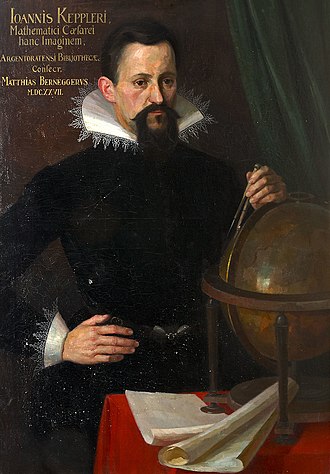
Later, Johannes Kepler used the dark night sky to suggest the universe wasn’t endless. Isaac Newton also wrote about motion in the universe on a large scale.
Early 20th century scientific developments
In the early 1900s, scientists noticed that most spiral galaxies were moving away from Earth. They used special tools to study light and found that these galaxies were moving faster the farther away they were.
Around the same time, a famous scientist named Albert Einstein developed new ideas about space and time. These ideas showed that the universe could not stay still—it was either growing or shrinking. Another scientist, Alexander Friedmann, used Einstein's ideas to show that the universe was indeed expanding.
In 1927, a Belgian scientist named Georges Lemaitre suggested that the universe began with a huge explosion from a very small point. In 1929, Edwin Hubble observed that galaxies were moving away from each other and that their speed increased with distance. This helped support Lemaitre's idea. Later, Lemaitre called this beginning the "primeval atom," which we now call the Big Bang.
1950 to 1990s
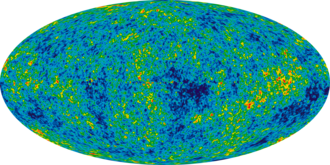
From about 1950 to 1965, scientists were split in their beliefs about how the universe began. The Big Bang theory could explain why we see certain amounts of hydrogen and helium in space, while other ideas could not. Observations showed that objects like quasars and radio galaxies were more common far away in the past, unlike what some theories expected. In 1964, scientists found something called the cosmic microwave background radiation, which strongly supported the Big Bang idea.
Even with the Big Bang theory, some questions stayed unanswered through the 1970s and 1980s. Scientists were still looking for more details about the cosmic microwave background and some observations didn’t quite match what they expected.
1990 onwards
The 1990s and early 2000s brought big steps forward in understanding the Big Bang thanks to better telescopes and satellites like COBE, the Hubble Space Telescope, and WMAP. In 1990, the COBE satellite showed that the cosmic microwave background radiation matches what we would expect from a very hot, dense early universe. In 1998, discoveries suggested the universe’s expansion is speeding up.
From 2001 to 2010, NASA’s WMAP spacecraft created detailed images of the universe, supporting ideas that the universe is about 13.7 billion years old. Later, from 2013 to 2015, the Planck spacecraft provided even more detailed images. Today, scientists work on understanding how galaxies form and what happened right after the Big Bang, while also studying mysterious parts of the universe like dark energy and dark matter.
Images
Related articles



This article is a child-friendly adaptation of the Wikipedia article on History of the Big Bang theory, available under CC BY-SA 4.0.
Images from Wikimedia Commons. Tap any image to view credits and license.