 Safekipedia
Ilmenau
Adapted from Wikipedia · Discoverer experience
Ilmenau is a town in Thuringia, central Germany. It is the largest town in the Ilm district, with about 38,600 people living there. The town sits in the Ilm valley near the edge of the Thuringian Forest, at a height of 500 metres above sea level. It is about 33 kilometres south of Erfurt and 135 kilometres north of Nuremberg.
The most important place in Ilmenau is the Technische Universität Ilmenau, a public research university. It focuses on subjects like engineering, computer science, and natural sciences. The university began in 1894 and became a full university in 1992. Since 1990, many research centres have grown up around Ilmenau, making it a key spot for technology and science.
Historically, Ilmenau was known for its mining of silver, copper, and manganese. Later, it became a popular relaxing place for Johann Wolfgang von Goethe. In 1838, it developed as a spa, which helped bring tourism to the area. Railways reached Ilmenau in 1879, leading to growth in industries like glass and porcelain making. Today, glass manufacturing, along with engineering and software work, remains important for the town's economy. The area has also produced many winners of winter Olympic events in sports such as luge, bobsleigh, and biathlon.
History
Middle Ages
The name Ilmenau comes from old German words for "elms" and "floodplain", referring to the area along the Ilm river that once had many elms. The town's symbols are a hen and a goat.
We do not know exactly when Ilmenau began, but it may have started as a village near St. Peter's monastery in Saalfeld during the Middle Ages. The first church was built in the 1100s, and the town was first written about in 1273. It was ruled by different families over time, including the Counts of Käfernburg, the Schwarzburgs, and the Hennebergs.
Early modern period
From the 1400s to the 1600s, mining copper was very important for Ilmenau's economy. Later, a mint made silver and copper coins. However, a big fire in 1752 destroyed much of the town, and it took many years to rebuild.
Since 1815
In the 1800s, Ilmenau grew from a small town into an industrial center, making glass, porcelain, and toys. Railways helped connect the town to others, bringing more growth. Today, Ilmenau is home to a university where a special event called ISWI happens every two years.
Geography and demographics
Ilmenau is a town in the German state of Thuringia. It lies in a valley formed by the Ilm River, near the edge of the Thuringian Forest. The town is surrounded by hills and mountains, with the Kickelhahn being a popular spot for its viewing tower.
Historically, Ilmenau was a small town with fewer than 2,000 people. Its population grew slowly during the 1800s and more quickly in the early 1900s. After World War II, the population continued to rise, reaching nearly 30,000 in the late 1980s. Following German reunification in 1990, the population dropped slightly but has since stabilized. Today, Ilmenau has about 38,600 residents.
The town includes several smaller villages that were added over the years. Recent economic improvements have helped reduce unemployment in the area. Most people in Ilmenau do not follow a specific religion, though some belong to the Evangelical Church or the Roman Catholic Church.
Culture, sights and cityscape
Museums
Ilmenau has several interesting museums. The Goethe-Stadt-Museum in the Amtshaus building in the market place shows the city's history and its connection to Johann Wolfgang von Goethe. The Jagdhaus Gabelbach, a former hunting lodge built in 1783, has exhibits about hunting and forestry from the 18th century. The Fischerhütte, an old glass factory, displays historic glassware and has special exhibitions about light and optics.
Cityscape
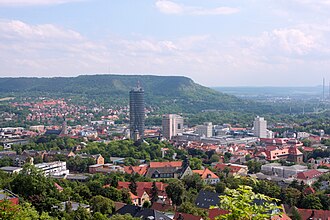
Most of Ilmenau's buildings were rebuilt in the 1750s and 1760s after a big fire, giving the town a uniform late-Baroque style. The town centre lies between Obertorstraße to the north, Poststrasse to the east, Mühlgraben to the south, and Burggasse to the west. Older parts of the town include areas around Rasen to the north-west and Lindenstraße to the south-west. Between 1871 and 1914, fancy houses were built around Waldstraße and Goetheallee, and around Sturmheide, some in Gründerzeit and Art Nouveau styles. During the GDR time, large housing areas called Plattenbau were built in the south-east and north. The university's main campus at Ehrenberg started in the 1950s and has grown since then, featuring interesting architecture from Stalinist neo-classicism to modern glass-and-steel designs.
Sights and architectural heritage
Older buildings (pre-1870)
Ilmenau has many older buildings, including the Church of St James, built after the 1752 fire in late-Baroque style. The Holy Cross Church, built in 1852, is a small church near the cemetery, which also has old graves and a classicistic mourning hall. The town hall was also built after the 1752 fire. Other old buildings include the Zechenhaus from 1730, the Bergmannskapelle chapel from the 17th century, the Alte Münze mint from 1691, and the Wasserburg castle ruin.
Modern architecture (after 1870)
Modern buildings in Ilmenau include the Neues Technikum from 1926, a department store with a Bauhaus-style glass front from 1928, and a Bauhaus-style house from 1929 to 1932. St. Joseph's Church was built between 1979 and 1983. The Goethe memorial was placed in the market place in 1996, and the university's new Audimax and a glass-cube auditorium were built in the 2000s. The Bundesanstalt für Wasserbau building, constructed around 2000, has a unique boomerang shape.
Economy
Agriculture is not very important for Ilmenau’s economy because only a small part of the land is used for farming. The soil isn’t very fertile, and the weather can be tough. The main crops grown there are maize and rapeseed, and there is also some cattle farming.
Most of Ilmenau’s land is covered in forests, which makes wood production an important part of the local economy.
In the past, Ilmenau was known for making glass and porcelain. Many well-known companies made these products in the 1800s and early 1900s. After Germany reunited in 1990, many of these factories closed down. However, the glass industry continued to focus on making laboratory glass items like thermometers and test tubes. Even today, this factory remains an important maker of such products in Germany.
Since the 1990s, new industries have grown in Ilmenau, especially in mechanical engineering, working with polymers, and software development. These industries benefit from being close to the university and research centers. In 2012, 26 larger companies employed 1,500 people and made €170 million in sales.
Besides industry, many people in Ilmenau work in local services such as shops, hospitals, and cinemas, especially those connected to the university, which is the largest employer with 2,000 staff. Tourism is also important, as Ilmenau has been a popular spa town since the 1830s. In 2012, the town welcomed 49,000 visitors who stayed for a total of 114,000 nights.
Transport
Rail
Ilmenau station is in the city center on the Plaue–Themar railway, which opened in 1879. The station and others nearby are connected by an hourly train service to Erfurt through Arnstadt. Another railway line to Großbreitenbach opened in 1881 but closed in 1998. A third line to Themar through Schleusingen opened in 1904. Since 1998, there has not been regular service, but special events sometimes feature old steam trains on this line. The Nuremberg–Erfurt high-speed railway passes nearby, but no trains stop in Ilmenau.
Road
Ilmenau is close to motorways that go to Erfurt in the north and Würzburg/Nuremberg in the south. Near the town, these motorways cross the Thuringian Forest with some of Germany’s longest tunnels and bridges. Three major roads used to connect Ilmenau, but one was closed when the motorway opened. Another now starts a bit north-east of the town, and the third was moved to bypass Ilmenau.
Air
The nearest airport is Erfurt–Weimar Airport, about 40 km north, which mainly offers holiday flights. Bigger airports are in Frankfurt, Berlin, and Munich. Some people also travel through Nuremberg Airport, which has more destinations and is closer than Munich.
Bicycle
Cycling is growing in popularity because of new bike paths built in the 1990s. There is a path called the Ilm track that goes from the Rennsteig in the Thuringian Forest to the Saale valley, passing through Ilmenau and Weimar. Other paths connect to Erfurt and the Saale valley. Mountain biking is popular in the area. Although some parts are hilly, Ilmenau is friendly for cyclists.
Public transit
Buses connect the city center to the outskirts and nearby villages.
Education and research
The Technische Universität Ilmenau is a big school with about 4,000 students. It is the third-largest university in Thuringia and was started in 1894. It became a university in 1992 and focuses on subjects like math, physics, computer science, engineering, and media studies.
Ilmenau also has two special schools called grammar schools. One is the Gymnasium "Am Lindenberg", which focuses on languages and economics. The other is Gymnasium "Goetheschule", which is known for its strong science and math programs.
There are also important research institutes in Ilmenau, including the Fraunhofer Institute for Digital Media Technology, the Fraunhofer Institute of Optronics, System Technologies and Image Exploitation, and the Institut für Mikroelektronik- und Mechatronik-Systeme.
Politics
Mayor and city council
Daniel Schultheiß is the current mayor of Ilmenau. He has been serving as mayor since November 2018 and is not affiliated with any political party.
Twin towns – sister cities
See also: List of twin towns and sister cities in Germany
Ilmenau is twinned with:
- Blue Ash, United States
- Homburg, Germany
- Wetzlar, Germany
- Târgu Mureș, Romania
Notable people
Ilmenau has been home to many interesting people throughout history. Some of these include:
- Andreas Libavius (1555–1616), a philosopher and chemist who taught in Ilmenau
- Karl Ludwig von Knebel (1744–1834), a poet who retired to Ilmenau
- Corona Schröter (1751–1802), a singer who passed away in Ilmenau
- Johann Karl Wilhelm Voigt (1752–1821), a mineralogist who worked and passed away in Ilmenau
- Friedrich Christoph Pelizaeus (1859–1942), a neurologist who was temporarily a spa doctor in Ilmenau
- Marie Gutheil-Schoder (1874–1935), a soprano who passed away in Ilmenau
- Paul Löbe (1875–1963), a politician who worked as a printer in Ilmenau
- Michael Roth (1936–2019), an engineer
- Jan Behrendt (born 1967), a luger
- Matthias Platzeck (born 1953), a politician who studied and graduated in Ilmenau
- Ute Oberhoffner (born 1961), a luger
- Jens Müller (born 1965), a luger who lives in Ilmenau
- Claudia Nolte (born 1966), a politician who studied in Ilmenau from 1994 to 1998
- Stefan Krauße (born 1967), a luger
- Peter Sendel (born 1972), a biathlete
- André Lange (born 1973), a bobsledder
- Andrea Henkel (born 1977), a biathlete and Olympic champion
- Dajana Eitberger (born 1991), a luger and Olympic medalist
Many athletes, scientists, and artists have connections to this town.
Images
Related articles




This article is a child-friendly adaptation of the Wikipedia article on Ilmenau, available under CC BY-SA 4.0.
Images from Wikimedia Commons. Tap any image to view credits and license.