 Safekipedia
Islamic world
Adapted from Wikipedia · Discoverer experience
The terms Islamic world and Muslim world refer to the global community of people who follow the religion of Islam. This community, known as the Ummah, includes everyone who believes in the teachings of Islam, its laws, and its way of life. Today, these terms often describe countries where many people practice Islam, though there is no single rule to decide which countries belong to the Islamic world.
The history of the Muslim world is very long, spanning over 1,400 years. During a time called the Islamic Golden Age, Muslims made big advances in science, medicine, art, and many other areas. Many Muslims turn to the Quran for guidance and believe in the teachings of the Islamic prophet Muhammad. Over time, different groups formed within Islam, such as Sunni Islam and Shia.
Today, more than 1.8 billion people, or about 25% of the world’s population, are Muslims. The largest Muslim populations live in countries such as Indonesia, India, Pakistan, Bangladesh, Iran, and Egypt. Islam is growing quickly, mainly because Muslim families tend to have more children than people of other religions. Muslim communities can be found all around the world, from Europe to the Americas, Asia, Africa, and even Oceania.
Terminology
The words "Islamic world" and "Muslim world" talk about places where many people follow the religion of Islam. These words have been used since at least 1912. Back then, reporters wrote about how people from different parts of the world, like Turkey and Arabia, came together in Paris.
Today, these terms usually mean countries where lots of people practice Islam, even though there isn’t a clear rule for which countries to include. Some people think these words are too simple because no country has only Muslims. For example, in Egypt, about 10% of the people are Christians. Also, sometimes there are more Muslims living in countries where they are not the majority than in countries where most people are Muslim. The idea of one single "Muslim world" is not completely true. Long ago, some people used this idea to talk about being united against countries that wanted to control them. Because of this, many writers prefer to use the phrase "Muslim-majority countries" instead.
History
Further information: Spread of Islam and History of Islam
For a chronological guide, see Timeline of the history of Islam.
See also: History of the Middle East
The history of Islam as a religion and community started around 610 CE, when Muhammad, a man from Mecca, began sharing messages he believed came from God. In 622 CE, Muhammad and his followers moved to Medina, where he helped create a new community. This move, called the Hijra, started the Islamic calendar. By the time Muhammad passed away, he had become a leader for many people in Arabia.
After Muhammad's death in 632, leaders called Caliphs guided the Muslim community. The first four Caliphs were known as the Rashidun. Muslim armies spread Islam far beyond Arabia, reaching places from India to Europe. Over time, Muslims divided into two main groups, Sunni and Shia, after disagreements about leadership. Many large empires, like the Abbasids, Ottomans, and Mughals, were led by Muslims and had big impacts on the world. In the 1800s and 1900s, European countries took control of many Muslim lands, which changed life for many Muslims. Today, many countries with Muslim majorities are independent and think about how Islam fits with modern ideas like democracy and equality.
Gunpowder empires
Main article: Gunpowder empires
Scholars often talk about the "Age of the Islamic Gunpowders" when talking about the Safavid, Ottoman, and Mughal empires. These empires used new weapons like cannons and guns to build their powers between the 1300s and 1700s. During this time, the Mughal Empire even made India one of the richest parts of the world.
[Safavid Empire](/wiki/Safavid_Empire)'s [Zamburak](/wiki/Zamburak)
Bullocks dragging siege-guns up hill during [Mughal Emperor](/wiki/Mughal_Emperor) [Akbar](/wiki/Akbar)'s [Siege of Ranthambore](/wiki/Siege_of_Ranthambore_\(1568\)) Fort in 1568.
-
.jpg)
The Mughal Army under the command of Islamist Aurangzeb recaptures Orchha in October 1635.
Gun-wielding Ottoman [Janissaries](/wiki/Janissary) in combat against the [Knights of Saint John](/wiki/Knights_Hospitaller) at the [Siege of Rhodes](/wiki/Siege_of_Rhodes_\(1522\)) in 1522
Cannons and guns belonging to the [Aceh Sultanate](/wiki/Aceh_Sultanate) (in modern [Indonesia](/wiki/Indonesia))
Great Divergence
Main article: Great Divergence
The Great Divergence explains why European countries became powerful enough to take over many lands, including places like the Mughal Empire and the Ottoman Empire. This started a time known as colonialism.
1894 illustration of [Shah Alam II](/wiki/Shah_Alam_II) reviewing the British East India Company's troops in 1781
[East India Company](/wiki/East_India_Company)'s [Robert Clive](/wiki/Robert_Clive) meeting the [Nawabs of Bengal](/wiki/Nawabs_of_Bengal) before the [Battle of Plassey](/wiki/Battle_of_Plassey).
[Siege of Ochakov (1788)](/wiki/Siege_of_Ochakov_\(1788\)), an armed conflict between the Ottomans and the Russian [Tsardom](/wiki/Tsardom)
Combat during the [Russo-Persian Wars](/wiki/Russo-Persian_War_\(1722–1723\))
[French campaign in Egypt and Syria](/wiki/French_campaign_in_Egypt_and_Syria) against the [Mamluks](/wiki/Mamluk) and Ottomans
Colonialism
Main articles: Colonial empire and Colonialism
Starting in the 1400s, European countries began taking control of many places where Muslims lived. This brought big changes to those societies. Some Muslims reacted strongly, while others tried to mix new ideas with their traditions.
The only parts of the Muslim world not taken over by Europeans were Saudi Arabia, Iran, Turkey, and Afghanistan. Turkey was once a big empire itself, ruling many places for centuries.
The [French conquest of Algeria](/wiki/French_conquest_of_Algeria), from 1830 to 1903
-
La_batalla_de_Tetuan-Marià_Fortuny_Marsal-_MNAC.jpg)
The Hispano-Moroccan War between Spain and Morocco, from 1859 to 1860
The [Italo-Turkish War](/wiki/Italo-Turkish_War) between [Italy](/wiki/Kingdom_of_Italy) and the Ottoman Empire from 1911 to 1912
The Christian reconquest of [Buda](/wiki/Buda), [Ottoman Hungary](/wiki/Ottoman_Hungary), 1686, painted by [Frans Geffels](/wiki/Frans_Geffels)
[French conquest of Algeria](/wiki/French_conquest_of_Algeria) (1830–1857)
[Anglo-Egyptian invasion of Sudan 1896–1899](/wiki/Anglo-Egyptian_invasion_of_Sudan_1896–1899)
The [Melilla War](/wiki/Second_Melillan_campaign) between Spain and [Rif Berbers](/wiki/Riffian_people) of Morocco in 1909
Postcolonial era
Further information: Decolonization
In the 1900s, many places where Muslims lived became independent from European rule. These new countries used Islamic traditions in different ways to build their laws and schools. A big change was the end of the Ottoman Empire, which was replaced by modern Turkey.
In the year 2001, some people from a group called Al-Qaeda carried out attacks in the United States. This led many to think more about how to understand the Muslim world today.
Islam by country
Main article: Islam by country
Further information: Political aspects of Islam and Islam and secularism
When the world began to think more about ideas that were not based on religion, some countries where many people follow Islam reacted in different ways. Some of these countries decided to run their governments without a strong religious influence. For example, Turkey has been led this way since changes were made a long time ago. On the other hand, in 1979, Iran changed from a king-led government to one where leaders were chosen based on Islamic ideas.
Some countries have officially said that Islam is the main religion of the country. Even in these places, the laws for most daily life matters are not based on Islamic rules. Only rules about family and property follow these ideas. There are different ways that Islamic ideas are used in laws, and scholars from around the world agreed on a few main groups of these ideas in 2005.
Government and religion (50)
Islamic states (8)
Eight countries have built their governments and laws around Islamic ideas.
State religion (17)
Seventeen countries say that Islam is the official religion of the country. Even though they allow people to follow other religions, these countries do not separate government matters from religious ones.
- Algeria
- Bahrain
- Bangladesh
- Comoros
- Djibouti
- Egypt
- Iraq
- Jordan
- Kuwait
- Libya
- Malaysia
- Maldives
- Morocco
- Palestine
- Qatar
- Somalia
- United Arab Emirates
Secular states (25)
Twenty-four countries where many people follow Islam have chosen to keep government matters separate from religious ones.
- Albania
- Azerbaijan
- Bosnia and Herzegovina
- Burkina Faso
- Chad
- Gambia
- Guinea
- Guinea-Bissau
- Indonesia
- Kazakhstan
- Kosovo
- Kyrgyzstan
- Lebanon
- Mali
- Niger
- Nigeria
- Senegal
- Sierra Leone
- Sudan
- Syria
- Tajikistan
- Tunisia
- Turkey
- Turkmenistan
- Uzbekistan
Muslim-minority states (8)
Besides the countries where most people follow Islam, there are some places where Muslims are a smaller part of the population, but their numbers are still quite large.
- India: 200 million Muslims
- Ethiopia: 34.7 million Muslims
- China: 25–40 million Muslims
- Tanzania: 19.4 million Muslims
- Russia: 14–20 million Muslims
- Ivory Coast: 12 million Muslims
- DR Congo: 10 million Muslims
- Philippines: 8–9 million Muslims
Politics
Further information: Islamic revival and Liberalism and progressivism within Islam
Over the past century, the role of Islam in politics has grown, especially in recent times. As the world pays more attention to areas where Islam is practiced, and with many international conflicts and changes in how countries connect with each other, Islam's influence continues to shape events around the globe.
Demographics
See also: Muslim population growth
More than 24% of people in the world are Muslim, with about 1.9 billion total. Muslims are the largest group in 49 countries. They speak many languages and come from many different backgrounds. The city of Karachi has the largest Muslim population in the world.
Geography
Main article: Islam by country
The terms 'Muslim world' and 'Islamic world' can be hard to define because no country has only Muslims. One way to decide is to look at countries where more than half the people are Muslim. In 2010, 73% of all Muslims lived in countries where most people were also Muslim. India has the largest group of Muslims who are not in a country where most people are Muslim. Nigeria recently became a country where Muslims are the majority.
Religion
Islam
Islam has two main groups: Sunni and Shia. Sunnis believe the leader after Prophet Muhammad should be chosen by the people. Shias believe Prophet Muhammad picked his relative, Ali ibn Abi Talib, to lead. Most of the world's Muslims, about 90%, are Sunni. Countries with many Shia Muslims include Iran, Azerbaijan, Iraq, and Bahrain.
Some Muslims do not belong to either Sunni or Shia groups. These groups are found mainly in parts of Europe and Asia. Kazakhstan has the most people who are not part of either main group.
There are also smaller groups of Muslims, like the Kharijites, who have a strong presence in Oman.
Islamic schools and branches
Main article: Islamic schools and branches
The early years of Islam created three big groups: Sunnis, Shias, and Kharijites. Each group developed its own ways of understanding laws and rules. Sunni groups include Hanafi, Maliki, Shafi'i, and Hanbali. Shia groups include Twelver, Ismaili, and Zaidi. Some groups, like the Druze, are not considered Muslim by all others but have their own beliefs.
Other religions
Many countries where Muslims are the majority also have people who follow other religions, such as Christianity, Judaism, Hinduism, Buddhism, and others. For example, Indonesia has many Christians, and Bangladesh has many Hindus. There are also small groups of Jews, Druze, and others living in these countries.
Literacy and education
The ability to read and write varies in countries where Muslims are the majority. Some countries, like Azerbaijan, Iran, and Kuwait, have high rates of literacy. Others, like Afghanistan and Mali, have lower rates. In general, people in these countries have fewer years of schooling than the global average. There are also differences between men and women in education levels.
Refugees
Many countries where Muslims are the majority have taken in people who had to leave their homes because of conflict. For example, countries in the Middle East have taken in many people from Syria. In Asia, many people from Myanmar have gone to Bangladesh.
Culture
Muslim cultures have been very different from each other in terms of race, language, and location. These cultures include many different beliefs, ways of doing things, and groups of people with shared interests. Many people outside the Muslim world form their ideas about it mostly from books about Islam, which might not show what life is really like for Muslims every day.
Classical culture
The "Islamic Golden Age" was a time when science, business, and art grew a lot in places where most people were Muslim. This period started around the year 786 when a leader named Harun al-Rashid began a special school in Baghdad called the House of Wisdom. Scholars from many places came there to share knowledge. This time ended around 1258 when Baghdad was attacked. During this age, cities like Baghdad, Cairo, and Córdoba became centers for learning about science, philosophy, medicine, and more. People in these places learned from old cultures like the Greeks, Romans, Persians, Chinese, Vedic Indians, Egyptians, and Phoenicians.
Ceramics
Between the 8th and 18th centuries, making decorated pottery was very common in Islamic art. One important discovery was a way to make pottery look shiny and blue using a special mix. Other new ways of making pottery came from places like Iraq, Fustat, Damascus, and Tabriz.
Literature
One of the most famous books from the Islamic world is One Thousand and One Nights. It is a collection of stories from India, Persia, and Arabia. The book became very popular in Europe after it was translated in the 1700s. Characters like Aladdin, Sinbad the Sailor, and Ali Baba became well-known around the world.
Another famous story is Layla and Majnun, which tells a sad love story from the 7th century. Shahnameh by Ferdowsi is an epic poem about Persian history. There were also important books about thinking and learning, like Hayy ibn Yaqdhan and Theologus Autodidactus.
Philosophy
Islamic philosophy is the kind of thinking and learning that happened within Muslim culture. One well-known thinker was Ibn Sina (Avicenna), who wrote many books about medicine and philosophy. His book The Canon of Medicine was used in European universities for many years. Another important writer was Ibn Tufail, whose book Hayy ibn Yaqdhan talked about ideas like learning by yourself and nature versus how people are raised.
Other famous thinkers included Ibn al-Haytham, who studied light; Al-Biruni, who questioned old ideas; and Ibn al-Nafis, who wrote a story with ideas about the future and science.
Sciences
Muslim scientists made many discoveries in areas like medicine, astronomy, and mathematics. For example, Ibn al-Haytham is known as the father of optics for his work on how light works. Other scientists contributed to understanding the body, stars, and numbers.
Technology
Muslim inventors and engineers created many useful tools and machines. They learned how to make paper from China and brought new farming methods to Europe. They built mills powered by water and wind, and they created new ways to grow crops like almonds and citrus fruits. Trade was very important, with merchants from Muslim countries traveling across the Indian Ocean and the Silk Road.
Arts
Islamic art and building include many beautiful designs made from the 7th century onward by people living in areas where Islam was practiced.
Architecture
Aniconism
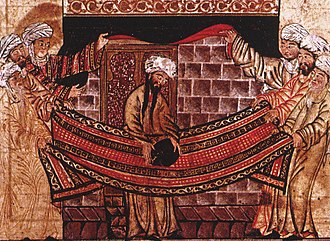
In Islamic belief, showing pictures of God or Mohammed is not allowed because it might lead to worshipping images. Instead, Muslims describe God using words from the Quran. This idea of not using images can also be found in some Jewish and Christian beliefs.
Arabesque
Islamic art often uses designs with flowers, leaves, or shapes that repeat in patterns called arabesque. These designs are not meant to show real things because Islam teaches against making pictures of living things that were used in older religions before Islam. Even so, some places like Persia and the Ottoman Empire did make paintings of people and animals, and stories from the Quran. Another reason Islamic art uses abstract designs is to show the endless and all-powerful nature of God. Islamic writing is also very common in art, with verses from the Quran written in special styles.
Islamic buildings often use repeating patterns, shapes that spread out, and rhythms. Designs can include columns, pillars, and arches mixed with small spaces and tiny columns. Domes are very important in Islamic buildings, used from very early times up until today.
Girih
Islamic calligraphy
Calendar
Two calendars are used in the Muslim world. One is a lunar calendar, which is the most common and is known in the West as the Islamic calendar. The other is a solar calendar used officially in Iran. Both calendars measure time starting from the Hijri era. The lunar calendar counts years based on the phases of the moon, while the solar calendar counts years based on the Earth's path around the sun.
Sciences |
Nasir al-Din al-Tusi's Astrolabe (13th century) One of Mansur ibn Ilyas (Ak Koyunlu era) colored illustrations of human anatomy |
A self-trimming lamp from Banū Mūsā's work On Mechanical Devices on Automation |
The Elephant Clock was one of the most famous inventions of Al-Jazari. |
"Cubic equations and intersections of conic sections", of Omar Khayyam Lagâri Hasan Çelebi's rocket flight depicted in a 17th-century engraving |
Building with islamic architecture |
Great Mosque of Kairouan, Kairouan, Tunisia Great Mosque of Samarra, Samarra, Iraq Prophet's Mosque, Medina, Saudi Arabia Umayyad Mosque, Damascus, Syria |
Hagia Sophia a journey from church to mosque, embodying centuries of history and faith in Istanbul, Turkey Sultan Salahuddin Abdul Aziz Mosque in Selangor, Malaysia Lagos Central Mosque in Lagos, Nigeria |
Women
See also: Women in Islam and Musawah
In many places where many people follow Islam, the experiences of women can vary a lot depending on where they live and their family backgrounds. Sometimes, leaders don’t clearly separate cultural traditions from the religion itself. Some traditional views in Islam suggest that men and women have different roles, which can lead to unequal treatment. However, there are movements working to support equality and respect for women within Islam, encouraging everyone to think more critically about these issues.
Images
Related articles




This article is a child-friendly adaptation of the Wikipedia article on Islamic world, available under CC BY-SA 4.0.
Images from Wikimedia Commons. Tap any image to view credits and license.