 Safekipedia
Judiciary
Adapted from Wikipedia · Discoverer experience
The judiciary is the system of courts that helps solve legal problems and explains what the law means. It is also called the judicial system, judicature, judicial branch, judicative branch, or court system. These courts make important decisions to help people understand and follow the rules that keep our communities safe and fair.
When people or groups have disagreements that cannot be solved easily, they can bring their problem to the judiciary. The courts then listen to both sides and decide what is right based on the law. This helps make sure everyone is treated fairly and that the rules are followed.
The judiciary is one of the main parts of a government that makes and enforces laws. It works together with other parts, like the group that makes the laws and the group that carries out the laws, to keep everything balanced and working well for everyone.
Meaning
The judiciary is the system of courts that helps decide disagreements and explains what the law means. It makes sure the law is used fairly in every case. Usually, the judiciary does not create new laws or enforce them; that is done by other parts of the government. But in some places, the judiciary can help make new rules based on past decisions.
In many places, courts have the power to check if laws are fair and match important rules, like the constitution or agreements between countries. They can decide if a law does not follow these important rules. The judiciary also helps solve problems between people or groups without using force.
History in Europe
See also: Legal history
This section gives an overview of how courts and legal systems developed throughout history.
Roman judiciary
See also: Roman law and Byzantine law
Archaic Roman Law (650–264 BC)
The most important part of early Roman law was called Ius Civile (Latin for "civil law"). This included Mos Maiorum (Latin for "way of the ancestors") and Leges (Latin for "laws"). Mos Maiorum were rules based on social customs passed down over time. In 451–449 BC, these rules were written down in the Twelve Tables.
Leges were rules set by leaders, first kings and later elected leaders. Legal cases had two parts. The first part, called In Iure, involved looking at the rules that applied to the case. The second part, called Apud Iudicem, had judges—regular Roman citizens—decide the case.
Pre-classical Roman Law (264–27 BC)
A big change happened when the head of the judicial system changed from priests to a praetor. The praetor would announce new laws or ideas each year in an edict, also called praetorian law.
Principate (27 BC – 284 AD)
The Principate began with the rule of Augustus. During this time, the praetor's yearly edict became a permanent set of rules called edictum perpetuum, collected by Hadrian. A new way of handling cases appeared called cognitio extraordinaria. In this process, one professional judge, representing the emperor, handled the case, and appeals were possible.
Legal experts began studying law and advising the emperor. They could also give legal advice in the emperor's name.
Dominate (284–565 AD)
This time is also called the "post-classical era of Roman law". The biggest legal event was the Codification by Justinianus: the Corpus Iuris Civilis. It included all Roman law in four parts:
- Institutiones: An introduction and summary of Roman law.
- Digesta/Pandectae: A collection of edicts.
- Codex: All the laws of the emperors.
- Novellae: New laws created later.
Middle Ages
See also: Canon law of the Catholic Church
During the late Middle Ages, education grew. It started in monasteries and expanded to cathedrals and city schools, eventually creating universities. Universities taught five subjects: arts, medicine, theology, canon law, and Ius Civile (civil law). Canon law was created by the Pope and dealt with church matters, while civil law handled everyday issues. Civil law was mostly based on the Corpus Iuris Civilis, which was rediscovered in 1070.
The period after 1070, called the Scholastics, saw renewed interest in old legal texts.
According to Kenneth Pennington, a legal history expert, medieval law came from many sources like consilia, decretals, church rules, and Spanish legal guides. He says it's hard to know what medieval judges really thought.
Ius Civile
Early scholastics (1070–1263)
The rediscovery of the Digesta from the Corpus Iuris Civilis led the University of Bologna to teach Roman law. Professors researched old laws and advised emperors and the Pope. They created materials to help understand these laws:
- Glossae: Translations of old Roman laws
- Summae: Summaries
- Brocardica: Easy-to-remember phrases
- Quaestio Disputata (sic et non): A way to explore arguments and counterarguments
Accursius wrote the Glossa Ordinaria in 1263, marking the end of the early scholastics.
Late scholastics (1263–1453)
The successors, called Post-Glossators or Commentators, studied laws logically. They wrote comments, treatises, and advice based on old Roman law.
Canon Law
Early Scholastics (1070–1234)
Canon law included rules made by church councils and decisions by Popes. A monk named Gratian organized church law into the Decretum Gratiani, or Decretum. This became part of the Corpus Juris Canonici, used by church lawyers until 1918.
Late Scholastics (1234–1453)
Decretalists, like the Post-Glossators for civil law, wrote treatises and advice based on church laws.
Ius Commune
By the 15th century, canon law and Roman law combined into Ius Commune. This created more legal books and a more organized legal process. Appeals were possible. Cases were partly investigated by the judge and partly argued by both sides.
After the French Revolution, only lawmakers could interpret laws, not judges. This changed with the Napoleonic Code.
Functions of the judiciary in different law systems
In places that follow common law, courts explain what the laws mean. These laws include big rules like constitutions, smaller rules made by governments, and other official guidelines. Courts can also help make new rules based on past decisions, especially when there aren't specific laws already written.
In the United States court system, the Supreme Court has the last say on what the main rules mean and whether state rules follow them. In France, two special courts decide what the laws mean: the Council of State for government-related cases and the Court of Cassation for everyday and serious cases. In the People's Republic of China, the National People's Congress decides what the laws mean. Other countries, like Argentina, have their own mix of courts, with a Supreme Court that always has the final decision.
Judicial systems by country
For judicial systems of individual countries other than Japan, Mexico, and the United States, and some U.S. states, see "Judiciary of...".
Japan
Main article: Judicial system of Japan
Japan has a careful process for choosing judges. Assistant judges are chosen after finishing training at the Legal Training and Research Institute in Wako. They must work for five years before they can serve alone. Judges need ten years of experience, either as a public prosecutor or a lawyer. Japan's judicial branch includes the Supreme Court, eight high courts, fifty district courts, fifty family courts, and 438 summary courts.
Mexico
Justices of the Mexican Supreme Court are chosen by the President of Mexico and approved by the Mexican Senate to serve for twelve years. Other justices are chosen by the Supreme Court for six-year terms. Federal courts include the Supreme Court's 9 ministers, 32 circuit tribunals, and 98 district courts, located in Mexico City. Judges must be between 35 and 65 years old and have a law degree.
United States
Main articles: Federal judiciary of the United States and List of courts of the United States
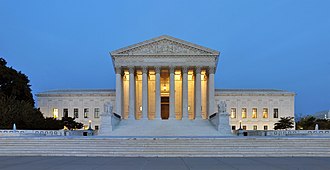
United States Supreme Court justices are chosen by the President of the United States and approved by the United States Senate. They serve for life or until they retire. The Supreme Court is in Washington, D.C.. The United States federal court system has 94 federal judicial districts, divided into twelve regional circuits. The United States has several types of courts under the Supreme Court: United States bankruptcy courts, United States Court of Appeals for the Federal Circuit, United States Court of International Trade, United States courts of appeals, and United States district courts.
Immigration courts are not part of the judicial branch; immigration judges work for the Executive Office for Immigration Review, which is part of the United States Department of Justice.
Each state, district, and inhabited territory has its own court system. These courts follow the laws of their area and have their own highest courts, called supreme courts.
Images
Related articles


This article is a child-friendly adaptation of the Wikipedia article on Judiciary, available under CC BY-SA 4.0.
Images from Wikimedia Commons. Tap any image to view credits and license.