 Safekipedia
Junípero Serra
Adapted from Wikipedia · Discoverer experience
Junípero Serra Ferrer, known simply as Junipero Serra, was a Spanish Catholic priest and missionary of the Franciscan Order. He was born on November 24, 1713, and passed away on August 28, 1784. Serra is best known for founding many missions along the coast of California, from San Diego to San Francisco.
He started by establishing the Franciscan Missions in the Sierra Gorda, which is now a UNESCO World Heritage Site. Later, he founded a mission in Baja California and went on to create eight of the 21 Spanish missions in California in what was then Spanish-occupied Alta California.
Serra's work made him famous, and he was called the "Apostle of California". In 1988, he was beatified by Pope John Paul II, and in 2015, Pope Francis officially recognized him as a saint during a visit to the United States. However, some Native American groups disagreed with this honor, feeling that his actions during the time of Spanish rule caused suffering.
Early life
Serra was born Miquel Josep Serra i Ferrer in the village of Petra on the island of Mallorca in the Balearic Islands near Spain. From a young age, he helped his family work in the fields and showed great interest in the local Franciscan church. He learned reading, writing, and other subjects at the church school.
At 16, Miquel began studying at a Franciscan school in Palma de Majorca. At 17, he joined the Franciscan Order, taking the name Junípero. He spent years studying and preparing to become a priest, learning many subjects like philosophy and theology. In 1737, Serra became a priest and later taught philosophy to other students, including future missionaries.
Ministry in the Americas
In 1749, Serra and a group of Franciscan missionaries arrived in Veracruz on the Gulf coast of New Spain, which is now Mexico. Instead of riding horses like his companions, Serra chose to walk the long and difficult path to Mexico City, following the rules of his religious order. Along the way, he faced many challenges, including a painful foot injury that troubled him for years.
Serra joined other Franciscan missionaries at the College of San Fernando de Mexico in Mexico City. He worked hard to help local communities, teaching them new skills and supporting their farming efforts. He also traveled to different areas, helping to guide and support people in their faith.
Serra showed great dedication in his work, often taking on difficult tasks himself. He helped build churches and worked closely with local people to create a sense of community and support. His efforts were important in spreading the missions and helping people live together in new ways.
President of missions of the Californias
When the Jesuits left Mexico, Franciscan missionaries stepped in. In July 1767, Junípero Serra was appointed president of the missions of Baja California, leading a group of 15 Franciscan friars. Jesuit priests had established 13 missions there, but two had died in an uprising by local people in 1734–36.
In March 1768, Serra and his team sailed from San Blas on Mexico’s Pacific coast. They landed at Loreto two weeks later, where Governor Gaspar de Portolá welcomed them. Though Serra was in charge of spiritual matters, the military managed daily operations of the missions.
By 1772, the local population had dwindled due to diseases like those introduced by Spanish troops. Serra and his team then moved north to establish missions in Alta California, aiming to bring the Catholic faith to the local people and support Spain’s interests in the region.
Serra faced health challenges but remained determined. He founded Mission Velicatá in 1769 and later arrived in San Diego, where he established Mission San Diego de Alcalá. Despite tensions with local groups, Serra continued to found missions up and down the coast, including Mission San Carlos Borromeo in Monterey. His efforts helped spread the Catholic faith and support Spanish control in the area.
Treatment of Native Californians
Further information: Spanish missions in California
Father Junípero Serra wanted to help the native people of California. He believed that teaching them about his faith was very important. He also tried to protect them from some unfair treatment by soldiers. However, some people today feel that his actions were not fair to the native cultures.
Some statues of Serra have been removed or damaged by people who disagree with how he treated native people. These actions happened during times of strong feelings about history and fairness.
Some native people still support Serra and believe he helped their communities in many ways. Others feel that his actions hurt their cultures and way of life. This difference in views continues to be discussed today.
Death
During the last three years of his life, Junípero Serra visited the missions from San Diego to San Francisco, traveling over 600 miles to meet with people who had joined the missions. Despite pain in his leg and chest, he continued his work without using any medicine. He met with over 5,300 people during these visits.
Junípero Serra passed away on August 28, 1784, at the age of 70, at Mission San Carlos Borromeo. He is buried there under the sanctuary. After his passing, another priest named Fermín Lasuén took over the missions in Alta California.
Veneration
In 1951, the process to honor Junípero Serra as a holy person began. He was recognized for his holy life by Pope John Paul II in 1988. Later, in 2015, Pope Francis officially named him a saint during a visit to the United States. Many people admire Junípero Serra for his work with the missions. His special day of celebration is held on July 1 in the United States and on August 28 everywhere. He is considered a special protector for California, Hispanic Americans, and those who want to serve others in faith.
The mission in Carmel, California, where Serra is buried, remains a place where people come to honor him. You can see parts of his old coffin and some of his personal items in the mission museums.
Legacy
Many of Junípero Serra's letters and documents still exist today. One important diary, called his "Diario", records his journey from Loreto to San Diego. It was published in a magazine called Out West between March and June 1902.
The Junípero Serra Collection, stored at the Santa Barbara Mission Archive-Library, contains early materials from the years 1713 to 1947. This library is part of the Mission Santa Barbara buildings but operates separately as an educational and research center. It remains connected to the Franciscan community and Serra's heritage.
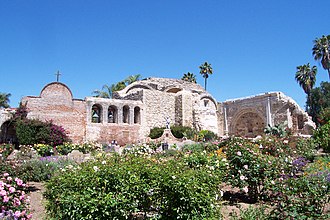
The chapel at Mission San Juan Capistrano, built in 1782, is considered one of the oldest surviving buildings in California. It is often called "Father Serra's Church" because it is the only church where Serra is known to have led Catholic services. He performed confirmations for 213 people there on October 12 and 13, 1783.
Many cities in California have streets, schools, and landmarks named after Serra. Examples include Junipero Serra Boulevard in San Francisco; Serramonte, a neighborhood in Daly City and Colma; Serra Springs in Los Angeles; Serra Mesa in San Diego; and Junipero Serra Peak, the highest mountain in the Santa Lucia Mountains. Schools named after him include Junípero Serra High School in San Diego (renamed Canyon Hills High School in 2021) and several other Catholic high schools in Gardena, San Mateo, San Juan Capistrano, and McKeesport, Pennsylvania. Public elementary schools in San Francisco and Ventura also carry his name, along with a K-8 Catholic school in Rancho Santa Margarita.
Both Spain and the United States have issued postage stamps honoring Serra.
In 1884, the California Legislature declared August 29 a legal holiday to mark the 100th anniversary of Serra's burial.
Serra International, a worldwide organization supporting religious vocations to the Catholic Church, was named after him. Founded in 1935, it has about 20,000 members across 44 countries and over 1,000 chapters.
Serra's impact on Native Americans has been widely discussed in recent years, especially in the Los Angeles area. In February 2015, the Mexica Movement, a group advocating for indigenous rights, protested Serra's recognition at the Los Angeles Cathedral. In 2018, a Spanish producer created an animated film called The call of Junipero about his life and work.
In 2019, Stanford University renamed two buildings previously named after Serra, citing the historical actions of the mission system toward Native Americans as a reason for the change.
Statuary and monuments
See also: List of monuments and memorials removed during the George Floyd protests § Junípero Serra
- A statue of Junípero Serra represents California in the National Statuary Hall Collection in the United States Capitol. There have been discussions about replacing it with a statue of astronaut Sally Ride.
- The statue of Serra in Ventura, California, which stood in front of Ventura City Hall from 1936 to 2020, was moved to storage after agreement by city, church, and tribal leaders.
- The Douglas Tilden statue of Serra in Golden Gate Park in San Francisco was torn down during a protest on June 19, 2020.
- A granite monument to Serra in Monterey, erected in 1891, had its figure damaged in 2015 but the missing piece was recovered in 2016.
- When Interstate 280 was built in the 1960s from Daly City to San Jose, it was named the Junipero Serra Freeway. A statue of Serra once stood on a hill along the freeway in Hillsborough, California.
- The statue of Serra at Mission Santa Barbara was damaged in 2017, as was the statue at Mission San Gabriel Arcángel.
- A bronze statue of Serra in the California State Capitol's Capitol Park was torn down by protestors on July 4, 2020.
- Statues or monuments to Serra can still be found at several mission churches, including Mission Dolores in San Francisco and Mission Santa Barbara. A statue near the San Fernando Mission in Los Angeles was vandalized in 2017.
In popular culture
Fiction
The famous writer Robert A. Heinlein included Serra in a story called Lost Legacy. This story was first published in November 1941 in a magazine called Super Science Stories, which was edited by Frederick Pohl. In the story, Serra finds a hidden collection of very old knowledge on Mt. Shasta. The story also includes Ambrose Bierce, a well-known writer who went missing and was later declared dead in 1913 at the age of 72.
Images
Related articles



This article is a child-friendly adaptation of the Wikipedia article on Junípero Serra, available under CC BY-SA 4.0.
Images from Wikimedia Commons. Tap any image to view credits and license.