 Safekipedia
Prophet's Mosque
Adapted from Wikipedia · Discoverer experience
The Prophet's Mosque (Arabic: ٱلْمَسْجِد ٱلنَّبَوِي, romanized: al-Masjid al-Nabawī, lit. 'Mosque of the Prophet') is the second mosque built by the Islamic prophet Muhammad in Medina, after the Quba Mosque. It is also the second largest mosque and holiest site in Islam, after the Masjid al-Haram in Mecca, in the Saudi region of the Hejaz. Located in the heart of Medina, it is a very important place for people to visit during their pilgrimage.
Muhammad helped build the mosque himself. At the time, the land belonged to two young orphans named Sahl and Suhayl. When they learned Muhammad wanted to build a mosque there, they offered their land as a gift. But Muhammad insisted on paying for it because they were orphaned children. The payment was made by Abu Ayyub al-Ansari, who became known as the donor of the mosque. al-Ansari also welcomed Muhammad when he arrived in Medina in 622.
Originally, the mosque was an open-air space. It served as a community center, a place for solving problems, and a school for teaching the Quran. It had a raised platform called a minbar where teachers shared the Quran and where Muhammad would speak to the people on Fridays. Over time, leaders expanded and decorated the mosque. After an expansion under the Umayyad caliph al-Walid I, the mosque became the resting place of Muhammad and the first two Rashidun caliphs Abu Bakr and Umar. One famous part of the mosque is the Green Dome, where Muhammad is buried.
In 1909, during the time of Ottoman Sultan Abdul Hamid II, the Prophet's Mosque became the first place in the Arabian Peninsula to have electric lights. Today, the mosque is open to visitors almost all the time. It was only closed once in modern times, during the COVID-19 pandemic in 2020, as the holy month of Ramadan was beginning.
History
Main article: Muhammad in Medina
See also: History of Islam
Under Muhammad and the Rashidun (622–660)
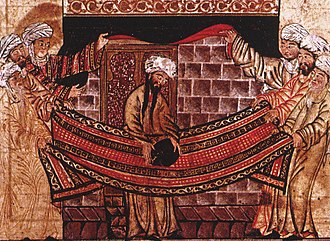
The mosque was built by Muhammad in 622 after he arrived in Medina. He rode a camel named Qaswa to the place where the mosque was built, which was used as a burial ground. Muhammad wanted to buy the land from two young orphans, Sahl and Suhayl, who offered it to him as a gift. However, Muhammad insisted on paying for the land because they were children. It took seven months to finish building the mosque. It was 30.5 meters by 35.62 meters. The roof, supported by palm trunks, was made of clay and palm leaves and stood 3.60 meters high. The mosque had three doors: the Gate of Mercy to the south, the Gate of Gabriel to the west, and the Gate of the Women to the east. At first, the wall showing the direction of prayer faced north toward Jerusalem.
Umayyad era
In 706 or 707, the leader al-Walid I decided to greatly expand the mosque. It took three years to complete. Materials were brought from the Byzantine Empire. The area of the mosque grew from about 5,094 square meters to 8,672 square meters. For the first time, walkways were built connecting different parts of the mosque. The mosque was decorated with beautiful marble and mosaics. Later visitors described the mosaics as showing landscapes with trees, similar to other famous Umayyad buildings.
Abbasid era
The leader al-Mahdi expanded the mosque northward by 50 meters. He also planned to change the steps to the raised platform used for speeches but decided against it to protect the wooden parts. Later leaders made smaller changes and added decorations around the tomb of Muhammad.
Mamluk era
In 1269, leaders sent artisans to rebuild parts of the mosque, including areas around important tombs. In 1279, a wooden dome was added over the tomb of the prophet. More changes were made in the late 1400s, including rebuilding roofs, walls, and minarets (tall towers for calling people to prayer).
Ottoman era
Sultan Suleiman the Magnificent rebuilt parts of the mosque’s walls and added a new minaret. He also placed a new dome over the tomb of Muhammad and added the names of past Ottoman leaders. Later leaders continued to make changes, adding new decorations, prayer spaces, and a place for washing before prayers.
Saudi rule and modern history (1925–present)
When Saudi leaders took control in 1925, they made many changes to the mosque. In the following years, they expanded the mosque several times. New wings were added, old columns were strengthened, and new minarets were built. In the 1970s and 1980s, the mosque grew much larger, and in recent years, plans were made to expand it even more to welcome millions of visitors.
Architecture
The Prophet's Mosque is built on a rectangular shape and has two floors. The oldest part, called the Ottoman prayer hall, is on the south side. It has a flat roof with 27 sliding domes on square bases. When the domes close, they let light into the building through holes in their bases. During afternoon prayers, the roof closes to keep visitors cool. When the domes open, they shade parts of the roof and create light wells inside. Umbrellas on columns also provide shade for the courtyard. You can reach the roof using stairs and escalators. The area around the mosque also has umbrella tents for prayer.
Main article: Green Dome
The room next to the Rawdah holds the tombs of Muhammad and two of his close friends, Abu Bakr and Umar. There is also a grave prepared for Jesus, who Muslims believe will return one day and be buried there. This area is covered by the Green Dome, which was first built in 1279 and has been rebuilt several times. The current dome was made in 1817 and painted green in 1837.
The Rawdah is a special area between the pulpit and Muhammad's tomb. It is considered very holy, like a garden of paradise. It used to have a green carpet to make it stand out from the rest of the mosque, which had red carpeting.
In the early days of the mosque, there were two markers called mihrabs that showed the direction Muslims should face during prayer. One was placed by Muhammad himself, and another was added later. The later one was bigger and used for prayers, while Muhammad's became a memorial. Today, the mosque still has a mihrab from ancient times and another one marking where Muhammad used to lead prayers.
The original pulpit used by Muhammad was made from date palm wood. It was later replaced with one made from tamarisk wood. Over time, many leaders replaced the pulpit, including Baybars I, Shaykh al-Mahmudi, Qaitbay, and Murad III. The current pulpit dates back to Ottoman times and is still used today.
The first minarets were built between 707 and 709. There were four of them, and they were about 26 feet tall. More minarets were added over the centuries. After a big renovation in 1994, the mosque had ten minarets that were 104 metres tall. The minarets change shape from cylindrical at the top to octagonal in the middle and square at the bottom.
List of Imams
Main article: List of Imams of the Two Holy Mosques
Here are some of the important leaders who help guide prayers at the Prophet's Mosque:
- Ali ibn Abdur-Rahman al Hudhaify – main leader of prayers
- Salah Al Budair – helper to the main leader
- Abdulbari ath-Thubaity
- Saleh Al-Maghamsi
- Abdulmohsen Al-Qasim
- Abdullah bin Abdurahman al-Baijan
- Ahmad bin Ali al-Hudhaify, son of Ali ibn Abdur-Rahman al Hudhaify
- Muhammad Barhaji, guest leader during Ramadan in 2024, became a permanent leader in October 2024
- Abdullah Qarafi, became a leader in October 2024
Images
Related articles




This article is a child-friendly adaptation of the Wikipedia article on Prophet's Mosque, available under CC BY-SA 4.0.
Images from Wikimedia Commons. Tap any image to view credits and license.