 Safekipedia
Reich
Adapted from Wikipedia · Discoverer experience
The word "Reich" is a German term that means something like "realm" in English. It is often used to talk about important states and empires throughout history. In English, people sometimes use "the Reich" to mean Nazi Germany, which was called the "Third Reich."
In German history, the word "Reich" has been used for several important states. It was used for the early Frankish and Carolingian Empires, the Holy Roman Empire, the German Empire, and later for the Weimar Republic and Nazi Germany. Even after Germany no longer had an emperor, many Germans still used the term "German Empire" or "Deutsches Reich."
The Nazis used the idea of the "Third Reich" to make their government seem like the rightful successor to earlier great states. They thought of themselves as following the "First Reich" (the Holy Roman Empire) and the "Second Reich" (the German Empire). Historians usually do not use the terms "First Reich" or "Second Reich," and the idea of a "Fourth Reich" is mostly found in stories or used by groups that support old Nazi ideas.
Etymology
The word "Reich" comes from an old Germanic word that means "realm," similar to a kingdom or empire. In German, it is often used to talk about big lands ruled by a leader, like the Roman Empire. Words like Kaiserreich are used in German to describe empires led by an emperor.
The German word Reich shares its roots with the English word "realm." Both come from ancient languages and mean something like a kingdom or a place ruled by a king. This idea of ruling and leadership can be found in many languages, including Latin and Sanskrit.
Usage throughout German history
Frankish Empire
Frankenreich or Fränkisches Reich is the German name for the Frankish Kingdom of Charlemagne. This name was later used for Western Francia and medieval France after Eastern Francia became the Holy Roman Empire. The German word for France, Frankreich, comes from Frankenreich and has been used since the late medieval times.
Holy Roman Empire
See also: Holy Roman Empire
The word Reich was often used in German names for Germany throughout history. In the common German name for the Holy Roman Empire, (Heiliges Römisches Reich (HRR)), Reich meant the land or country ruled by an emperor. However, Latin was the official language of the medieval Empire, so historians often use the Latin word imperium instead of the German Reich.
Modern age
As Europe moved into newer times, some people began calling the Holy Roman Empire the "Holy Roman Empire of the German Nation." This showed a growing sense of German identity. Later, after big wars and changes, people felt strongly about creating a united German country. This feeling led to strong ideas about nation and country in 1871. As different groups of people lived together, some groups like the Polabs, Sorbs, and Low Germans had to change to fit in better. This time also brought strong feelings about who should be considered German, which caused problems for some groups like Jewish people.
German Reich
See also: German Reich
From 1871 to 1918, Germany was officially called Deutsches Reich, meaning "German Realm." This was because, under the Constitution of the German Empire, Germany was a group of states led by the King of Prussia. The King of Prussia was called the "German Emperor," but this title was for the German nation, not just the country of Germany.
The name "German Empire" is sometimes used for Germany from 1871 to 1918, but the first German Emperor, Wilhelm I, did not like this name and it was never made official.
The country that became unified Germany in 1871 under Otto von Bismarck was the first to be officially called Deutsches Reich. This name stayed until 1945, even though the government changed three times: the "German Empire" (1871–1918), the Weimar Republic (1919–1933), and Nazi Germany (1933–1945).
During the Weimar Republic
After 1918, the word "Reich" was not usually translated as "Empire" in English. Instead, it was used to mean the whole country's organizations and leaders, not just one part of Germany. This is similar to how we might talk about "The Crown" in some countries today.
During the Nazi period
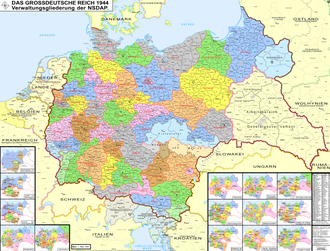
The Nazis wanted to make their rule seem like a continuation of old German history. They used the term Drittes Reich ("Third Empire" – often called "the Third Reich" in English), first used in a 1923 book. They thought of the medieval Holy Roman Empire as the first and the 1871–1918 monarchy as the second, and their rule as the third. The Nazis did not consider the 1918–1933 Weimar period important and called it "the System".
In 1939, the Nazis stopped using the term "Third Reich" and told people to use other names like "Nationalsozialistisches Deutschland" ("National Socialist Germany") or "Deutsches Reich" (German Reich) instead.
Even though "Third Reich" is still used to talk about Nazi rule, historians do not usually use "First Reich" or "Second Reich," as these were mostly used by the Nazis.
Possible negative connotations in modern usage
Some words that the Nazis used later became negative in German, though Reich is not usually one of them. However, using Reich to talk about a government can sometimes suggest strong national pride or wanting to control other countries. Because of this, Reich has not been used in official names since 1945, except for the Reichstag building, which still houses the German parliament, the Bundestag. The word "Bund" (federation) is now used instead of "Reich" in many official names.
Limited usage in the railway system of the German Democratic Republic
During the Cold War, the East German railway kept using the name Deutsche Reichsbahn (German Reich Railways), which had been used before. Even after German reunification in 1990, the Reichsbahn kept operating the railways in eastern Germany until January 1, 1994, when it merged with the western Deutsche Bundesbahn to form Deutsche Bahn AG.
Usage in related languages
In Scandinavian languages
The word similar to "Reich" is used in all Scandinavian languages and means "realm". In Danish and older Norwegian, it is spelled rige, and in Swedish and modern Norwegian, it is rike. This word usually means "country" or "nation" and talks about sovereign states. It does not suggest a special type of government but implies the country is of a certain size and importance. The word is often used for the Scandinavian countries themselves and for some historical empires, like the Roman Empire. The usual word for "country" is land, and there are many other words to refer to countries.
The word is part of the official names of Denmark, Norway, and Sweden, such as kongerige (Danish), kongerike (Norwegian), and konungarike (Swedish), all meaning "kingdom". Two areas in Norway that were small kingdoms before Norway was united around 900 AD still use this word in their names, like Ringerike and Romerike. The word also appears in the name of Sweden in Swedish, Sverige, and in the official name of Sweden, Konungariket Sverige.
The prefix rigs- (in Danish and older Norwegian) and riks- (in Swedish and Norwegian) means something nationwide or under central control. Examples include riksväg and riksvei, words for a national road in Swedish and Norwegian. It is also used in the names of many institutions in Scandinavian countries, such as Rigsrevisionen in Denmark and Sveriges Riksbank in Sweden, the central bank of Sweden. Words like udenrigs (Danish), utrikes (Swedish), and utenriks (Norwegian) relate to foreign countries.
Rijk/ryk
Rijk is the Dutch and ryk the Afrikaans and Frisian equivalent of the German word Reich.
In political terms in the Netherlands and Belgium, rijk often links to the Kingdom of the Netherlands and the Kingdom of Belgium, rather than just the European part of the Netherlands or local governments. Words like rijkswetten (kingdom laws) and institutions such as the Rijkswaterstaat follow this use.
In everyday speech, rijk can mean working for the central government. In Afrikaans, ryk refers to areas of control, used in phrases like die drie ryke van die natuur (the three kingdoms of nature). Like in German, rijk/ryk also means "rich".
Related articles


This article is a child-friendly adaptation of the Wikipedia article on Reich, available under CC BY-SA 4.0.