 Safekipedia
St. Peter's Basilica
Adapted from Wikipedia · Discoverer experience
The Papal Basilica of Saint Peter in the Vatican, often called St. Peter's Basilica, is a grand church located in Vatican City, a tiny country inside the city of Rome, Italy. It was built during a time called the High Renaissance and is one of the most famous churches in the world. Work on the current building began in 1506 and finished in 1626, replacing an older church that had been there for many centuries.
This amazing church was designed by famous artists such as Donato Bramante, Michelangelo, and Carlo Maderno. With its huge size and beautiful design, St. Peter's is the largest church inside, and it holds a very special place in the Catholic Church. Many important leaders of the church, called popes, are buried here because it is believed to be where Saint Peter, one of Jesus’s closest followers, is buried.
People from all over the world visit St. Peter's Basilica for important religious events and to see its wonderful art and architecture. The pope, the leader of the Catholic Church, holds special services here, and thousands of people come to listen and pray together. St. Peter's has played a key role in many important moments in Christian history.
Overview
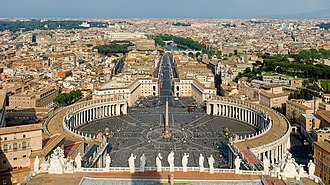
St. Peter's is a beautiful church built in the Renaissance style and located in Vatican City, just west of the River Tiber. Its huge dome can be seen from far away, making it a famous part of Rome's skyline. You reach the basilica through St. Peter's Square, a large open space with tall rows of columns called colonnades. The square has two parts: one oval and one shaped like a trapezoid.
The church's shape is like a cross, and it has a very large dome, one of the biggest in the world. Inside, there are huge statues and important holy items, such as St. Longinus with his spear and St. Helena with the True Cross. The main entrance has special bronze doors, including the Holy Door, which is only opened during special church events called jubilees. The inside of the church is very grand, with tall ceilings, wide aisles, and many chapels and statues, including Michelangelo's famous sculpture, the Pietà.
Status
St. Peter's Basilica is one of the most important churches in the world. It is one of the four Major Basilicas of Rome, along with the Basilicas of St. John Lateran, St. Mary Major, and St. Paul outside the Walls. Unlike the others, it is located entirely within Vatican City State, making it very special.
It is a very important place in Christianity because many believe it is where St. Peter, one of Jesus' important followers, is buried. Many popes are also buried there. The current building started in 1506 and was finished in 1615. It is the largest Christian church building in the world and has a very tall dome. In 1984, it became a UNESCO World Heritage Site.
History
Saint Peter's burial site
Main article: Saint Peter's tomb
After Jesus was crucified, one of his important followers, Simon Peter (also called Saint Peter), became a leader for Jesus' followers. Peter was a fisherman from Galilee. According to tradition, Peter traveled to Rome and was crucified there in 64 AD during the time of the Roman Emperor Nero. His tomb is believed to be near an old Egyptian obelisk, which now stands in St. Peter's Square.
In 1939, archaeologists began digging under the basilica and found bones that might have belonged to Peter. In 1950, Pope Pius XII announced the discovery of what they believed to be Saint Peter's tomb.
Old St. Peter's Basilica
Main article: Old St. Peter's Basilica
The original St. Peter's Basilica was built starting in 319 AD by Emperor Constantine the Great. It was built over a shrine thought to mark Peter's burial place. This old church had many burials and memorials, including those of popes from St. Peter to the 15th century.
Plan to rebuild
By the late 1400s, the old basilica was falling apart. Pope Nicholas V wanted to rebuild it and started some work, but died before much was done. Pope Julius II decided to completely replace the old basilica with a grand new one. Over the next 120 years, many popes and architects worked together to build the current St. Peter's Basilica.
Digital copies
In recent years, the Vatican has used digital technology to create models of the Basilica. In 2024, they worked with Microsoft to make a 3D model using artificial intelligence and many photographs. In 2025, they also made a version of the Basilica in the game Minecraft to engage younger people.
Architecture
Successive plans
Pope Julius II wanted to build the most important church in Christendom. A competition was held, and Donato Bramante won with a design shaped like a large Greek cross. His plan included a big dome inspired by an ancient Roman temple called the Pantheon. Later architects like Raphael and Michelangelo changed parts of the design. Eventually, Michelangelo became the main architect and shaped much of the church as we see it today.
Michelangelo's contribution
Michelangelo took over when the building was already underway. He used ideas from earlier architects but focused on Bramante’s Greek cross design. He made the building stronger and more unified. Today, the part with the big dome at the far end of the church is mostly Michelangelo’s work.
Dome: successive and final designs
The dome of St. Peter’s is the tallest in the world. It was designed by several architects, starting with Bramante and Sangallo, and finally completed by Michelangelo and Giacomo della Porta. The dome’s shape changed over time but ended up being tall and elegant.
Addition of nave and facade
Later, Carlo Maderno added a long section called the nave to the front of Michelangelo’s design. He also built a grand facade with tall columns and statues. This part sometimes gets criticism for not matching the rest of the building perfectly.
Influence on church architecture
St. Peter’s Basilica has inspired many other churches around the world. Its design, especially the dome, has been copied in buildings from Rome to Paris, and even in modern times. Churches in cities like London, Vienna, and Chicago show influences from St. Peter’s.
Bernini's furnishings
Pope Urban VIII and Bernini
Gian Lorenzo Bernini (1598–1680) was a young boy who visited St. Peter's Basilica and dreamed of creating something special for it. As a young adult, he began working on the beautiful decorations of the Basilica in 1626 under the support of Pope Urban VIII. Over 50 years, Bernini became known as one of the greatest artists of the Baroque period. His work at St. Peter's includes important designs like the baldachin, the Chapel of the Sacrament, and plans for special spaces in the church.
Baldacchino and niches
Main article: St. Peter's Baldachin
Bernini's first big project was the baldacchino, a tall bronze structure standing under the dome above the altar. It is very large, about 28.74 metres (94.3 ft) tall, and is said to be the biggest bronze piece in the world. The design was inspired by old columns and the special canopy used above the pope during ceremonies. The baldacchino has bronze columns with laurel leaves and bees, which were symbols of Pope Urban. It also includes detailed gold work, such as pictures of people and special symbols.
Bernini also created special spaces called niches in the church's huge pillars. Inside these niches, he placed glass cases with important holy items, like a spear said to have touched Jesus and a piece of the True Cross. Large statues were placed around these niches to match the holy items.
Cathedra Petri and Chapel of the Blessed Sacrament
Main article: Chair of Saint Peter
Next, Bernini worked on a very old chair thought to be connected to Saint Peter. Since the chair was old and fragile, Pope Alexander VII wanted it displayed beautifully. Bernini made a large bronze throne to hold the chair, with four strong bronze figures supporting it. These figures represent important teachers of the Church. Behind the throne, bright light shines through a special window, creating a glowing effect.
Finally, Bernini decorated the Chapel of the Sacrament in 1676. He made a small golden structure to hold special holy items, inspired by an old chapel built by Bramante. Two small angel figures are placed beside it, one looking up in wonder and the other welcoming viewers. Bernini passed away in 1680 at the age of 82.
St. Peter's Piazza
Main article: St. Peter's Square
To the east of the basilica is St. Peter's Square. The square we see today was built between 1656 and 1667 by the artist Bernini. Before Bernini’s design, the square already had an ancient Egyptian obelisk. This tall stone tower, called “The Witness,” is one of the largest still standing today. It was moved to this spot in 1586 by order of Pope Sixtus V.
Bernini had to work around this obelisk and a large fountain that was already there. He created a square in two parts. The part closest to the church is shaped like a triangle, and the far part is a large oval. Around the oval, Bernini placed columns that reach out like arms, symbolizing a welcoming space. He also added another fountain to balance the design. Today, a wide street called the Via della Conciliazione leads visitors to the square, offering a grand view of the basilica as they approach.
Clocks
The top of St. Peter's Basilica has two clocks and many sculptures. The clocks replaced old bell towers that were taken down because they were not strong enough. The clock on the left shows the time in Rome, while the clock on the right shows the time used in much of Europe. There are also statues of important religious figures, including Christ the Redeemer, St. John the Baptist, and 11 Apostles. Above the Rome time clock is the coat of arms for the city-state of Vatican City, held by two angels.
Bells
St. Peter's Basilica has six bells located under the Roman clock. Three of these bells can be seen from the ground, while the others are hidden behind a special bell called the bourdon. These bells vary in size, from a small one weighing 235 kg to a very large bourdon that weighs about 9 tonnes. Since 1931, the bells have been operated using electricity, allowing even the largest bell to be rung from far away.
The oldest bell, named Rota, dates back to 1353. The largest bell, called Campanone, is rung on special occasions such as Christmas, Easter, and important church celebrations. It is also used when the Pope gives a special blessing called "Urbi et Orbi" to the city and the world.
| Bell# | Name | Mass | Date cast |
|---|---|---|---|
| 1 | Campanella | 235 kg | 1825 |
| 2 | Ave Maria | 250 kg | 1932 |
| 3 | Predica | 830 kg | 1909 |
| 4 | Rota | 1815 kg | 1353 |
| 5 | Campanoncino (Mezzana, Benedittina) | 3640 kg | 1725 |
| 6 | Campanone | 8950 kg | 1785 |
Treasures
Tombs and relics
St. Peter's Basilica holds over 100 tombs, many located beneath the church. These include important figures such as popes, saints, emperors, and royalty. Notable people buried here include 91 popes, Saint Ignatius of Antioch, Holy Roman Emperor Otto II, and the composer Giovanni Pierluigi da Palestrina. The most recent person buried here was Pope Benedict XVI in January 2023. Near the crypt, a fourth-century tomb called the "Tomb of the Julii" was recently discovered.
Artworks
Towers and narthex
The towers on either side of the church's front have two clocks. One clock has been electric since 1931, and its oldest bell dates back to 1288. A famous mosaic above the main door, called the "Navicella," was designed by Giotto. It shows a ship representing the Christian Church. Statues of important leaders like Constantine the Great and Charlemagne stand at the ends of the narthex.
The church has special bronze doors. The central door is a Renaissance design from 1455. The southern door, called the "Door of the Dead," features a portrait of Pope John XXIII. The northernmost door is the "Holy Door," which is normally sealed but opened for special holy years. Plaques above the Holy Door remember popes who opened it in past years.
Nave
The nave, or main area, has beautiful decorations. There are special water basins held by angel figures. Markers on the floor show how long other famous churches are. Statues and medallions along the walls show early popes and founders of religious orders. A famous statue of Saint Peter has one foot worn away from centuries of visitors touching it.
Important statues around the dome include Saint Helena with the True Cross, Saint Longinus with the spear that pierced Jesus, Saint Andrew with his cross, and Saint Veronica with a cloth showing Jesus' face.
North aisle
In the first chapel of the north aisle is Michelangelo's famous Pietà statue. There are also monuments to Queen Christina of Sweden, who gave up her throne to become Catholic. The second chapel holds statues of popes Pius XI and Pius XII. Nearby is the Chapel of the Blessed Sacrament, with a beautiful tabernacle designed by Bernini.
South aisle
The first chapel in the south aisle is a baptistry. Against one wall is a tomb for members of the Stuart royal family who were granted shelter by the Pope. Other chapels hold memories of popes and saints, including a tomb for Pope Alexander VII by Bernini.
The south aisle also has altars dedicated to saints like Thomas and Joseph, and a tomb for Pope Pius VIII near the entrance to the Sacristy.
Archpriests since 1053
The Vatican Basilica has had many important leaders called archpriests since the year 1053.
These leaders have served over many years, guiding the basilica through history. Some of the well-known names include Deusdedit, Stefano Conti, Giovanni Gaetano Orsini, and Eugenio Pacelli, among many others. The list shows the long tradition of leadership at this important church.
Specifications
The St. Peter's Basilica is a very large and impressive church. It is 730 feet long and 500 feet wide. Inside, the space is huge, covering over 227,000 square feet. The dome is particularly grand, with an outer diameter of about 138 feet. The square in front of the basilica stretches 1,115 feet long and 787 feet wide, with tall columns and statues lining its edges. An ancient obelisk stands nearby, reaching a total height of 132 feet including its base and cross.
Images
Related articles




This article is a child-friendly adaptation of the Wikipedia article on St. Peter's Basilica, available under CC BY-SA 4.0.
Images from Wikimedia Commons. Tap any image to view credits and license.