 Safekipedia
Province
Adapted from Wikipedia · Adventurer experience
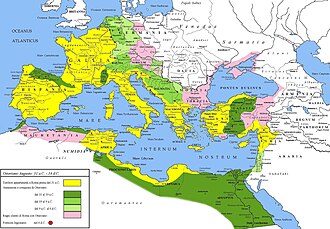
A province is a special part of a larger country or state. It helps organize and manage areas. The word comes from ancient times, from the ancient Roman provincia, which was a big region ruled by Rome outside of Italy.
Many countries today use the term "province" to describe these important sections.
In some places, provinces were created by rulers far away. In others, they grew from local groups with their own traditions and cultures. Some provinces, like those in Canada, have their own powers and make their own decisions. In places such as China or France, provinces are set up by the main government and don’t have as much freedom.
Sometimes, when people talk about “the provinces,” they mean areas away from the big capital city. This shows how provinces can be real places and ways to describe parts of a country that are not the main center.
Etymology
The word province comes from old languages. It entered English around 1330 from the Old French word province. This word came from the Latin word provincia. In ancient times, provincia meant a place or job that a Roman leader managed for the government.
Some people think the word comes from Latin words meaning "on behalf of" and "to take control of." This would mean a province was a place a Roman leader controlled. The word province really means a job or area a Roman leader was responsible for.
History and culture
In France, the phrase en province means "outside the Paris area". Similar expressions are used in Peru (en provincias, "outside the city of Lima"), Mexico (la provincia, "lands outside Mexico City"), Romania (în provincie, "outside the Bucharest area"), Poland (prowincjonalny, "provincial"), Bulgaria, the Netherlands (uit de provincie, "from outside Amsterdam"), and the Philippines (tagá-probinsiya, "from outside Metro Manila").
Before the French Revolution, France had many different regions, some called "provinces". Today, people often use the word région instead.
In Italy, in provincia usually means "outside the biggest cities" like Rome, Milan, and Naples.
The British colonies in North America were often called provinces. Most of the Thirteen Colonies that became the United States changed their names to "states" after independence. The colonies that stayed with Britain, now Canada, kept the name "province".
Legal aspects
In many countries, power is shared between a central government and smaller parts called provinces or states. These smaller parts often have their own powers. These powers are decided in a document called a constitution.
For example, in Canada, provinces control things like property, civil rights, education, social welfare, and medical services. Because these areas are important, provincial governments in Canada have gained more influence over time.
In Canada, provinces can make their own laws and collect certain taxes. The national government can also collect taxes for both levels, and provinces can ask for extra money from these taxes. Sometimes, there are disagreements between the national government and provinces about who controls certain issues. This can lead to changes in laws to balance these powers.
Current provinces
See also: Administrative divisions
Not all areas with a special government are called "provinces." In Arab countries, areas are called a muhafazah and are often called a "governorate." In Poland, they are called "województwo," or "voivodeship."
Historically, New Zealand had areas called provinces. These were changed in 1876. The old lines are sometimes used today. New Zealand now has 16 Regions and 21 District Health Boards. The word the provinces can mean the countryside away from big cities like Auckland and Wellington.
In many places, a province is a smaller part of a country, like a county in the United Kingdom. In China, a province is part of the country and can be changed by the government.
In some countries, a province is a big important part of the country. Examples include Argentina, Canada, South Africa, and the Democratic Republic of the Congo. In the United States, a state cannot leave the country without permission.
In other countries like Belgium, Chile, Italy, Peru, the Philippines, and Spain, a province is a smaller part of a bigger area called a region. In Italy, provinces are named after their main town and have smaller parts called comuni (communes). Chile has 15 regions, divided into 53 provinces. Italy has 20 regions, divided into 14 metropolitan cities and 96 provinces. Peru has 25 regions, divided into 194 provinces. Spain has 17 autonomous communities and 2 autonomous cities, divided into 50 provinces.
The island of Ireland has four historic provinces: Connacht, Leinster, Munster and, Ulster. These do not have much government role today but are important for sports. Northern Ireland is sometimes called "the Province."
From the 1800s, Portuguese colonies were called overseas provinces of Portugal.
Some faraway parts of the British Empire were called "provinces," like the Province of Canada and the Province of South Australia. Before the American Revolution, many areas that became the Thirteen Colonies in British America were also called provinces.
Canada
The parts of Canada are called provinces. Before Canada was a country, areas were called provinces too. In 1867, Canada was made, and the word provinces was used for its parts.
Canada is very big but has only 10 provinces. Many are larger than any country in Europe except Russia. Quebec is the largest province. Some provinces have areas called "counties." How these work can be different.
The Western provinces have different kinds of areas than the Eastern provinces. British Columbia has "regional districts." Manitoba and Saskatchewan have rural municipalities.
Alberta has areas called "counties" but they are called "municipal districts." Some places in Alberta have special rules.
Pakistan
Pakistan has four provinces:
It also has two special areas:
Russia
The word "province" is sometimes used for old areas of Russia. It can also mean areas called provinces from old times. Today, people use the word for oblasts and krais of Russia.
Polities translated
Historic provinces
The idea of a province started in ancient Rome. Big parts of the Roman Empire were called provinces. Many other countries later used this idea to organize their lands.
Over time, many places like empires and kingdoms had their own ways of setting up provinces. For example, the Roman Empire, the Caliphate, and Pharaonic Egypt all had special names for their areas. Later, countries such as Spain, Britain, and France also set up provinces in their colonies and lands around the world.
Related articles



This article is a child-friendly adaptation of the Wikipedia article on Province, available under CC BY-SA 4.0.
Images from Wikimedia Commons. Tap any image to view credits and license.